




Abstract
Rumour has it that influential people in Bulgaria are being paid by the Kremlin to spread its lies.
“FUCK PUTIN!” SHOUTS the message scrawled in red on litter bins near the monument to the Soviet army in the heart of the Bulgarian capital.
Millions of people nationwide agree with that response to the invasion of Ukraine – a neighbour across the Black Sea – although they might not necessarily put it so crudely.
This story is complicated because millions of others disagree after being inveigled into believing Russian President Vladimir Putin’s big lies that his country is defending itself against Nato aggression and fighting to rid Ukraine of neo-Nazis and fascists.
While the shells mercilessly pound the Donbas region of eastern Ukraine, the Kremlin is bombarding Bulgaria with propaganda about what it calls its “special military operation” and others see as an unjustified war. And Russia’s assault on a traditional Slavic ally, hitherto its closest friend in the European Union, is working. About a quarter of the population of nearly seven million still support Putin, according to polls – although that is down from about a third before the killing began.
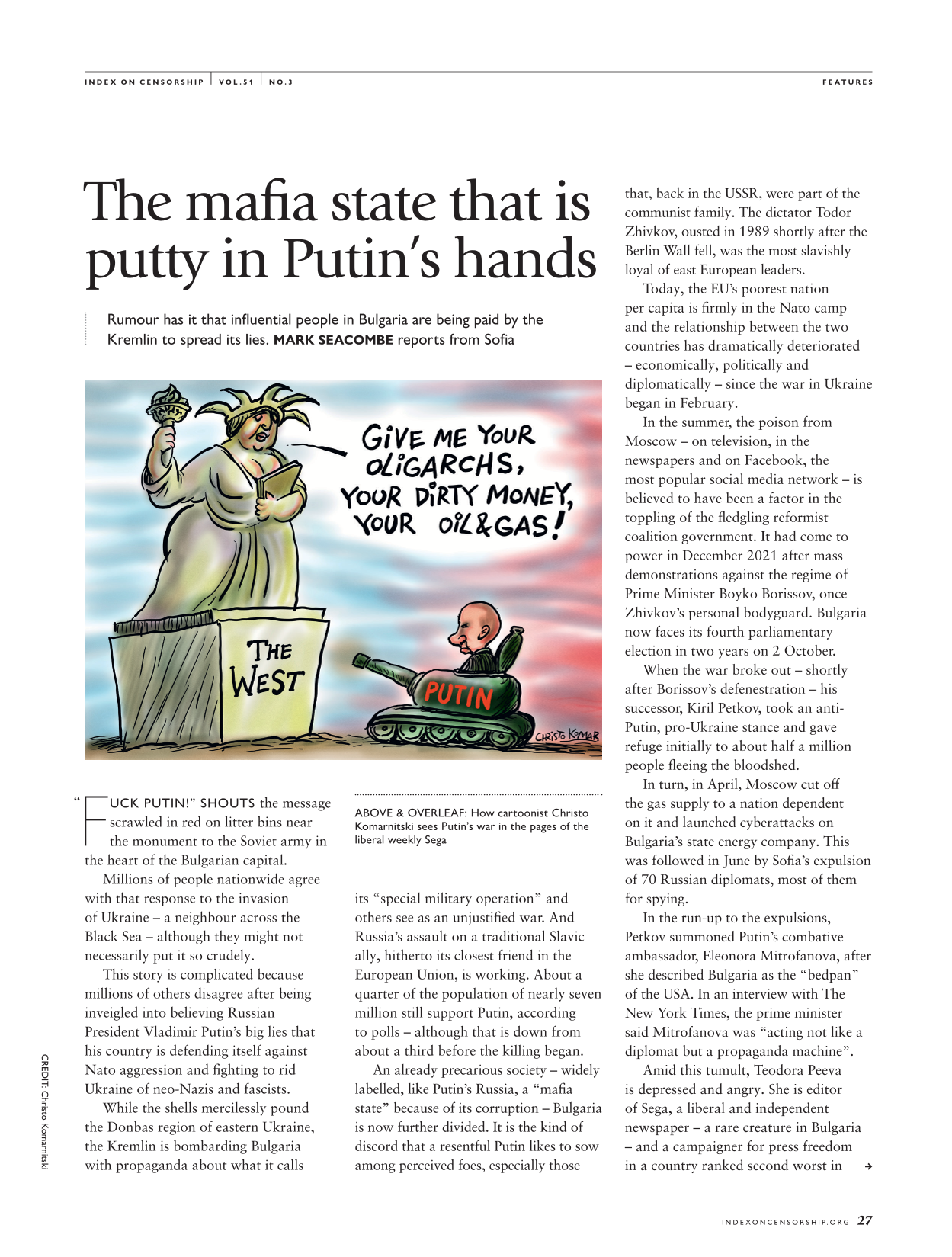
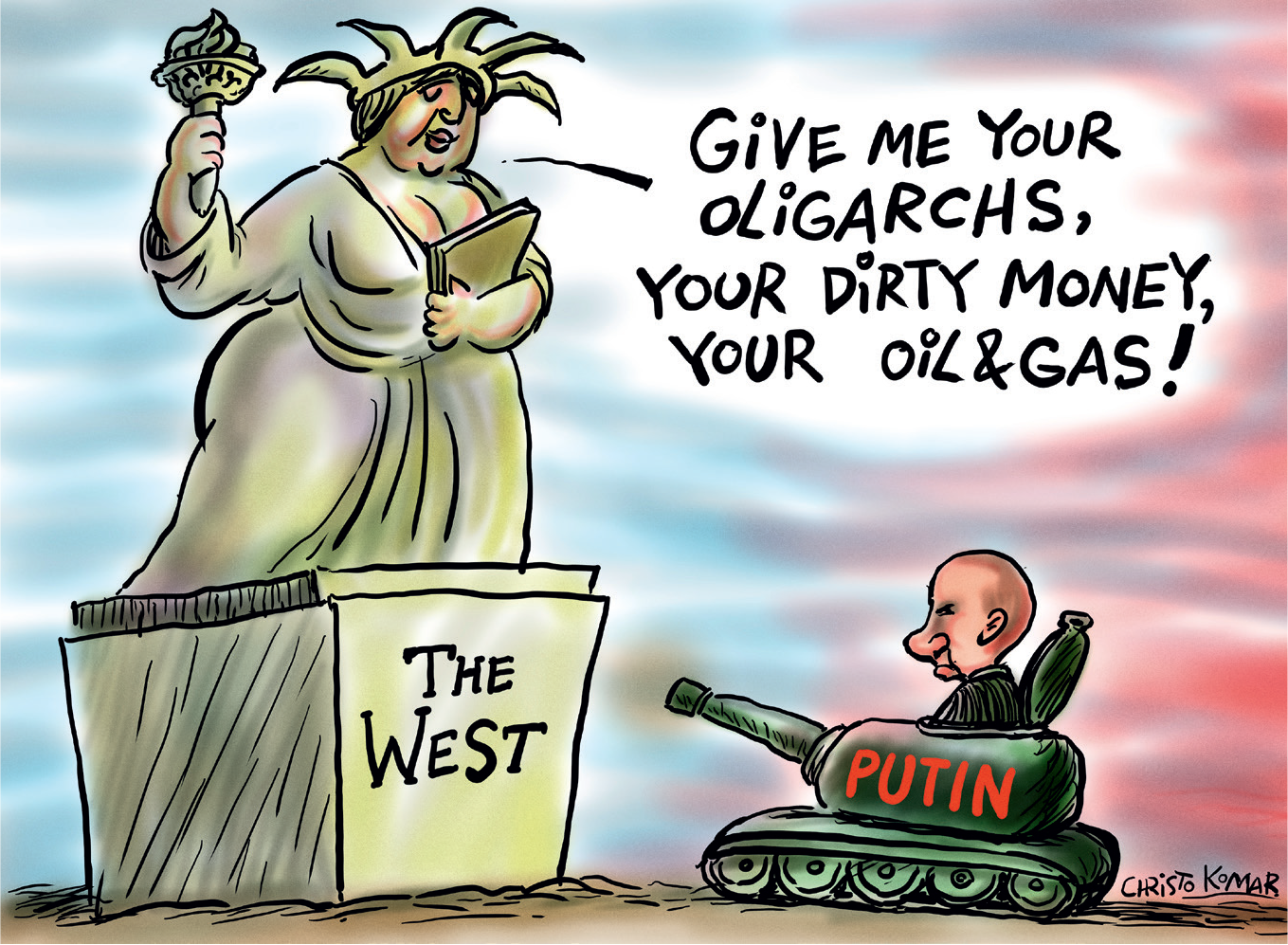
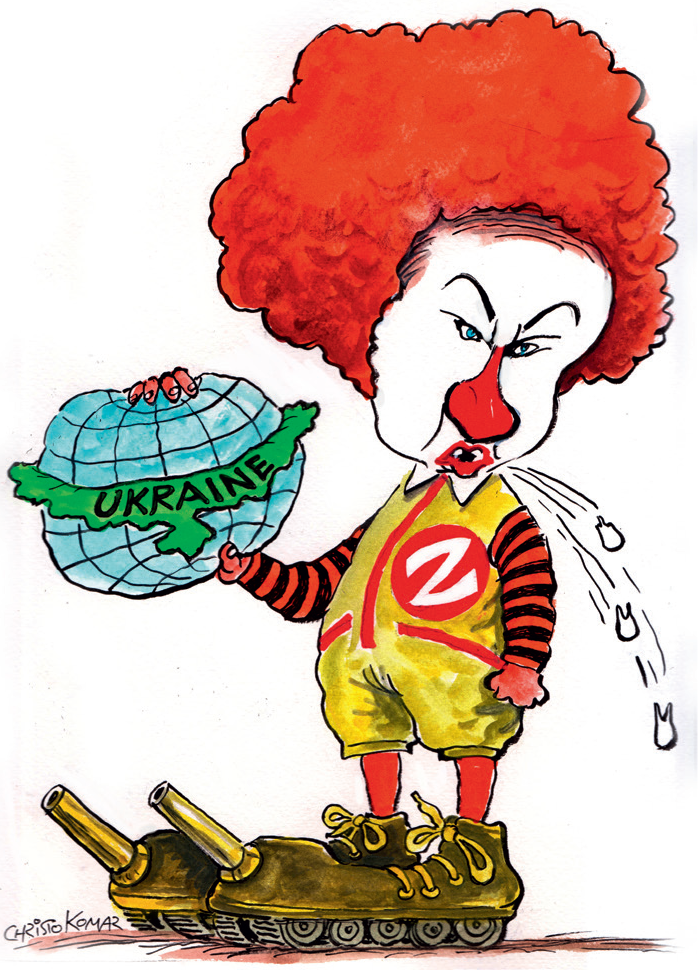
ABOVE & OVERLEAF: How cartoonist Christo Komarnitski sees Putin’s war in the pages of the liberal weekly Sega
CREDIT: Christo Komarnitski
An already precarious society – widely labelled, like Putin’s Russia, a “mafia state” because of its corruption – Bulgaria is now further divided. It is the kind of discord that a resentful Putin likes to sow among perceived foes, especially those that, back in the USSR, were part of the communist family. The dictator Todor Zhivkov, ousted in 1989 shortly after the Berlin Wall fell, was the most slavishly loyal of east European leaders.
Today, the EU’s poorest nation per capita is firmly in the Nato camp and the relationship between the two countries has dramatically deteriorated – economically, politically and diplomatically – since the war in Ukraine began in February.
In the summer, the poison from Moscow – on television, in the newspapers and on Facebook, the most popular social media network – is believed to have been a factor in the toppling of the fledgling reformist coalition government. It had come to power in December 2021 after mass demonstrations against the regime of Prime Minister Boyko Borissov, once Zhivkov’s personal bodyguard. Bulgaria now faces its fourth parliamentary election in two years on 2 October.
When the war broke out – shortly after Borissov’s defenestration – his successor, Kiril Petkov, took an anti-Putin, pro-Ukraine stance and gave refuge initially to about half a million people fleeing the bloodshed.
In turn, in April, Moscow cut off the gas supply to a nation dependent on it and launched cyberattacks on Bulgaria’s state energy company. This was followed in June by Sofia’s expulsion of 70 Russian diplomats, most of them for spying.
In the run-up to the expulsions, Petkov summoned Putin’s combative ambassador, Eleonora Mitrofanova, after she described Bulgaria as the “bedpan” of the USA. In an interview with The New York Times, the prime minister said Mitrofanova was “acting not like a diplomat but a propaganda machine”.
Amid this tumult, Teodora Peeva is depressed and angry. She is editor of Sega, a liberal and independent newspaper – a rare creature in Bulgaria – and a campaigner for press freedom in a country ranked second worst in the EU, after Greece, in the Reporters Without Borders World Press Freedom Index 2022. Bulgaria’s media is described as “fragile and unstable”.
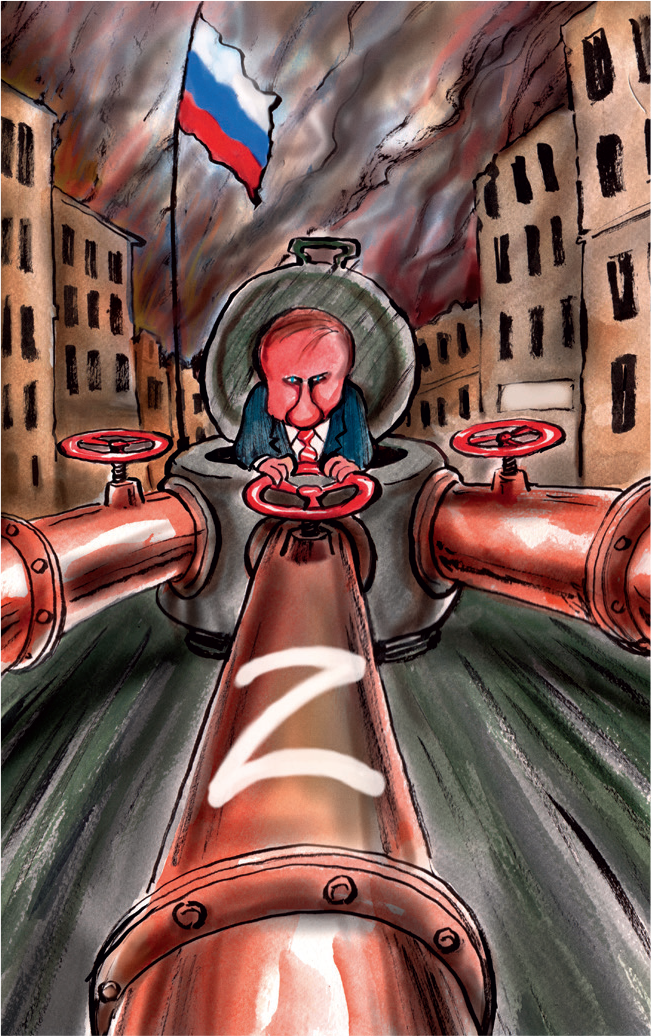
CREDIT: (all images) Christo Komarnitski
Peeva, the paper’s editor since 2005, is upset because “the government has done nothing to stop the flow of propaganda”, she told Index.
In concert with the rest of the EU, Bulgaria had banned RT (formerly Russia Today), the international TV network funded by the Kremlin. “But what was the point when people can turn on the TV any time and hear pro-Russian views, in Bulgarian, from commentators and politicians?” she asked.
She said Trud, a brash tabloid daily, reprinted pro-Putin stories from Russian newspapers. One of these stories, from the tabloid Komsomolskaya Pravda, falsely claimed that the Ukrainian soldiers under siege for weeks in the Azovstal steel plant in Mariupol were Nazis. Trud said the report justified the invasion.
“That was terrible,” said Peeva, “but they do it all the time.”
She was in no doubt, she said, that the toxic atmosphere generated by disinformation about Ukraine had helped to bring down the government, which was felled when it lost a vote of confidence.
So what did she make of the claim by Lena Borislavova, the outgoing prime minister’s spokesperson and head of the political cabinet, that, according to the Bulgarian secret services, the Kremlin was paying Bulgarian politicians, journalists and other prominent people to spread its propaganda?
Borislavova had told a TV network that there was evidence that the influential people, whom she did not name, were being paid 4,000 leva (about $2,114) a month.
“Well, my reaction is that 4,000 leva isn’t very much!” said Peeva, laughing derisively. “I know people – politicians – who boast of being paid by the Russians. And they wouldn’t get out of bed for 4,000 leva a month; 4,000 a minute, maybe.”
Most of the people speaking up for Putin in the media did not believe what they were saying. “They are just doing it for the money,” she said – but in this case much more than 4,000 leva.
“The big problem in Bulgaria is media freedom, or the lack of it,” said Peeva, whose paper began as a daily in 1997 but, in order to survive, was forced to turn weekly just before the pandemic began. “Even those politicians who want to reform the system – to end corruption – don’t understand this. They don’t like criticism.”
And because trust in the independence of the mainstream media was so low among the public – down to about 10%, according to polls – people were forced to go online for information, she said.
About 70% of Bulgarians get their news from social media, according to the Digital News Report 2021 by the Reuters Institute at Oxford University.
While the trolls generated by the Kremlin’s vast propaganda machine are anonymous, Bulgaria’s pro-Russian politicians are visible, audible and unapologetic. Peeva described the ultra-nationalist party Revival and the Bulgarian Socialist Party – key parts of the collapsed coalition – as “the public faces of Russian propaganda in Bulgaria today”.
Revival, which won almost 5% of parliamentary seats last December, is led by Kostadin Kostadinov, who was banned from entering Ukraine at the start of the war, suspected of being a Russian agent. He has a lively following of 270,000 on Facebook and has organised “peace” demonstrations in Sofia in support of Putin. The Socialists, formed from the remnants of the old Communist Party, have their own TV network, Bulgarian Free Television, which broadcasts pro-Putin propaganda, according to Peeva.
You do not have to go far in Sofia to encounter those who have bought into the Kremlin narrative.
“The world says Putin is the bad guy, but I think he is just defending his country from the Americans who wanted to occupy Ukraine,” Yniki Ynikiev, aged 16, told Index. “Most people who say the Ukrainians are good people didn’t study history. I think they are Nazis and fascists. Not all of them, of course.”
Ynikiev, who was promoting Nescafe in the gardens of the National Palace of Culture, a brutalist concrete behemoth built in 1981 at the height of the Zhivkov regime, said his information came from the internet and TV.
But why does a bright young man like Ynikiev, and so many of his compatriots, believe the Russian version of the “truth”?
“Partly because they want to – and partly for historical reasons,” the (outgoing) minister for e-government, Bozhidar Bozhanov, told Index. “For a long time – because of our ties – we have been taught history from an angle that favours Russia. So people are primed to accept things that glorify the Russian army, that say how great Putin is – and, therefore, how decadent the West is, how aggressive Nato is, how the EU is crumbling. As the old cliche goes, if you repeat the lies for long enough, they do not become true but people start suspecting that they may be true.”
Speaking in his office at the ministry he set up at the beginning of 2022, Bozhanov said: “It is absolutely vital and healthy to have a debate about what is true and what is not true. But when a nation state – Russia – interferes in this debate, using all the techniques that they have mastered in the Cold War, and applies them to social media platforms, then things become complicated for citizens trying to find their way out of the maze.”
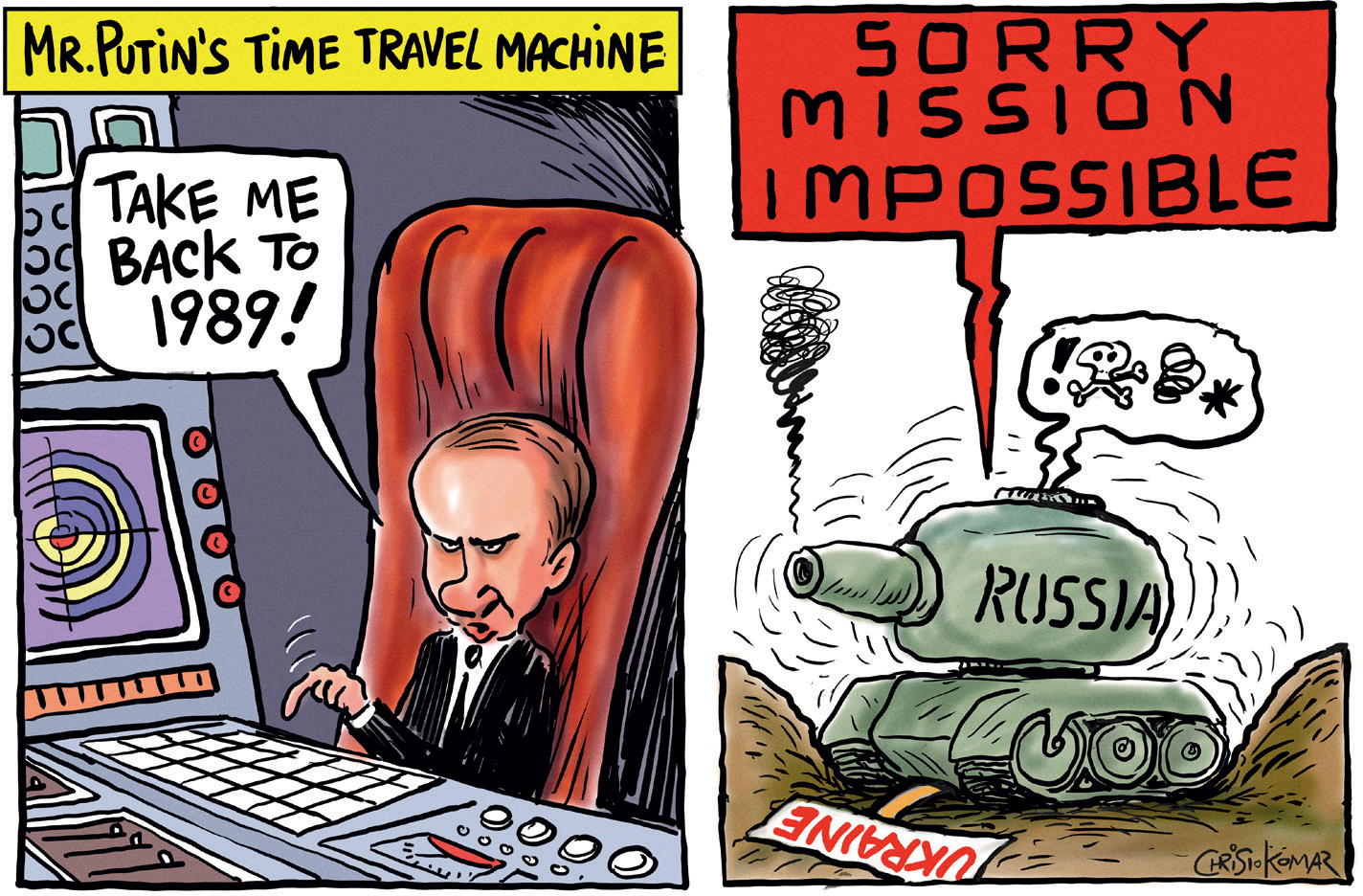
Asked whether Russian propaganda was a threat to democracy in Bulgaria, he said yes. And he was certain that the Kremlin would interfere in the campaign for the October election and try to influence its outcome using people in Sofia sympathetic to Putin.
One of the political leaders that the Russians will be backing is the controversial Socialist leader Korneliya Ninova, the deputy prime minister in the fallen coalition. Her party opposes Bulgarian arms sales to Ukraine and at one point she threatened to collapse the government over the issue.
An IT expert, Bozhanov aims to help Bulgarians to negotiate the maze of information and misinformation by trying to squeeze details out of Facebook about its workings via the new EU Digital Services act (approved by Strasbourg this summer). But he is not holding his breath waiting for Mark Zuckerberg’s colossus to reveal much about its key recommendation engine – what determines the newsfeed, what it shows and what it does not show. He described this as “a black hole”.
The Act, the purpose of which was to outlaw “harmful” material on the web, was of little use against much of the Russian disinformation, he said. “The propaganda isn’t, by definition, harmful content; it is not even always completely false – it may be 60% or 70% true in some cases. Just taking something out of context, putting a little touch on it to make it fit the narrative … That’s propaganda; that’s how it works.”
Not harmful per se, perhaps, but propaganda can hurt as well as distort. Imagine being among the 87,500 Ukrainian refugees – predominantly women and children – now settled on the Black Sea coast, nearly 400 kilometres east of Sofia. You switch on the TV or scroll through Facebook, only to be confronted with the lie that Putin’s butchery is a just cause.