




Abstract

Journalism has taken a new turn, requiring skills that would be the envy of forensic investigators.
THE JOURNALISM THAT I practised over 40 years in newspapers and at the BBC was, at its best, a pursuit of truth.
BELOW: Stabilised and ‘motion tracked’ video footage is projected back onto a model of London’s Grenfell Tower, the scene of a devastating fire in 2017
CREDIT: Forensic Architecture

Crucially, we did it in competition with other news organisations. Speed was all. When we covered big events, we might claim a stab at the first draft of history.
At the Evening Standard in the days of hot metal, a front-page scoop would last all day. As the sellers called out “Read all about it!” they could be confident that nobody already had.
The arrival of new techniques and the notion of “citizen journalism” was treated with scepticism by Fleet Street.
How would amateur observers know what they were looking at? Veracity and corroboration would go out the window, names would be spelled incorrectly, the pursuit of truth would end up in a maze. Who could we trust? Naturally, we were disinclined to discuss questions about our own objectivity.
And now here I am, 40 years after setting out as a local news reporter, in the cool, pale premises – part technology hub, part gallery, part laboratory – of Forensic Architecture, a multidisciplinary group based at Goldsmiths, University of London. I am witnessing the future of investigative journalism, using techniques so advanced that I feel like a town crier.
Forensic architecture is alchemising data, images and sound from smartphones, CCTV, satellites, audio recordings, weather reports, government documents and anything else that might be relevant. It is bringing a new dimension to journalism.
To understand what is happening, we must first understand a little about Bellingcat – the investigative agency founded by Eliot Higgins, who started his journalistic enterprise blogging under the name of Brown Moses.
As he put it at the time: The Press is dying, long live the news. Generations of journalists learned to ask: who, what, why, where and when? The Bellingcat motto is identify, verify, amplify.
Higgins, perhaps the most influential journalist of our age, was not trained as a reporter. He was quick to understand the range of open-source material in a computer age, the testimony that emerged from mobile phones crosschecked with databases and free satellite maps, the expected lists of names and functions and roles. He realised that being in the thick of the action was not necessarily enlightening and offered only a snapshot of the truth. The new investigative journalism is multi-sourced and multi-layered, raising evidence to the standard of the international courts.
This is where forensic architecture offers a whole new level. Eyal Weizman is professor of spatial and visual cultures at Goldsmiths and heads the Centre for Research Architecture, the first of its kind in the world. He said: “Wars are fought first on the ground and public perception, then in the courts and history.”
When we meet, I ask if I may tape the conversation and he gives a little smile. Tape! A particle of evidence. His department understands that journalism, if it is to achieve its noble function of truth-finding, is multi-disciplinary. His colleagues are architects, engineers, coders, film makers, legal experts.
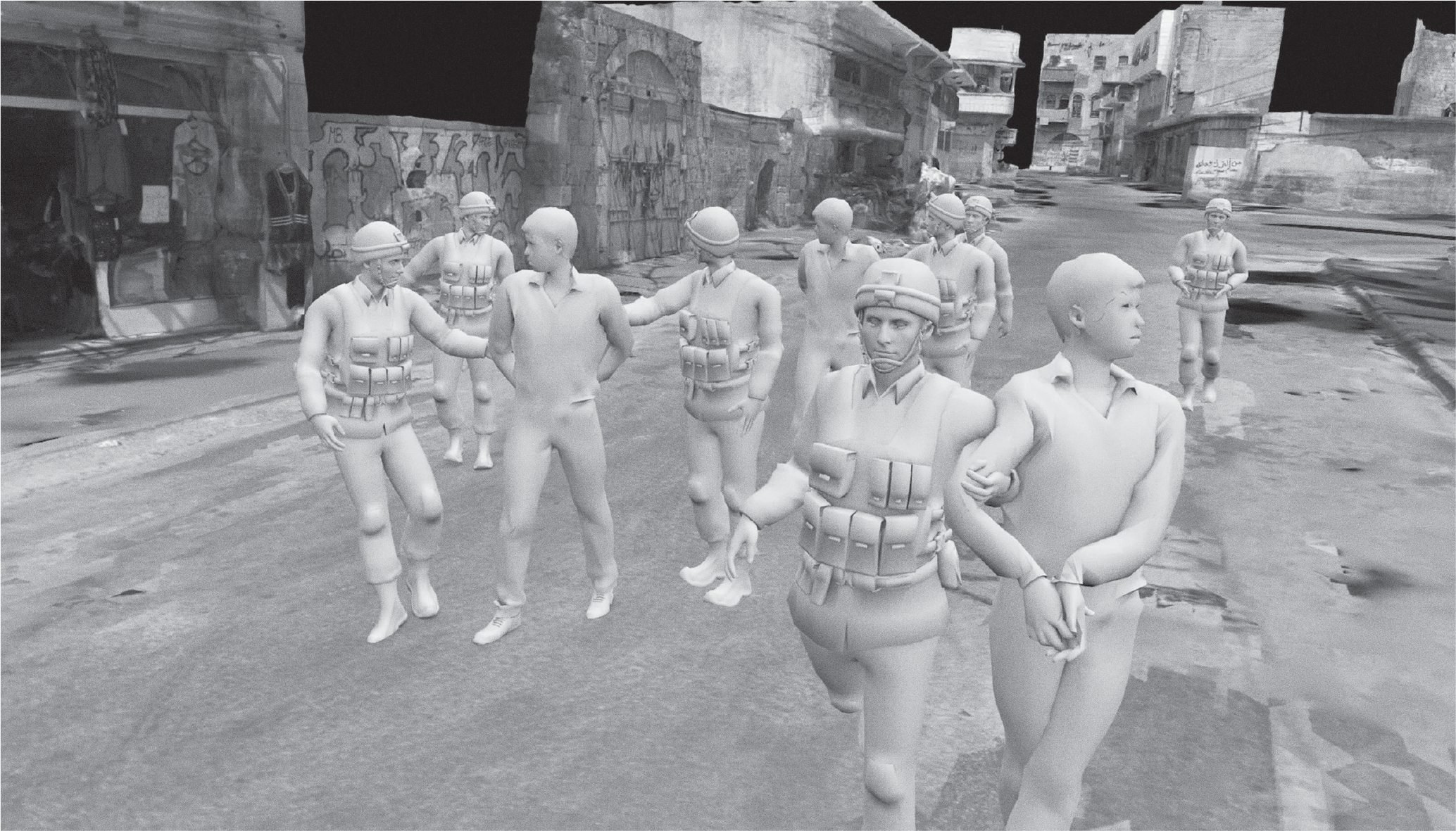
The department used technology in 2020 to establish the facts of an inflammatory episode in Hebron, in the West Bank, when a former Israeli officer, Dean Issacharoff, confessed to assaulting a Palestinian. It was asked to produce a photorealistic 3D model of the event, recreating the alley where the assault took place and walking witnesses through it with the aid of virtual reality goggles.
Weizman, born in Israel, remembers the architecture of occupation – “bridges, roads, walls”.
This kind of reconstruction is an extraordinary tool for reliving memory. One of Weizman’s colleagues shows me on his screen a 3D model of London’s Grenfell Tower on the night it caught fire in the summer of 2017.
Conventional media would show a picture of the tower on fire and interview witnesses. Forensic Architecture walks you to the building from various angles and can accurately say how and where fire-filled debris would have fallen.
Weizman says: “We understood something very simple, which was that the architecture model that we were building was a very powerful way to synchronise and locate an incident. So you have an incident and a few seconds later – it takes people about five seconds to switch on their smartphones – there are different perspectives. People report different things, but through locating those video sources we can weave them into a story which is precise.”
Traditional journalism in the field communicates drama and atmosphere but cannot give you a complete picture.
It was important for journalists headed for Kyiv in late February to record Russia’s invasion. Audiences understood the severity of what was happening but, apart from news graphics, it was hard to follow the developments of battles or be clear about the numbers of casualties. Raw social media was little help.
Weizman says: “Very often we see material on social media but what they communicate is chaos – sometimes journalists use it smartly to communicate chaos almost like a roll: here is a place, jagged video, narrative voice – but it is not actually a piece of evidence.”
In taking on state injustice, investigative journalism needs to be of a standard fit for prosecution. Anyone who has seen the remarkable documentary Navalny, exploring the Russian opposition leader Alexey Navalny, can only admire this new era of journalism.
Bellingcat is now establishing an innovation lab in Berlin along with Forensic Architecture, Syrian Archive and the European Centre for Constitutional and Human Rights (ECCHR) – a non-governmental organisation that uses litigation to hold the guilty responsible.
The idea is a centre of excellence for open-source techniques: Bellingcat for the online investigations, the department of forensic architecture applying technological tools to visualising and expanding evidence, Syrian Archive preserving digital records and the ECCHR ensuring such material helps to enforce human rights.
The centre must pick and choose the cases it takes on. It is not going to become the Reuters news agency, but each time it does investigate, it innovates further. It is likely at some point to support investigations into war crimes committed in Ukraine, but it also sheds light on historical events, suggesting criminals can never be confident of escaping their past.
Researcher Imani Jacqueline Brown gives me a detailed account of a project to investigate genocide by Germany in Namibia in the early 20th century, subjecting collective memory and contemporaneous testimony to corroboration by locating ancestral homesteads and burial grounds.
In 1904, German colonial troops mistook a gathering of Ovaherero men as a mass mobilisation and mounted an attack in Okahandja, forcing the people from their ancestral homeland. The Ovaherero sought a peace treaty at Waterberg, but German troops blocked them, forcing them into arid land. Concentration camps were established across the country and there was an international trade in human skulls. While 80% of the Ovaherero were wiped out, descendants record ancestral memories.
Would it be possible to prove these colonial crimes? Phase one of the project is identifying partners within local communities and testing methodologies. Already they have identified scenes of conflict and, sure enough, German weapons have been excavated there. Phase two, next year, will map and model sites where atrocities are believed to have taken place, locating concentration camps that used forced labour. The researchers plan 3D scans of mass graves in the Namib desert. They will geo-locate archival photographs to prove the dispossession of communities.
Descendant families sit with an architectural researcher in front of a screen and reconstruct history, and “cartographic regression” overlays historical surveys, maps and aerial photographs onto modern satellite imagery to understand people and territory. “Photographic restitution” re-creates destroyed sites.
Identify, verify and amplify. Weizman’s department hopes the work in Namibia leads to an investigative film, an interactive mapping platform, a contribution to legal case files and exhibitions in Germany, Namibia and elsewhere. Weizman knows that films and exhibitions capture the attention of the wider public, who might not wade through lengthy reports.
ABOVE: Forensic Architecture uses a 3D model to allow for the placement of soldiers and civilians based on activist footage to investigate an assault in Hebron, which was cross-referenced against the virtual testimonies of the witnesses
CREDIT: Forensic Architecture
Forensic Architecture and Bellingcat work with a patience that it is hard for most journalists, operating these days under a challenging economic model, to emulate. It will not replace the older ways, which have contemporaneous colour and protagonists offering their version of events. But they will tell you, after the dust settles, what actually happened. They set out not only to speak truth to power but also to produce irrefutable evidence.