




Abstract
As book banning surges in the USA, people are finding ways to read illicit literature, reports
KING’S BOOKS, LOCATED in Tacoma, Washington state, holds a virtual monthly book club with a twist. Known as the Banned Book Club, the members read books that have been banned or challenged – typically at schools or in school libraries.
And to further combat the stigma against the titles, the one selected is then made available to buy in the shop.
“You’re able to learn about other people and their opinions through the books,” club co-ordinator David Raff told Index.
Raff, who said the club was attended by people of all ages, added that the topics varied month-to-month.
“You end up talking about topics that don’t normally come up in conversation because banned books cover those controversial topics [including] the clichéd things you don’t talk about in public.”
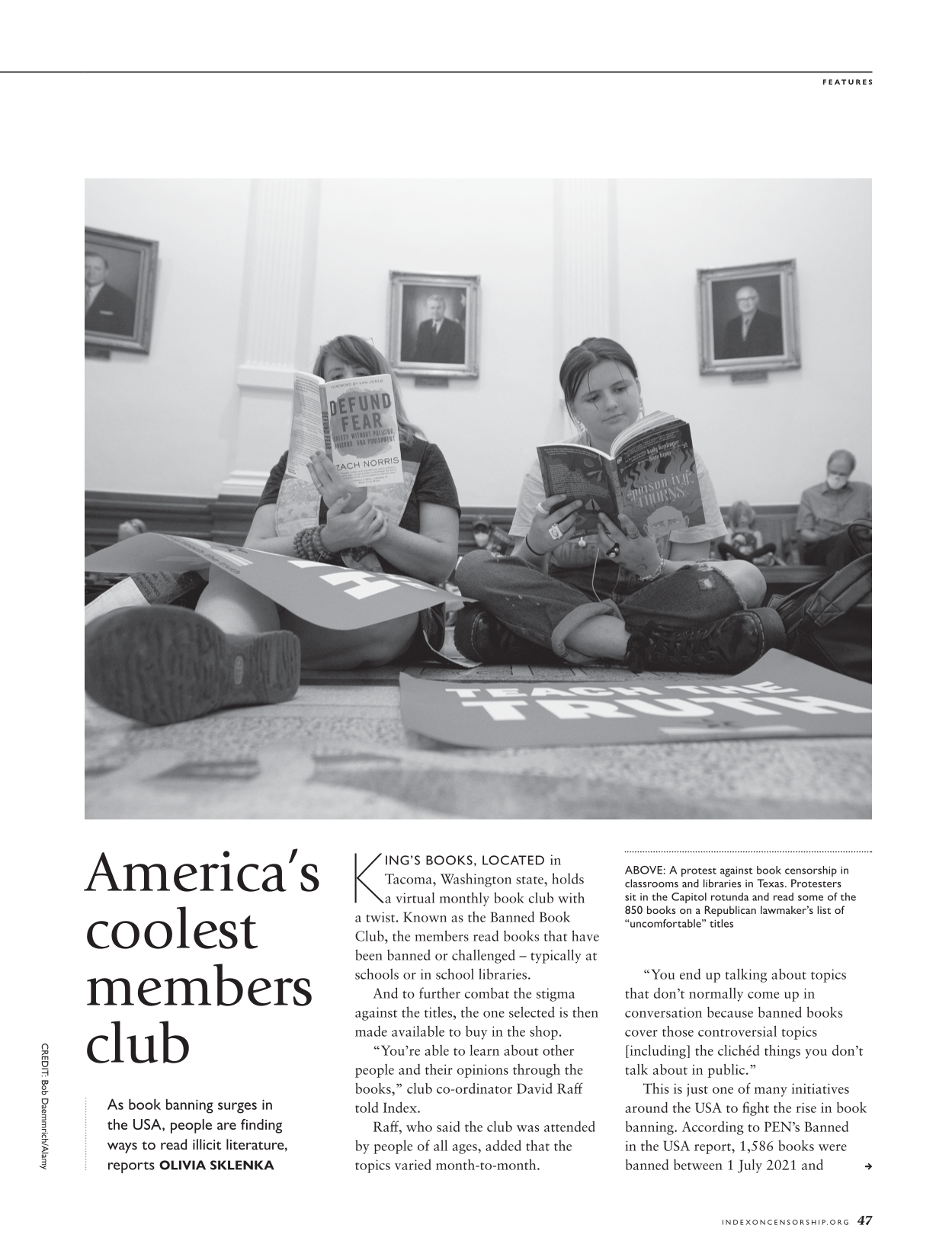
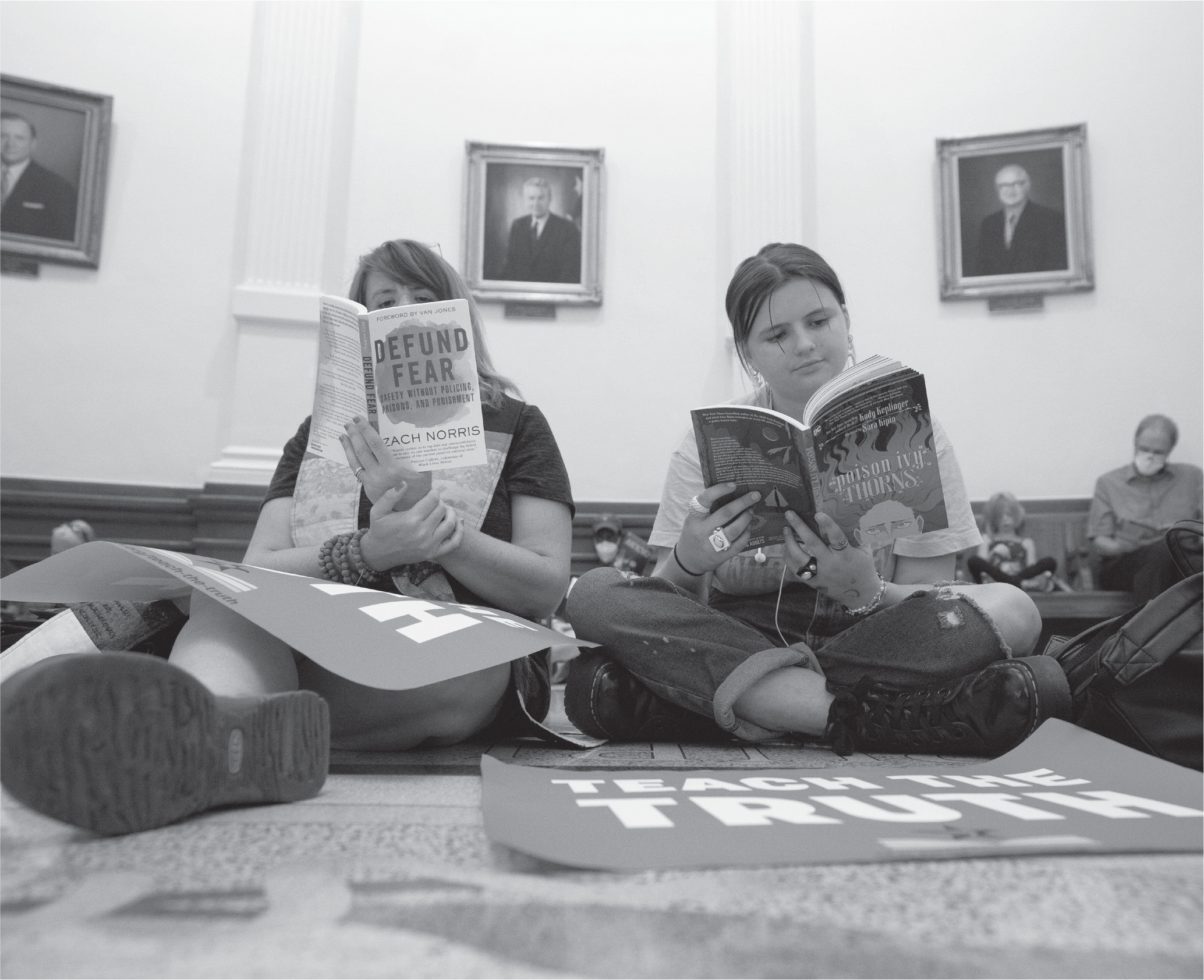
ABOVE: A protest against book censorship in classrooms and libraries in Texas. Protesters sit in the Capitol rotunda and read some of the 850 books on a Republican lawmaker’s list of “uncomfortable” titles
CREDIT: Bob Daemmrich/Alamy
This is just one of many initiatives around the USA to fight the rise in book banning. According to PEN’s Banned in the USA report, 1,586 books were banned between 1 July 2021 and 31 March 2022. The report further states that book bans have occurred in 86 school districts in 26 states during this time. Those districts represent a “combined enrolment of more than two million students”.
Other grassroots efforts include #FReadom, a campaign which started in Texas in which librarians tweet about books that are being targeted and describe their positive impact on students.
Carlyn Foote, one of the founders, is a retired librarian who lives in the state and is fighting back against attempted censorship.
“[The censorship effort] was so clearly targeting LGBTQ students,” Foote told CNN. “It was so clearly targeting race. I just don’t want students to feel like they are less than. That’s what brought me to this.”
Parents and students have also taken a stand against the regulations. According to the State of America’s Libraries Special Report, “students at the Central York High School in southern Pennsylvania protested to reinstate materials that had been removed from their library’s collection, including a children’s book about Rosa Parks, Malala Yousafzai’s autobiography and CNN’s Sesame Street town hall on racism”. Organisations have donated banned books to a plethora of establishments to ensure accessibility, and many parents have hosted protests in states including Texas and Florida. Efforts to ban books might be growing, but so too is the pushback.
It goes without saying that book banning is problematic, and that reading, particularly about subjects outside of our own experiences, fosters understanding knowledge. But in the USA it’s particularly targeted.
As wars over culture and ideology rage, many authors have found themselves, or rather their titles, in the crossfire. Topics about the LGBTQ community or from minority writers are frequently on the lists. Common titles include Racial Justice in America: Topics for Change by Hedreich Nichols, The Girls I’ve Been by Tess Sharpe, Cinderella is Dead by Kalynn Bayron, Understanding Gender by Juno Dawson, and Gender Equality by Marie Léonard.
Conservative politicians, public figures and groups have sought to eradicate any knowledge of those with diverse intersectional backgrounds and identities. Outspoken conservative groups believe that schools are forcing topics such as race theory and gender on children.
But, as many will highlight, these efforts are in conflict with the First Amendment of the US constitution, which guarantees the right to freedom of expression and includes the rights to read and learn.
Vera Eidelman, a lawyer with the American Civil Liberties Union, told the American Library Association: “Book bans in school and public libraries – places that are central to our abilities to explore ideas, encounter new perspectives and learn to think for ourselves – are misguided attempts to try to suppress that right.”
Stephanie Hlywak, director of the American Library Association, wrote in its latest report: “Banning books won’t make these realities and lived experiences disappear, nor will it erase our nation’s struggles to realise true equity, diversity and inclusion. That’s why the work of libraries is more essential than ever. Books reach across boundaries and build connections between readers.”
Likewise, Raff believes that “just because a book is objectionable to a person doesn’t mean that it should be banned to all”.
Bookshop chain Barnes & Noble made headlines when Tim Anderson, Republican state delegate in Virginia, brought fantasy novel A Court of Mist and Fury by Sarah J Maas and the memoir Gender Queer by non-binary cartoonist Maia Kobabe to court. Anderson claimed the books showcased material that was obscene and inappropriate for minors and wanted them to be sold only with parental permission.
Judge Pamela Baskervill ruled that “there is probable cause to believe” both books were “obscene for unrestricted viewing by minors”.
According to Virginia state law, a judge can issue a temporary restraining order that prevents “the sale or distribution of the book alleged to be obscene”.
With Anderson actively advocating for those two novels to be removed from shelves, only time will tell if the temporary restraining order will make it illegal to produce the books or to sell them to minors without their parental consent.
As it stands, allowing access to these books for teenagers without parental consent would implicate a variety of individuals, including any Barnes & Noble staff members.