




Abstract

Football’s popularity makes it appealing to populists. We shouldn’t overlook how it unites and gives a voice to many, writes
FOOTBALL IS A bit like post-impressionist painting: both are thrilling, beautiful and packed with meaning, and both have been bought up by the state of Qatar. Among the top five most expensive paintings ever bought are Cezanne’s The Card Players and Gauguin’s When Will You Marry? Qatar paid US$550 million for them.
The men’s football World Cup will be held in Qatar at the end of the year and will cost the state rather more: an estimated US$220 billion. It’s been reported that more than 6,500 migrant workers have died since construction of the eight stadiums began. Qatar has an infamous human rights record; homosexuality is illegal and the oppression of women is a matter of routine.
It’s called sportswashing. The word revels in glorious sport, associates the thrill, beauty and meaning with the host nation and forgets all about the nation’s darker side. It’s not a new idea. Russia held the previous World Cup in 2018; Abu Dhabi took over Manchester City in 2008 and created a team of fascinatingly brittle beauty; Qatar bought Paris St Germain in 2011 and filled it with glamour signings; the Saudi sovereign wealth fund acquired Newcastle United last year.
Football has long been used to make unlikely people look good. English football clubs were traditionally owned by the local dodgy builder or the town’s brewer; now they’re more often owned by gambling interests. It’s about both vanity and profit. Classic example: Roman Abramovich owned Chelsea from 2003 to this year, when he was forced to sell up because of Russia’s invasion of Ukraine; it made him a global figure.
It’s an ugly tradition. But Qatar’s involvements in football doesn’t make football ugly any more than Qatar’s investment in post-impressionism makes the work of Cezanne and Gaugin ugly.
Football is much loved across the world – and also much despised. There are two usual reasons for the despising: social snobbery and intellectual snobbery. Football is traditionally the game of the poor: I have often watched barefoot games in Africa with a ball made from a million plastic bags. You need rather more for the sports of the elite.
The intellectual’s aversion to football is based on the principle that stupid people like football, so if you hate football you must be clever. (Point of information: stupid people also like sex.) Intellectual disdain for football as a form of philistinism: the fact that you can appreciate the Dutch Total Football team of 1974 doesn’t disqualify you from enjoying Ulysses.
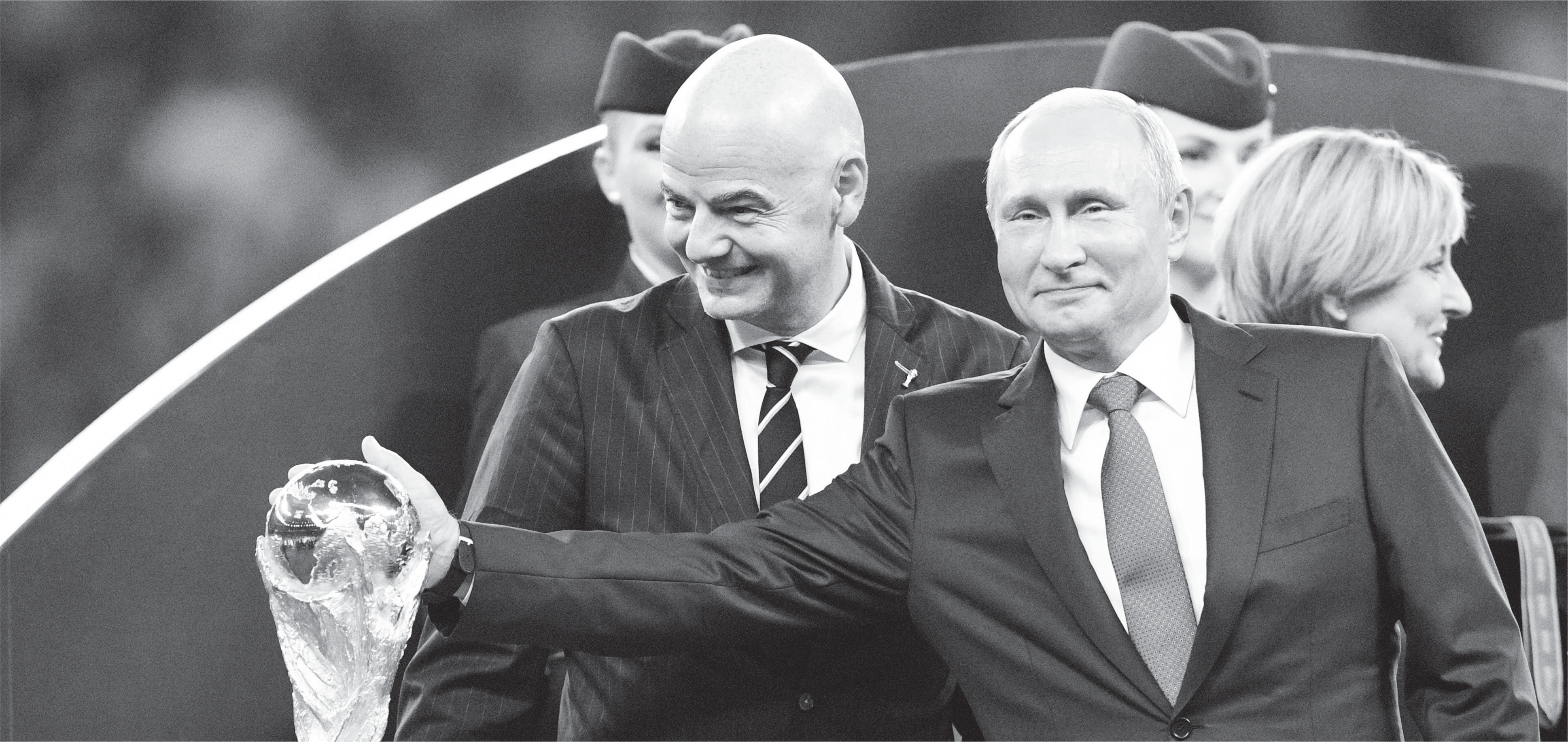
PICTURED: Russian President Vladimir Putin and Fifa president Gianni Infantino present the trophy to France after the final of the 2018 World Cup, which was held in Russia
CREDIT: Tim Groothuis/Witters Sport/Alamy
The practice of sportswashing is another reason to despise the game. But football is capable of doing good things. Sporting ability is obvious and unmistakable, which makes sport pretty egalitarian. Throughout the 1960s no one doubted that Pele of Brazil was the best footballer in the world. His speed of thought and body, his skill and his intelligence were blindingly obvious: a black man admired across the world to the point of veneration.
The process continues: football constantly throws up heroes from all races and backgrounds. France won the World Cup in 1998 thanks to the brilliance of Zinedine Zidane of North African extraction; they won again in 2018 and their top players were Kylian Mbappe and N’Golo Kante.
Football is the world’s Esperanto, the one global passport. I have discussed football with strangers on six continents. I used to play regularly against Chinese teams when I lived in Hong Kong: a better bond than my Cantonese or their English.
This summer the England women’s football team won the European Championship, and the final was watched by 17 million people, not a bad result for feminism. Oscar Wilde said: “Football is all very well as a game for rough girls, but it is hardly suitable for delicate boys.” The whole tournament was a glorious celebration of rough girls.
Sport depends for its existence on a paradox: it is trivial in itself, but played and watched as if it actually mattered. From this come vivid revelations of human beings in conflict. It was once believed that sport was good because it built character; these days we believe sport is good because it reveals character.
As novels, plays and films bring us significant incidents that reveal great truths, so does sport. Example: in 1986 when Argentina played England, Diego Maradona scored a goal with his hands, unabashed urchin cheating. He followed this with a run through England’s entire defence, still remembered by some as the greatest goal of all time: a classic demonstration of flawed greatness.
Football takes hold of people’s imagination. It’s been called the working man’s ballet. Speed, skill, cheating, triumph, disaster, despair, redemption: all these things can be found in a single football match. That’s why people follow the game. That’s why the floating voters watch half a match in the World Cup and get sucked in, watching to the bitter end. It often starts with partisanship, but sport can take you to lofty levels of excellence: and the pursuit of excellence can never be entirely trivial.
Sport is something people want, and so people want to control it. That’s why Hitler staged the Olympic Games in Berlin in 1936. Football, the most popular of all games, runs deep in human nature, and those who take control of football believe they control much of humanity. Football is no more a good thing than a bad thing, but like everything else – including great art – it is frequently put to bad use.
In the end, football is a sunflower. Sunflowers are beautiful. Van Gogh painted them and by doing so he taught us about the marvellous nature of the ordinary. BP uses a sunflower emblem for greenwashing: to convince us that the more we use petroleum the faster we will move into a green and pleasant future.
We don’t blame the sunflower for this. We shouldn’t blame football for the ways it is exploited. But if we are not aware of them we allow the exploiters to take us for fools.
In the second World Cup in history, Italian dictator Benito Mussolini did everything he could to guarantee the trophy would stay in Italy. First, he used the event to showcase the Italian fascist regime, and then invited South American players, such as Argentinians Luis Monti, Raimundo Orsi and Brazilian Filo, to play for the Italian side. They won.
The last World Cup before World War II took place in France. Nazi Germany recruited five Austrian players to join their side, who each wore a swastika on their kits. But Matthias Sindelar, arguably the most important Austrian player at the time, declined to play. When Germany faced Switzerland, they initially took an early 2-0 lead, which vanished in the second half when Switzerland scored four goals to win the match. Many believe the Austrian players lost it on purpose. One year later, Sindelar was found dead in his home.
Argentina hosted the World Cup when it was under a bloody military dictatorship which persecuted trade unionists, students, journalists and anyone suspected of being socialist or against the regime. All of this sparked protests. In Paris, for example, French and Argentine activists created the COBA (Committee to Boycott the Cup in Argentina).
The most talked about match of the 1998 World Cup was Iran versus United States. Tensions had been high between both country since the American hostage crisis in Tehran in 1979, and the USA’s support of Iraq in the war against Iran. Ali Khamenei, Iran’s supreme leader, wanted his team to take to the field with a spirit of war. Instead Iranian players came with flowers and offered them to the Americans, in a symbolic gesture for peace and human rights.
Many Brazilians were not happy about hosting the World Cup, leading to major popular protests. Known as “Fifa go Home”, the cities that hosted the matches were filled with protesters indignant that public money was being allocated to the construction of stadiums, instead of essential public services such as hospitals and schools.
In 2017, women’s football legend Ada Hegerberg informed the Norwegian Federation that she would no longer participate in the sport until women were treated fairly and on a par with men’s football in the country. Then in 2019 she refused to participate in the World Cup in France. In an interview with ESPN in 2019, Hegerberg said: “I feel like I was placed in a system where I didn’t have a voice. I felt this weight on my shoulders more and more: This isn’t working.”