




Abstract

Bnei Sakhnin, Israel’s top Arab football team, offers a rare opportunity for Arabs to voice their support of Palestine. Still, that comes at a cost, writes DANIELLA PELED
FOR SOME, IT’S a heart-warming tale of how a minor team from a small city in the Galilee, northern Israel, with a population of just over 30,000, fought to a historic victory in the State Cup in 2004. It’s a symbol of co-existence, with an Arab-majority team directed by a Jewish manager becoming the first team of its kind to play in what was then the Uefa Cup.
But for the Palestinian citizens of Israel, who make up just over 20% of the country’s population, it’s their de facto national team. In mainstream
Israeli society, there is very little room for this kind of expression of alternative identity. This means that Sakhnin’s top players can be national heroes who are reviled for not fully embracing Zionism, while their fans are viewed as traitors for flying Palestinian flags at the same time as watching a largely state-funded team.
“Sakhnin is a lot of different things to a lot of different people,” said Bassil Mikdadi, who runs a popular blog about football in Palestine. The change in the team’s fortunes over the past 20 or so years, he explained, has been accompanied by a drastic shift to the right in wider Israeli society.
Bnei Sakhnin /Abna Sakhnin (Sons of Sakhnin in Hebrew and Arabic respectively) started off in the 1960s as a small-town team, bumbling along with little financial backing and few achievements until a 1991 merger with another local team boosted its fortunes. It reached the country’s second tier in 1997, but ran into problems when its stadium was shut on security grounds, leading to a significant financial cost and the loss of the home side’s advantage.
LEFT: Fans of Arab-majority team Bnei Sakhnin arrive to watch a match against Beitar Jerusalem, a team notorious for its right-wing racist fans, at Teddy Stadium in Jerusalem
CREDIT: Ronen Zvulun/Alamy
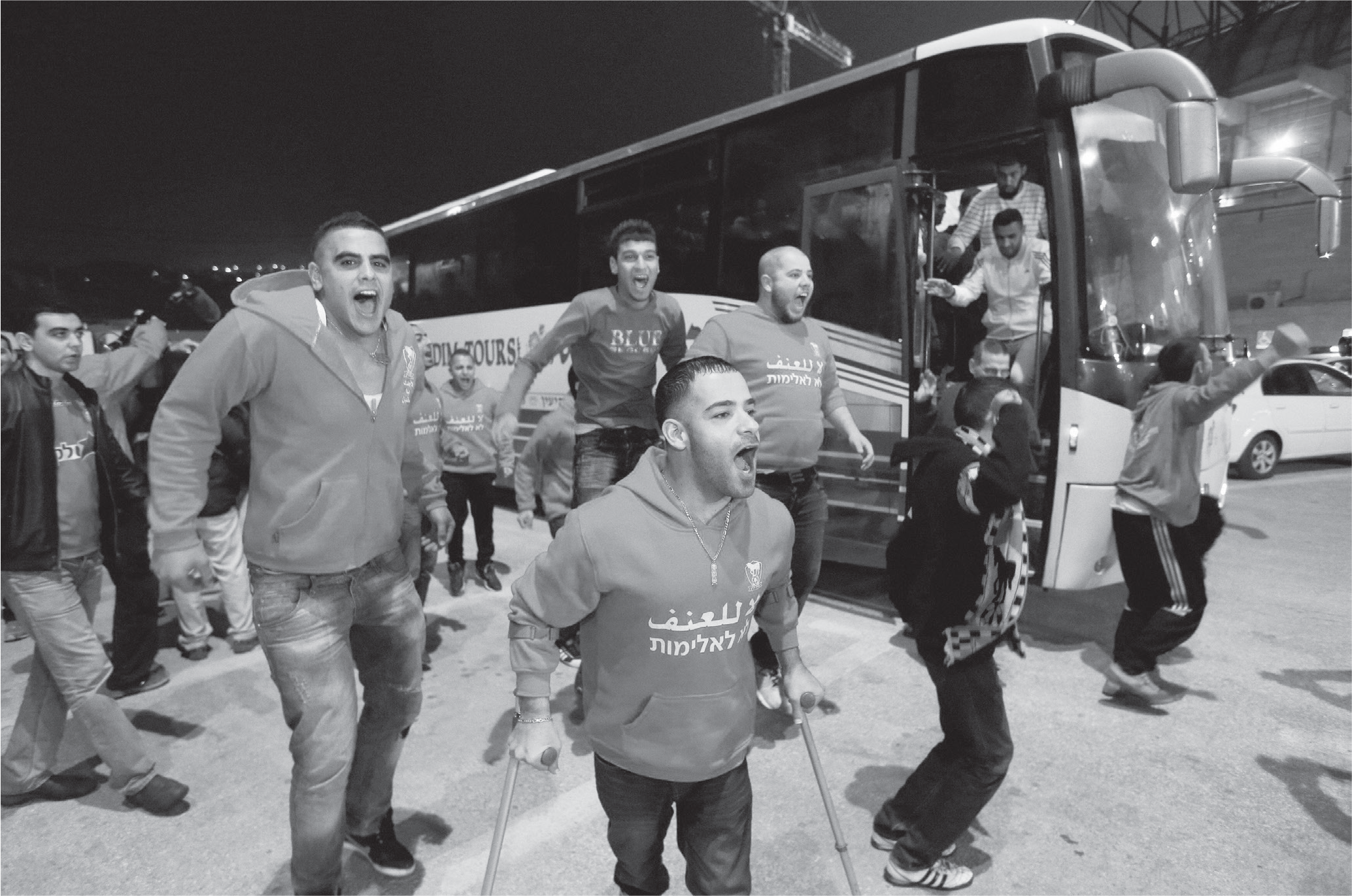
“One can say this was a political decision,” explained writer Nicholas Blincoe, author of More Noble Than War: The Story of Football in Israel and Palestine. He noted that the man responsible, regional police commander Guy Reif, was later dismissed after firing a gun at his own offices in an apparent attempt to justify his insistence that he was in the midst of an Arab terrorist conspiracy.
“The minute Reif was sacked they started playing at home again – there were no security risks – and that’s what helped them improve radically,” Blincoe said. That said, the stadium has been periodically shut since, including late last year, but perhaps with more basis. Public safety concerns continue, especially over policing matches with fierce rivals such as Beitar Jerusalem, notorious for its ultra-right wing following.
As soon as they entered the Premier League in 2003, Sakhnin appointed a Jewish manager and signed two Jewish players. In 2004, to national incredulity and delight, they won the State Cup – the Israeli equivalent of the English FA Cup. Sakhnin’s win came during a particularly dark period for the country, emerging from the ravages of the second intifada.
“It was an incredibly unhappy time, with few bright spots,” Blincoe said. “Sakhnin’s victory seemed to show what the future might hold.”
At the time, club chairman Mazen Ghnaim said: “We have qualified for Europe and we will prove to the world how to make peace between Jews and Arabs.”
But the faultlines stubbornly remained. “Football is definitely the national sport of Israel, the most popular and the one that draws in the biggest crowds,” said Ben Sharoni, a sports writer for the liberal Israeli Haaretz newspaper. “Even though Israel has more achievements in basketball, an international football match is always a major event,” Sharoni added.
This meant that when Arabic captain Abbas Suan scored the equalising goal in the last minute of the World Cup qualifier against Ireland in 2006, it made him a national hero. But earlier, during the national anthem – Hatikvah (The Hope), which is all about the yearning of a Jewish soul for its homeland – he and Walid Badir, the Israeli team’s other Arab player, gazed at the ground rather than singing.
This kind of behaviour is anathema to most Jewish Israelis, who also see Sakhnin’s fans’ clear identification with Palestine as a straightforward provocation. Supporters fly Palestinian flags in the stands and wave banners featuring symbols such as Handala, the iconic cartoon image of a barefoot boy with his back turned towards the viewer, representing Palestinian resistance. Songs can be nationalistic, with bursts of the classic protest chant “With our spirit, with our blood, we’ll sacrifice ourselves for al-Aqsa [Jerusalem].”
“Making a distinction between Israeli Arabs and Palestinians is important for a lot of Israeli Jews,” Sharoni said. “If there was a scale of racism, the Palestinians would be at the bottom, then Israeli Arabs, then other minorities, and then white Jewish Israelis at the top.”
All of this is thrown into particularly sharp relief by the flamboyant extremism of fans of Israel’s largest football club, Beitar Jerusalem – the only club in Israel never to have included Arab players. So pronounced is the racism within Beitar that the club’s new owner, Moshe Hogeg, said he would tackle its racist image as a priority. Whether that will happen is yet to be seen.
“When Sakhnin play Beitar, [supporters’] coaches have to have a police accompaniment,” noted Blincoe. “There have always been problems… Racism and bigotry bleeds into [football].”
As Jewish Israelis shifted to the right, Mikdadi said that Palestinians began to consolidate into a more unified identity, with the distinction between those in the West Bank and Gaza (who live under Israeli military occupation) and within Israel itself (where they have full citizenship) increasingly redundant.
“Historically, Israel’s hope was to depoliticise the Arabs, to think of themselves as citizens of the state, concerned with the cost of living -not very political, like in any other developed country,” he said. “For the multitude, this failed.”
The nail in the coffin, he said, was the passing of the 2018 Nation State Law, which delegated Arabic from a state language to one of “special status” and made clear that the right of national self-determination applied only to Jewish citizens. Then came the May 2021 violence in Gaza, which sparked unprecedented Palestinian anger within Israel.
The deepening faultlines in self-expression, heritage and belonging have been reflected on the pitch as much as anywhere else in society.
“I don’t think that 15 years ago it would be that common to see Palestinian flags in grounds,” Mikdadi said. “If people call you a ‘dirty Arab’ then at some point they will say, ’OK, I am Arab and this is my flag. Why are we suppressing our national identity?’”