




Abstract

Some players in Kenya had hopes that football could unite a dissatisfied population. But corruption has meant the national team is suspended from international matches by Fifa. ISSA SIKITI DA SILVA reports from Nairobi
A TRUCK CARRYING SUPPORTERS cheering for their political candidate stops near a depleted, gravelly football pitch in Umoja Innercore, an area on the outskirts of the Kenyan capital Nairobi. The atmosphere is festive as loudspeakers pump out songs praising the candidate and party hardliners distribute caps and T-shirts emblazoned with the politician’s face.
Youths pushing rickshaws full of water containers to sell to residents whose taps ran dry more than a decade ago launch a barrage of insults towards the convoy, which is trying to capture the attention of the players on the pitch in the futile hope of making them vote.
But on this football pitch it is business as usual, as young people largely ignore the political landscape.
ABOVE: Charity sports projects in Kenya aim to bring children together through football. In this case in Kibera, Nairobi
CREDIT: George Philipas/Alamy
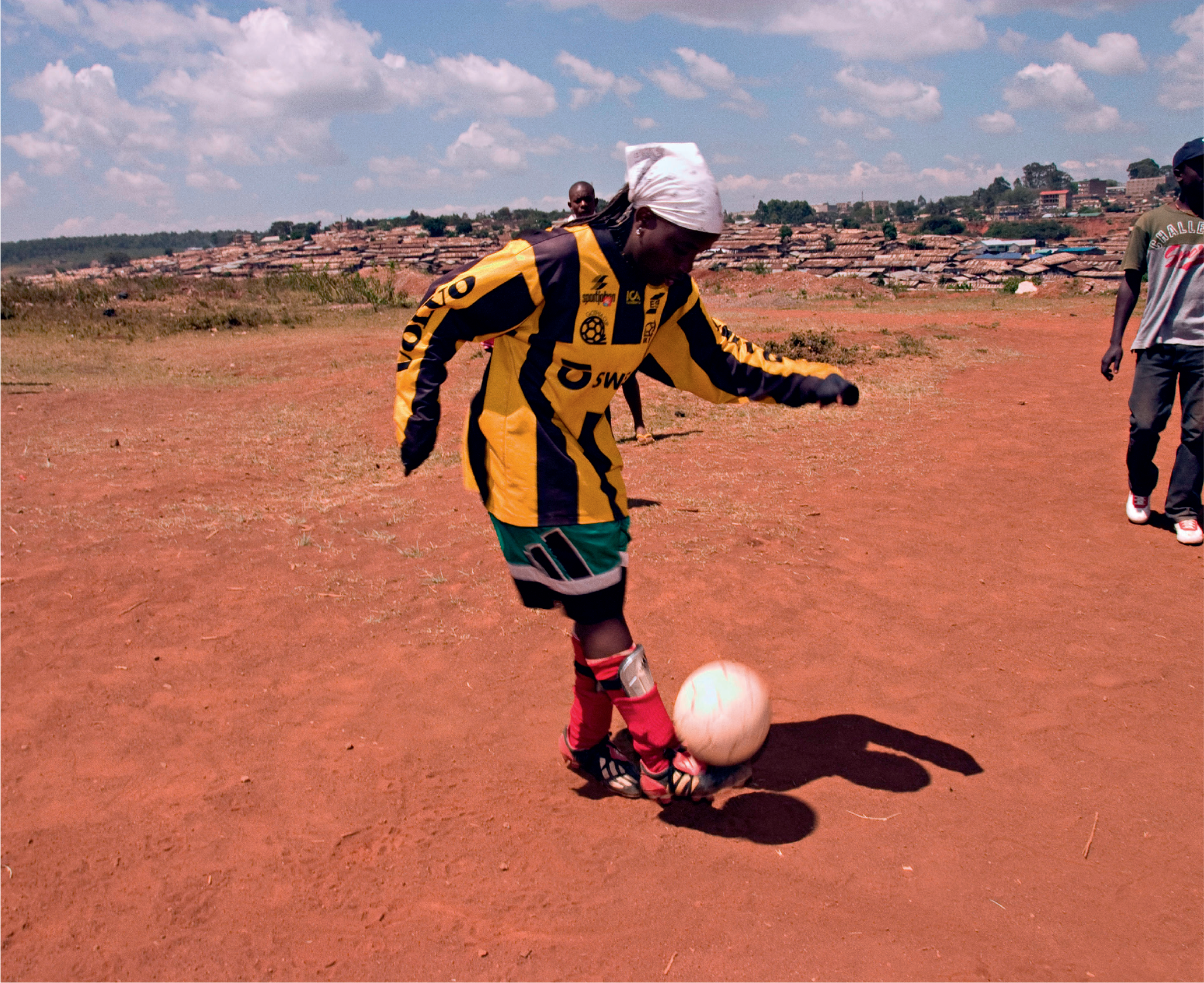
This scene took place in the weeks leading up to the election in August and most players gathered said they were no longer interested in voting, either for the opposition or for the ruling party, as previous elections did not seem to improve their lives.
“We only count when there is an election,” one of them, who gave his name as Fundi, told Index.
“Then you see them going street to street, singing and talking nonsense and lies to canvass for votes. Once they are elected they forget us and life goes on, without hope for the future.”
Fundi would like to see the nation’s youth interested in politics and hopes that they can bond over politics as they bond on the pitch. He said: “I think it is high time we, as committed footballers, start looking for peaceful ways of protesting against the way this country is being run.”
Fundi suggested rallying more senior players and mobilising supporters before boycotting matches and hoisting banners that stand up against police brutality, the teargassing of protesters and harassment of journalists.
“It will raise international awareness about the problems our country is facing and will force politicians to wake up from their slumber,” he said.
Fundi is not the only one trying to use the pitch to improve the country. In Kibera, another suburb of Nairobi which has been known for violence around elections, the residents partnered with County Governance Watch, a Kenyan non-profit that encourages civic participation, to organise a football match.
“Soccer matters today because it has brought together players who come from different worlds and different villages,” said Owino Kotieno, who helped organise the tournament.
In an interview with Al Jazeera, he explained that the game brought together people from different backgrounds who supported different candidates, all united through playing together.
But the game was to no avail. Weeks later, Kenyans headed to the polls in an election that had low voter turnout, and Deputy President William Ruto was declared the winner amid an outcry that the election was rigged.
Dissatisfaction towards politics in Kenya has been rising in recent years. Scores of unemployed, poor youths long for justice, equality, freedom of expression, freedom of assembly and the end of corruption and police brutality. Many describe politicians as thieves in suits, but they’re disillusioned and don’t know where to turn.
In the lead-up to Ruto’s “win”, chaos erupted from protesters who believed the election was corrupt. The police responded with tear gas. It is not the first time protests have ended in violence.
Not far from the Umoja football ground, police had shot dead two men during the Covid-19 lockdown.
“Every time we try to protest against these senseless and endless killings by the police, we are teargassed and some of us get arrested. The voice of the youth of this country is not being heard by the authorities,” Njoro, a goalkeeper, said.
While some believe football could be used as a powerful tool to help in the battle against corruption in the country, others are less convinced. A sports administrator, on condition of anonymity, told Index that footballers must concentrate on playing football and stay out of politics.
“We will not tolerate that our stadiums and pitches be used as a battleground for political ideas or to incite hatred against the government,” he said.
“The players are paid to play football, entertain the masses and represent their country at the highest level if the opportunity arises. These are the rules of Fifa, not mine or anyone else at Football Kenya Federation.”
“If they want to make their voices heard or enter politics, they should hang up their boots and join a political party.”
Football has been used politically for all the wrong reasons. Military history writer Anthony Clayton says that in Kenya football was initially introduced by the colonialists in urban areas and elite schools and was used as a tool of segregation and social control.
The current leadership continues to use football, in this case as a weapon of forging a false sense of national unity and trying to maintain peace amid election turmoil. Analysts feared the election would lead to violence – and they were right.
Football in this east African nation of 53.8 million seems to be lying on its deathbed, as Kenya has been suspended from international football by Fifa for political interference. The suspension has soured the joy of millions of fans who thought they would be cheering on their national team at the African Cup of Nations 2023 if they qualified.
And bad governance has put a dent in the lives of thousands of footballers who pinned their hopes on this sport to make a living in this unequal society, infested by rampant corruption and nepotism, police brutality, tribalism and numerous incidents of violations of fundamental freedoms.
There is an irony, though. Precisely because Kenyan football has become corrupt, players often come together to discuss this. And that leads to discussions on politics more generally.
A group of footballers, coaches and supporters gathered on a bumpy ground, amid freezing temperatures in Mathare, an impoverished area of Nairobi, after a training session to do just that.
“Football in this country is going nowhere – and if it is the case, then our lives are also coming to a standstill because this is our only hope to make a living,” a man named Okello told the crowd.
Another, a Gor Mahia FC supporter named Sonny, said: “I think it’s time for us to stand up as one man and fight for our rights. After all, we are the ones disbursing our hard-earned cash to buy tickets to watch the games.”
In August last year, fans of Gor Mahia FC and AFC Leopards, two of Kenya’s most illustrious clubs, held demonstrations in Nairobi to protest against the 10 million Kenyan shilling ($84,000) fine imposed on their teams by the FKF. The fans paraded their banners at the National Archives as they sang their teams’ theme songs in protest of the fines, local media reports said -adding that they threatened to storm the soccer body’s offices.
BELOW: William Ruto addresses supporters at a campaign rally ahead of the August general election, which he won amid cries of foul play
CREDIT: SOPA Images/Alamy
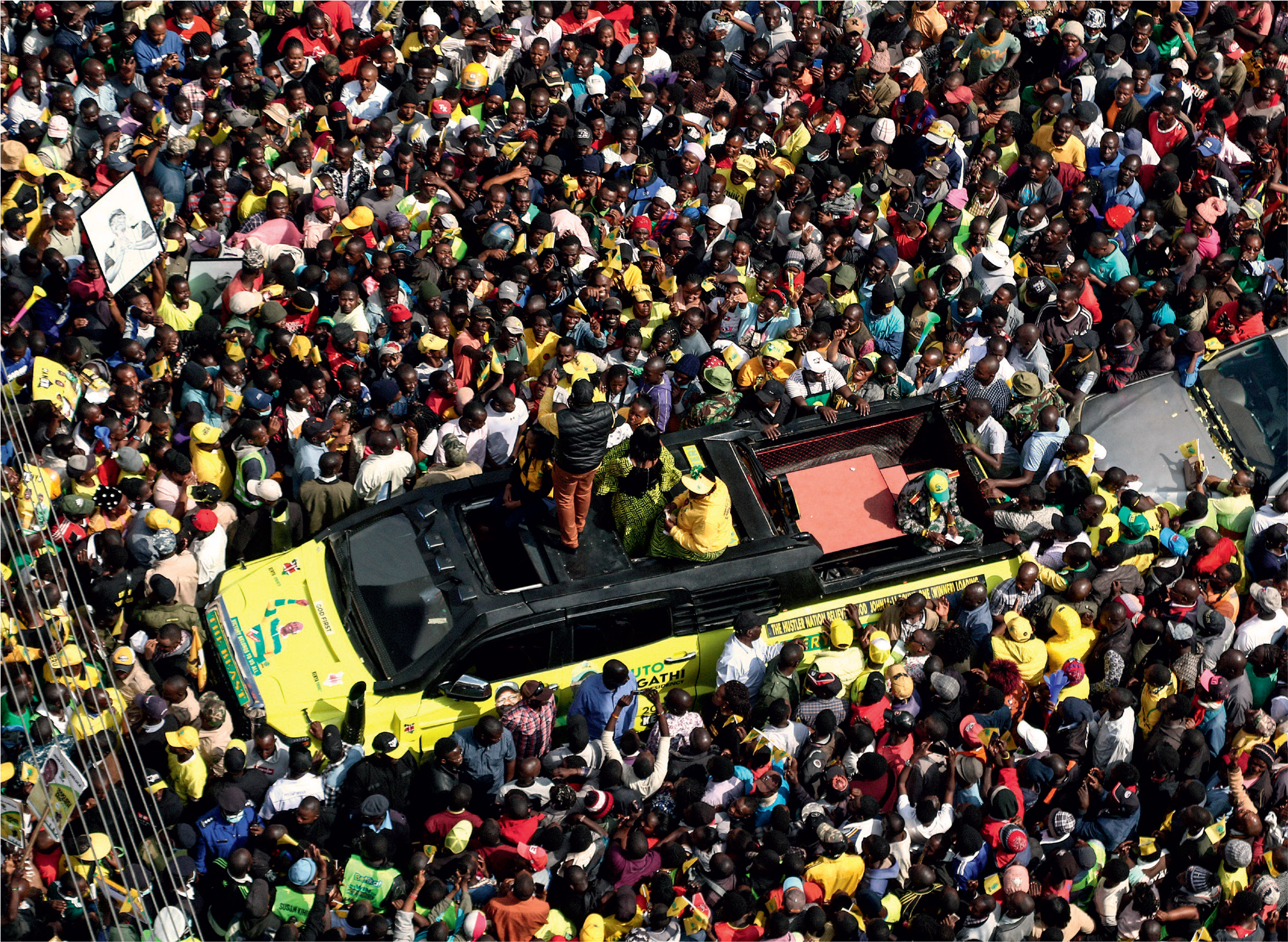
“That, we did for our team,” said Sonny. “This time it’s going to be for a national cause to demand the end of corruption and bad governance, and justice for all the victims of police brutality, the dead and those who are facing life-threatening injuries.”
Another player, Joseph, told Index that football in Kenya could not be dissociated from politics.
“You’ll be killing history,” he said. “The soccer fans’ revolution is gathering momentum. It will soon deliver.”
Football hasn’t delivered soon enough. Ruto is now firmly in power and discontent is sky high. But there is always another game, and – it is hoped – another election.