




Abstract

A new book, an excerpt of which is below, shines light on the scale and depth of Yemen’s ongoing civil war.
A FEW YEARS AGO, the civil war in Yemen made regular headlines. Not so today, despite the fact that the conflict is far from resolved.
“Yemen has been forgotten,” said Sawad Hussain, the translator of a new book about the war by journalist and writer Bushra al-Maqtari. What Have You Left Behind is a vignette of interviews with people across Yemen. Hussain was already familiar with the author – she’d translated some of her fiction and been, in her words, really moved by it. So when she discovered al-Maqtari had non-fiction work based on her journalism, it sang to her.
“It’s very rare to come across non-fiction translated from Arabic to begin with, let alone non-fiction that is chronicling a war that is ongoing… When I read it I was just really convicted that this had to [be translated] into English,” Hussain told Index.
Hussain, who majored in Middle Eastern studies, added: “If someone like me, who keeps up to date with everything, has also forgotten about it then how much more is the average person going to know what is happening in Yemen? And that’s why I said yes.”
Translating it was far from straightforward. There were the logistics. Al-Maqtari lives in Sana’a, the capital of Yemen, and was reachable only via email – at least to begin with. Collecting the stories that make up the book (which were recorded over two years from 2015) was dangerous and risky work, and Hussain, who often has a very close relationship with the writers she translates, had to play by different rules. Communication was kept to a minimum, in part to not open up past traumas unnecessarily and in part to protect al-Maqtari.
“I was always distinctly aware that I should be careful of what I was saying, and I would always preface it with ‘As you said in the book’, just making sure that this is not some conversation about what she is planning, because she is an activist,” said Hussain.
Another challenge was the material itself. The pain of those interviewed is breathtaking. It stays with the reader long after the book is put down.
“The process of translating the book was extremely traumatic,” said Hussain. “I had never worked with something this visceral before in terms of the descriptions of the dead and just the raw emotion of loss and the fact that I kept thinking ‘These are real people’.
“Each time I’m seeing the names of these people, I’m seeing the ages, I’m seeing the number of children they’ve lost.”
Hussain was a new mother at the time of starting the translation. It was in the middle of the Covid-19 pandemic and she was far from her family. Reading about the young children who were killed left her “kind of paralysed”. She described having nightmares and then feeling torn.
“I’m only translating this. I’m not living this,” she said. This conflict, in turn, made her more determined for the book to reach a wider audience, for the voices of those featured within its pages to be heard in English.
Still, she couldn’t escape the extreme anxiety that working with this material day and night created. She was more apprehensive than at any time in her life. And this from someone who is no stranger to conflict.
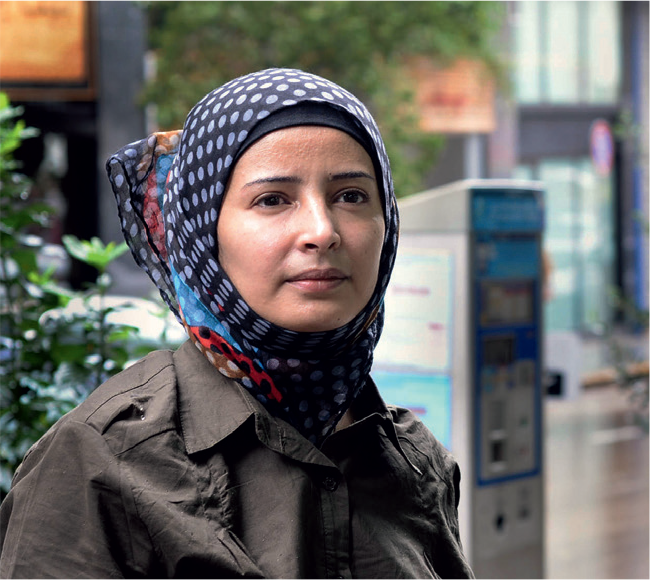
Yemeni writer and journalist Bushra al-Maqtari, pictured in 2021
CREDIT: Lina Malers
“I grew up in Karachi [in Pakistan]. I have grown up around guns, I have grown up around violence. I know people who have been in hostage situations, people who have been held up – that’s normal for me. But this was a different kind of violence, an everyday violence that doesn’t stop.”
In order to cope with translating the material, Hussain attended a workshop on translating traumatic literature where she connected with other people working on equally difficult projects. She found it helpful to hear about their strategies for coping. She made sure to meet friends, to take breaks and, as a faithful person, to pray.
As for al-Maqtari, she remains in Yemen today (with a string of awards now to her name). Whether for emotional reasons or out of safety, she is currently not doing interviews.
“I’m in awe of her making the decision to stay,” said Hussain.
“She’s been offered asylum and she’s refused because for her, I think, it’s really important to stay with the Yemeni people in her country where things are happening… It hasn’t abated, it’s not any easier than it was before.”And that remains the point – to remind people that tragedies continue in Yemen, even if no one reports them.
Extract from What Have You Left Behind?
At the al-Dehi checkpoint,1 the soldiers’ faces change just as their filthy uniforms do, but their weapons remain aimed at our heads. Their aggressive tone may change, the weather may change, but we women of this city never do. We, who are under siege, with nothing left at home to eat. We have to repeatedly risk crossing this death strip. There are women as far as the eye can see, some of them in lines, others in circles. Sometimes they stand in the street or sit on the pavement facing the crossing, protecting themselves from the sun with cardboard boxes over their heads. Next to them are empty gas cylinders and their young children.
At various times and places, I remember leaning on my cane, walking long distances on my exhausted feet, fear in my heart. But hunger forces me to take the risk. If the soldier was preoccupied, sometimes just by coincidence I could cross over to the market on the other side of the checkpoint. I’d buy what I needed and return safely home. Other times the soldier would forbid me to pass, and I’d stand next to the gate, my anger choking me.
One day during the blockade, the gas ran out at home once again. My daughters were worried, and forbade me from going to al-Dehi, but I went out behind their backs. Exhausted, I reached the crossing and tried to walk through, but the soldier blocked me. I swallowed my anger and stood to the side. Dozens of women were waiting, like me, to be let through. Looking at the crowds of women made my blood boil. Another day, I crossed the al-Dehi checkpoint and bought a sack of potatoes. By chance that day a friendly young man said, ‘Khala, I’ve got two gas cylinders here, but I’m sure the soldier won’t let me bring them in. How about I push the shopping trolley for you and you add my cylinders to your sack?’ I agreed, but when we reached the gate, the soldier blocked me, pulled a dagger from his belt and slit the potato sack open.2 The potatoes rolled everywhere.
I remember a sad day at al-Dehi, when one of my daughters had insisted on accompanying me. The road to the checkpoint was full of women. I stood with the women, waiting for the soldier to let us pass. First the soldier shot into the air, and then he aimed his gun at the women’s feet to stop them going any further. My daughter was among those women. As the women screamed, the taste of humiliation shot up from my stomach to my mouth. ‘Why are you shooting at us? Do we look armed?’ I protested. He barked, ‘Taiz women are animals.’ I then said, ‘Taiz women will fight you where you stand, and twenty others like you.’ He then yelled, ‘What do you want old woman?’ ‘I want to buy food for my children.’ ‘Go on then,’ he said. ‘But I need my daughters, I’m sick and I can’t carry everything.’ I called out some names and many women ran towards me. The soldier blocked them. ‘They’re all your daughters?’ I said, ‘Shame on you, let them pass to buy their children food.’
We were risking our lives standing where we were, and if we backed down or turned away, they’d never let us cross again. On the way back, we faced another soldier; an even ruder, heartless man. He didn’t respect my old age and screamed in my face, ‘Go back old woman, you won’t get through here.’ ‘Will you keep us at yours then?’ I asked. There was a man from the Habashi Mountain area, a Houthi sympathizer, who said, ‘Khala, don’t play with fire, you’ll get burned.’ I responded, ‘He can’t touch me.’ We walked a little further towards the gate. My daughter was afraid we’d get shot. I really was taking risks that day, the life-or-death kind of ones. At that time the price of a gas cylinder had reached 9000 riyals. We barely made it out. [She laughs.]
Another day, I went to al-Dehi, and their leader himself was there. They were calling him by his code name, Abu Ali;3 a scary-looking man. I’ll never forget his face. I heard later that a woman at the checkpoint had poisoned him. I also heard another story where he was found murdered. What we went through at the al-Dehi checkpoint, I can’t put into words. One time, the militia arrested a young man who was just trying to buy food for his family. They beat him up and humiliated him in front of the women. Another man, an ice cream seller, was also beaten by a soldier in front of us, but the man didn’t scream or cry out even once. He just kept staring into the soldier’s eyes. My heart broke for this poor young man, and I told the soldier, ‘Shame on you boy, why are you kicking him like this? He’s human, just like you.’ He growled, ‘Move it before I stick this in your stomach.’ He had his hand on his dagger.
One woman was with her son, who couldn’t have been more than sixteen years old. He couldn’t bear the way the soldier humiliated us women. When he cursed the soldier, he was dragged away to a shop. The militia had turned the shops at the al-Dehi crossing into prison cells, keeping young men locked up in there and torturing them. His mother threw herself to the ground, sobbing, kissing the soldier’s boots. ‘I beg you, he’s all I have, take me instead, and let him go!’ Another elderly woman argued with the soldier; he kicked her really hard and pushed her, and she rolled off the main road, crashing into a tree.
I can’t even describe the humiliation we endured at that checkpoint; the soldiers’ curses, their abuse. One day, I was walking with great difficulty, leaning heavily on my cane. A soldier joked, ‘No trouble walking to Sanaa! Sluts.’4 I answered him, ‘We walked because we are brave.’ Fear was always in al-Dehi, even after we passed the gate. We’d make our way to the souk, scared. We never used our phones, never picked up our family’s calls. We’d walk with our heads lowered, afraid of the snipers hiding atop the buildings.
After the resistance liberated the al-Dehi area,5 the bodies of soldiers and militia resistance fighters remained on the ground for days until they started to rot and stray dogs began to eat them. I didn’t go to see their corpses. My daughter went with the rest of the spectators; she recognized the body of the soldier that had cursed and shot at us.
Whenever I pass by al-Dehi today, I avert my eyes so that I don’t remember all we went through there. I’ve never seen anything like it, my girl. I’m now sixty years old; I’ve lived through the many wars that have come to this country, but none of them were like this. Back then, the fighters had morals at least, some sort of humanity. They didn’t attack women, torture prisoners, or kill children. When the revolution broke out in the city of Taiz on 26 September 1962, my husband was one of the first to fight against Imam Ahmad. When he was wounded in battle, he went on to join the National Guard in Sanaa, and fought there as well. But neither side committed massacres like this. All the terrors we have lived through in this war I can’t even describe. This is the apocalypse, not war.
Khadija Mohammed Hassan
Khadija Mohammed Hassan played a significant role in breaking the blockade the Houthi-Saleh militia imposed on the city of Taiz, after a military checkpoint was erected in the area of al-Dehi. Khadija risked her life helping numerous others enter al-Dehi, and shared with them what she could bring from the souk. She talked of the blockade days with bitterness, about what the women there had faced, how they had been humiliated and degraded. I visited her at her home in Wadi al-Madam in Taiz. By candlelight she talked of the blockade days and the war, or the apocalypse, as she calls it.
Translated by
What Have You Left Behind? by
1 In July 2015, Houthi-Saleh militia set up a military checkpoint in the al-Dehi area, west of the city of Taiz, and enforced a fatal blockade on the city’s families.
2 At the al-Dehi checkpoint, Houthi-Saleh militia wouldn’t allow citizens to buy more than a kilo of vegetables.
3 Houthi militia always give their fighters code names to conceal their identity
4 The soldier was referring to the Taiz women’s participation in the ‘March for Life’ (20-26 December 2011) from Taiz to Sanaa, a distance of 256 kilometres. The march took place as a protest against the regime of Ali Abdullah Salih. Bushra al-Maqtari was herself one of the leaders of this protest march.
5 The resistance liberated the al-Dehi crossing in March 2016
Footnotes
Jemimah Steinfeld is editor at Index