




Abstract

Discussing their own mental health has long been taboo for journalists.
RETURNING FROM A war zone can be jarring for journalists – a fact Peter Wilson knows all too well. “It’s really difficult to adjust when you haven’t got a life-or-death decision, and you’re not seeing horrible things every minute,” said Wilson, former news and Europe editor of The Australian.
One day he was covering the tennis at Wimbledon; the next, the war in Iraq. In 2003, Wilson, his photographer and a translator hired a car in Kuwait and drove across the Iraqi border. They were captured by soldiers about a week later.
“Initially, they thought we were spies and eventually we convinced them we were journalists,” Wilson remembered. “It was terrifying.
“There are literally tanks blowing up around us and we’re in a sort of SUV. It felt like it was made out of plastic because it was kind of bouncing around the road with the shockwaves of explosions. So, it was a pretty long and hairy drive,” Wilson told Index.
Wilson then spent time reporting from Baghdad. When a fellow journalist was seriously injured by mortar fire, he used his basic first aid, but the reporter died before reaching hospital.
Back in London, where he was based, Wilson was offered some time off to write a book about his experience, and he feels that helped him cope.
Now 61, he said that in those days there was little preparation for any mental health consequences on reporters or their teams – nor any expectation that they might need specific counselling to prepare themselves before heading off to cover a conflict. He remembers some colleagues and other journalists did have problems after difficult assignments and it was not handled well.
“It was considered your fault that you had a bit of an issue or if you couldn’t sleep, or you’re drinking too much, or your marriage broke up afterwards.”
But he feels things have changed.
“I would hope that if I was the news editor doing that today I’d be a little bit more aware of the vulnerability and what’s at stake for that person, and that there could be lifelong damage,” he said.
There are some signs that taboos around mental health issues stemming from covering difficult and dangerous stories are starting to be lifted – at least a little – but not for every reporter in every situation.
Ela Stapley worked in Mexico as a journalist until 2016 and is now a digital security consultant for media organisations, based in the UK. She said she doesn’t know any journalists in Mexico who haven’t been held at gunpoint or threatened with a knife at some point, because so many stories have a link to organised crime.
A journalist takes cover during shelling in Horenka, Ukraine on 7 March 2022
CREDIT: Eddie Gerald/Alamy
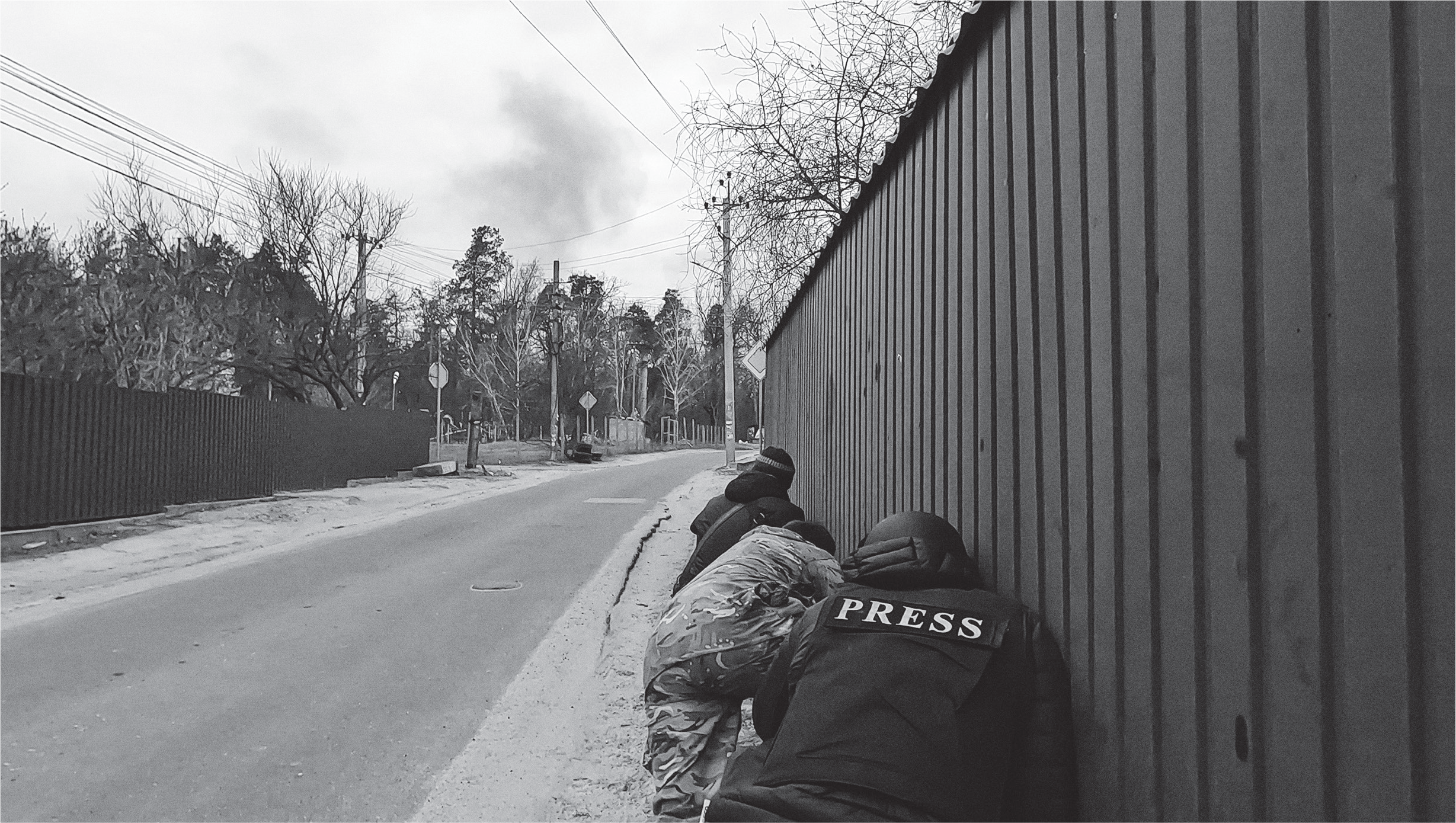
“The trauma impact for them was very high, whether they would realise that or not, or admit that or not,” she said. “I left Mexico because I just couldn’t do it anymore.”
And she thinks newsrooms are still well behind on mental health support for journalists.
Hannah Storm, co-director of the Headlines Network, runs mental health training for newsrooms.
“I don’t think even now there’s still really sufficient conversations around how you support people going into difficult and dangerous places,” she said.
Storm worked as a journalist in post-conflict and environmental disaster zones including Haiti and Libya. In 1999 there were conversations about flak jackets but no real discussions about dealing with the emotional problems caused by working in hostile environments. “You were just expected to have a few drinks and get over it,” she said. Along with taking the right kit, she believes there needs to be emotional and psychological support as well.
Stuart Ramsay, the longest serving foreign correspondent for the UK’s Sky News, recently told the podcast Behind the Headlines with Headlines Network about being shot on assignment in Ukraine, and how he copes with the stress. He talked about how he decompresses after coming back from an overseas assignment.
“Everyone deals with things very differently,” he said. “One thing is not to go on the lash the minute you get back. Control the partying. And do mundane things.”
Sarah Ward-Lilley, who was managing editor of news at the BBC until 2021 and head of the BBC’s international bureaux, said trauma and PTSD awareness started to be built into the organisation’s hostile environment training about 20 years ago.
“We started saying, ‘Look, these can also have an effect on you emotionally. It’s not unusual to feel this, please look out for each other.’ Acute reactions can be quite powerful. But they are your normal reactions to abnormal events,” she said. But she acknowledges there has been resistance along the way from the journalists themselves.
“There is a feeling that if I am struggling in any way to do any of this story, or any of this work, I’ll never get sent on the big story again,” she said.
Recent research from Middlesex University found that UK journalists felt newsroom culture and supervisors’ lack of understanding “were obstacles”. Researchers said that, until recently, any discussion of emotions appeared “to be at odds with the principles of the profession”. There were widely held perceptions in the media that being a journalist involved “having a thick skin” and “being able to cope”.
In the early days of the Covid-19 pandemic in Europe, when cases were rocketing in Italy, Milan-based freelance journalist Alessio Perrone was inundated with commissions from UK and US newsdesks to report on how the virus was spreading. He remembers talking to families about loved ones who had died and one funeral director saying that mass graves were being dug.
“I would work from 7am to 10pm – it was the busiest period of my life,” Perrone said. “In some ways work was a distraction and helped me cope.”
Then a friend got in touch and suggested talking to a therapist, and he was able to share his experiences. He said getting support became really important.
“It doesn’t feel like a taboo. I don’t know if it’s a generational thing. But I’m surrounded by people that I could talk to about these things.”
Footnotes
Rachael Jolley is a lecturer in journalism at Cardiff University, and former editor-in-chief at Index