




Abstract

The activist
SEED IS LIVING. Seed is the source of life. Seed is memory and the future. The ability of farmers to grow and exchange seed has long been the basis of maintaining both biodiversity and food security. Seeds are the first link in the food chain – the means of food production and agricultural livelihoods. This freedom is how both farming communities and nature express themselves.
Today, nature and culture’s freedom to evolve, to express themselves freely, is under violent and direct threat. Suppressing seed freedom impacts the very fabric of human life and the life of the planet.
For millions of years, seed has evolved to give us the diversity and richness of life. For thousands of years, farmers, especially women, have bred seed together. They’ve worked with nature to further increase the diversity that it gave us and adapt it to the needs of different cultures. Biodiversity and cultural diversity have mutually shaped one another, allowing cultural expression to flourish.
But industrial agriculture, based on chemical monocultures where land is filled with a single plant, has silenced the diversity of seed. Out of thousands of available species, today we largely depend on just 12 globally traded crops.
As well as silencing diversity through monocultures and uniformity, in the past few decades there has been another attempt to halt the evolution of seed. Sterile terminator crops have been created which do not produce their own seeds. Patents have also been imposed.
Farmers lose their freedom to speak, their freedom to live, under this seed totalitarianism. The fact that farmers in India are driven to suicide illustrates that all doors to speaking their pain and seeking justice are closed to them.
In 1987, I was invited to a meeting organised by NGO the Dag Hammarskjold Foundation on new biotechnologies, where major chemical corporations were present. They said they were not making enough profits through chemicals and needed to genetically engineer seeds so they could apply patents to them. Every farmer would have to buy seeds from them every season.
During the follow-up conference at the UN in Geneva, I first heard of the General Agreement on Tariffs and Trade, which became the World Trade Organization. Its Trade Related Aspects of Intellectual Property Rights agreement opened the door for multinational corporations to enter countries such as India and try to introduce genetically modified organisms and patents on seed.
That is when I committed myself to protect our seed diversity and farmers’ rights to save, breed and exchange seed freely.
A patent on seeds means that these living organisms are defined as something manufactured, invented by a corporation. Patents on seeds are a censorship of seed freedom. They halt evolution and the freedom of farmers to save, share and co-evolve seed.
For me, this is unscientific. Seeds are self-organised, self-evolving, self-renewing, self-multiplying living systems. A seed is not a machine. A patent on seeds is unjust and unethical. Now, four giants control the majority of the world’s commercial seed supply. They are Bayer (which acquired Monsanto), Corteva, ChemChina and BASF. These patents imply that a farmer saving seeds is an intellectual property thief. But it means more. A system in which seed has become a corporate monopoly, a system in which a few companies control the seed supply, is in effect a system of slavery for farmers. It silences knowledge and freedom. It even costs farmers’ lives.
CREDIT: Joerg Boethling/Alamy
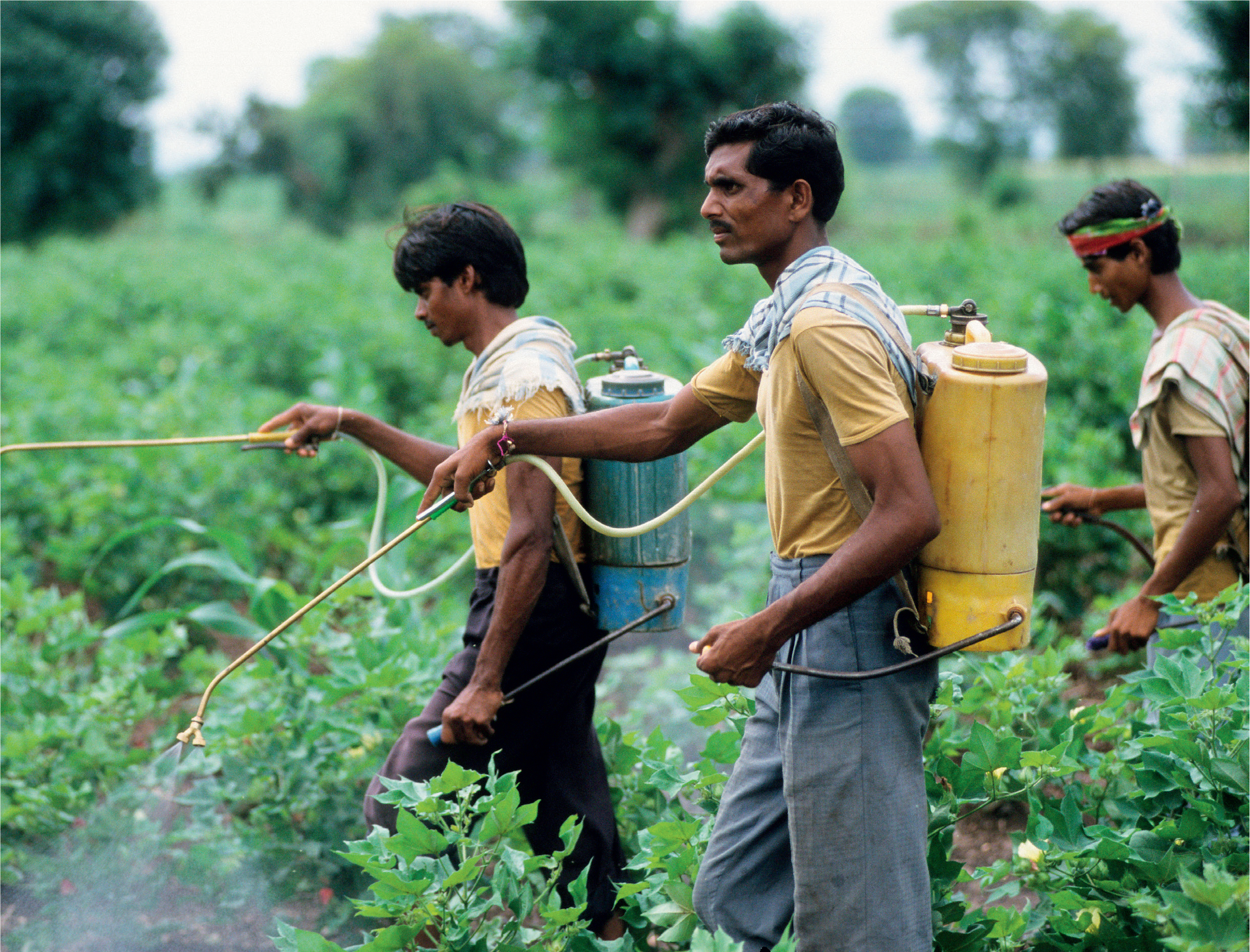
Seed slavery has trapped farmers in debt. The high number of suicides has long been a cause for concern in India, and in 2021 alone more than 10,000 people involved in farming took their own lives.
When I heard about farmers’ suicides, I started to monitor the government data and work in the field. I wrote and talked about the farmers’ plights, but then the censorship started. I used to have columns in Indian newspapers, but pressure was put on the news organisations to silence me – I cannot say from whom. When I appeared on TV, the channels were threatened. My website, where I used to publish my research, was hacked not once but twice.
Scientists who carry out independent research on GMOs have been silenced, too, beginning with Dr Arpad Putztai, a leading plant lectin expert based in the UK. His career was ended after a controversial episode where he attempted to share research about the toxic effect of GM potatoes on rats.
Where the freedom of seeds disappears, so too does the freedom of farmers. This is why we started the movement for Earth democracy, Navdanya. The name means “Nine Seeds”, which symbolises the richness of biodiversity. Movements such as Navdanya allow for the possibility of a different future. They shape laws that defend the integrity of seed and farmers’ rights, based on ethics, ecology and diversity.
Since 1987, we have worked for the defence of seed sovereignty and seed freedom by creating community seed banks. These protect seeds and the freedom of farmers to save and exchange seed. They lift the censorship imposed by patents and intellectual property rights and halt the erasure of diversity. They are the archives of freedom in nature and culture, repositories of Indigenous knowledge. They create hope and give life.
Footnotes
Vandana Shiva is an Indian eco-activist, author and scholar. Her most recent book is Terra Viva, published by Chelsea Green