




Abstract

If you’re in with the government, protest away. If you’re not, forget about it or face consequences.
STANDING OUTSIDE THE State Court of Singapore, just beyond the steps at the entrance, Jolovan Wham held up a piece of A4 paper on which he’d printed the words “Drop the charges against Terry Xu and Daniel de Costa”. A friend snapped a photo for him on a mobile phone, Wham put away the sign, then entered the courtroom to attend the hearing involving the friends he’d named. The whole thing took about 15 seconds.
That was 2018. Four years later, Wham would serve a 15-day prison sentence (in lieu of a £1,900 fine) just for doing that.
In 2009, Singapore’s Parliament passed the Public Order Act, a sweeping piece of legislation that effectively criminalised protests held in public spaces. Under the law, the term “assembly” is defined very broadly as a meeting or gathering to demonstrate support for, or opposition to, particular views or actions, or to publicise causes or commemorate events.
This applies even to actions involving only one person, making Singapore a special place where individuals are not able to “assemble” alone. Although it is technically possible to apply for a police permit to protest in public, activists are usually unsuccessful. The only exception to this rule is Speakers’ Corner, a modest-sized park near the central business district where Singaporeans can gather for a cause (subject to conditions, of course) without prior permission.
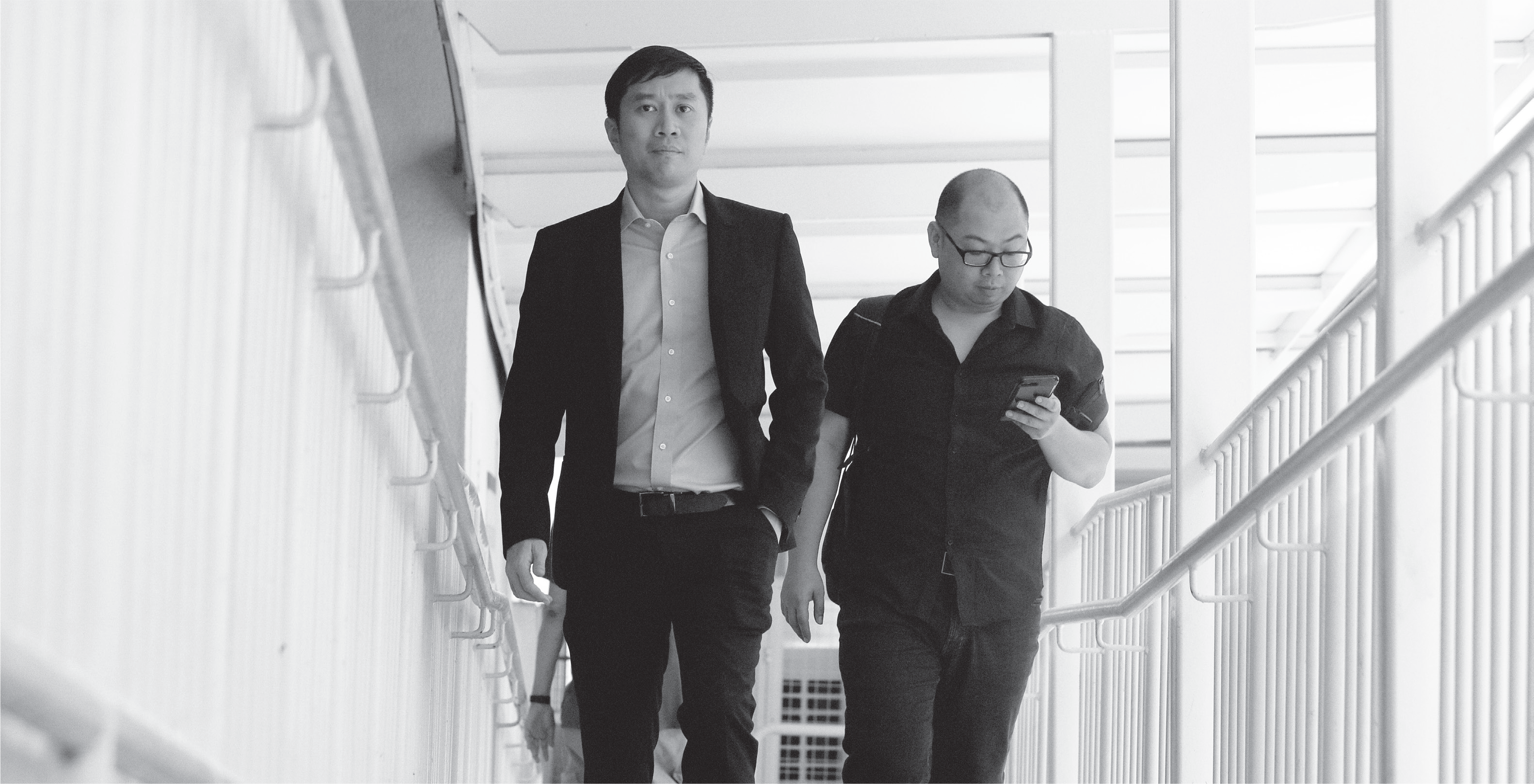
Human rights activist Jolovan Wham (left) arrives at the State Court in Singapore in February 2019 after being arrested for a 15-second peaceful protest
CREDIT: Edgar Su/Reuters/Alamy
A little over a week after Wham finished his prison stint, the Attorney-General’s Chambers (AGC) – who had argued so determinedly for Wham’s conviction – announced that they would not be taking action against ruling party parliamentarian Louis Ng for posing with hawkers running food stalls while holding up a piece of A4 paper saying “Support Them” alongside a smiley face.
According to the prosecutors, Ng had merely been “expressing care and support” for hawkers during the pandemic. The nature of the act and the intention, the AGC’s spokesman told the press, were key to deciding if it would be in the public interest to prosecute.
It must have been obvious that comparisons between Wham and Ng’s cases would be made, because the prosecution was also quick to distinguish between the two cases. They’d gone after Wham, they said, because he had been standing in a restricted area (outside the State Court).
What wasn’t addressed was that the AGC had also charged Wham for taking a photo on a public street while holding a piece of cardboard with a smiley face drawn on it. Although the AGC did eventually withdraw that case, the fact remains that they had initially thought it in the public interest to prosecute him for it. There had been no benefit of the doubt for Wham, no “he was just expressing care” rationale.
Even if we consider the AGC’s argument that the area around the State Court is a permanently restricted area in which no one will ever be allowed to demonstrate – itself an unjustified restriction of the right to freedom of assembly – prosecuting someone for standing with a sign just long enough to snap a photo is a ludicrous stretch of a law aimed at public order. Surveillance footage played during Wham’s trial showed that, apart from the friend taking the photo, no one had even noticed his presence.
It also doesn’t always seem to have been a problem. Years ago, I watched activists unfurl a banner in front of the press outside the State Courts and no action had been taken against them for that. Insisting that such an action falls under the definition of “illegal assembly” is a weaponisation of the Public Order Act to suppress fundamental rights to assembly and expression, and it seems like the state is now much more willing to wield this weapon.
Law enforcement can quickly turn political. If actions aligned with establishment messages are excused, even though they could fall under the Public Order Act’s wide definition, while actions that critique the powerful are deemed “protests” no matter how small or brief, then what Singaporeans are being told is that only acts that challenge the state will be penalised.
This is the danger of over-broad legislation. It’s also a modus operandi of the Singapore government – introduce laws that are widely scoped and give the authorities maximum discretion in application. In this way, the authorities can be presented with two people harmlessly holding up signs and decide one was simply being a nice guy while the other had threatened public order.
Footnotes
Kirsten Han is a Singaporean independent journalist running the newsletter We, The Citizens, and a member of the Transformative Justice Collective