




Abstract
Media freedom in Italy was always weak, but the new far-right government is attacking it with renewed vigour, writes
A FEW DAYS BEFORE the late-September election that would consign power to the hard right Fratelli d’ltalia (Brothers of Italy) and a coalition of allies, giving Italy its most right-wing government since Benito Mussolini, John Martin’s phone pinged with a notification.
Martin, a freelance journalist who covers Italy for publications in the UK and the USA and has asked Index not to use his real name, had just written an article about the party’s programme, quoting experts on both sides of the political divide. Here was the bite-back.
A party spokesperson criticised Martin’s use of the term “far-right”, which they called “slanderous”, and in the ensuing conversation asked him to change the article’s headline, or else there would be consequences for his newspaper.
“I wonder if I’ll be more careful about the way I present certain news items,” he said of the event. “And if, more subtly, this behaviour will influence the way I report the facts.”
Martin had already covered four Italian governments, and occasionally politicians would complain to him that they weren’t given enough space in stories, but it was the first time one was pressuring him so overtly.
“I didn’t see this as intimidation, more as a difference of opinions,” he told Index. “But it became clear how the party strived to control the narrative, using very direct methods.”
It wasn’t an isolated event. On the campaign trail and in office, Prime Minister Giorgia Meloni, her government, MPs and supporters have already picked several fights with critical media organisations and individual reporters – some small, others serious enough to have observers worried about freedom of speech in the country.
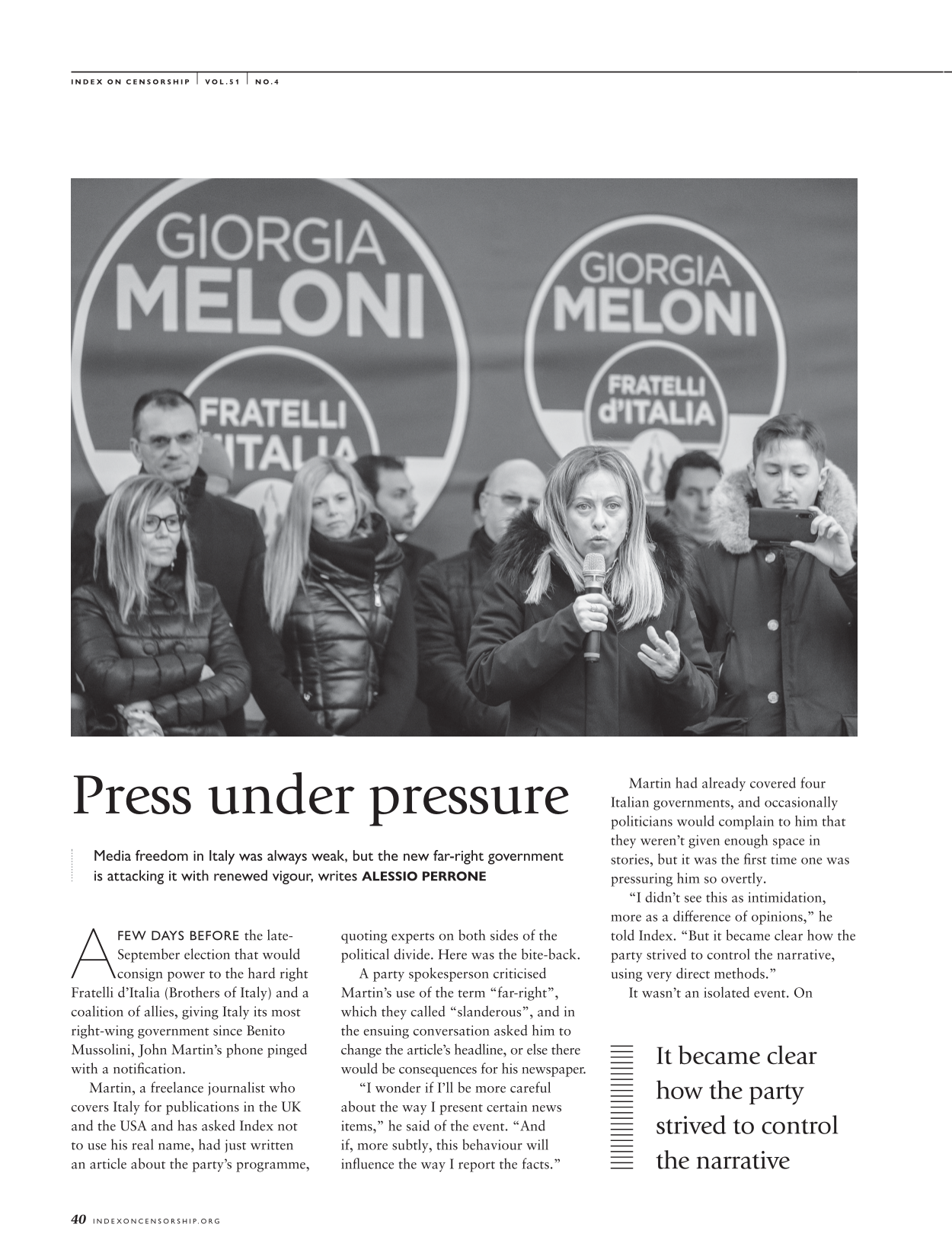
Giorgia Meloni campaigning during regional elections in Piacenza, Italy in January 2020
CREDIT: Claudio Rancati / Alamy
“The situation was already very uncertain before the new government,” said Giuseppe Giulietti, president of the National Federation of the Italian Press. “Now it’s even more uncertain.”
Italy’s unflattering track record on press freedom predates Meloni’s government. The country has long failed to improve the independence of public broadcasting service Rai, introduce conflict of interest rules or reform its libel laws – in Italy, defamation through the media is a criminal offence that carries prison sentences of up to three years, and defamation lawsuits are regularly used to intimidate journalists.
Some 9,479 defamation proceedings were initiated against journalists in 2017 alone, the last year for which data from the National Statistics Institute is available, but 60% were dismissed while only 6.6% went to trial. Months before September’s election, Reporters Without Borders ranked Italy 58th in its 2022 world press freedom index – the lowest spot in western Europe.
“The [lack of interest] toward press freedom has unfortunately been going on for a long time and under governments of many colours,” Giulietti said, comparing previous governments’ inaction on press freedom to “leaving loaded guns on the table”.
He added: “The situation is obviously destined to get worse. The prime minister and her government have already entered into conflicts with journalists repeatedly.”
In late August, young supporters followed and filmed journalists at Meloni’s first campaign speech as they asked her supporters questions about fascism. When Meloni was sworn in as prime minister, she refused to drop any defamation charges against reporters, unlike several previous prime ministers. She is suing anti-mafia journalist Roberto Saviano, who has been living under police protection since 2006 for his investigations into organised crime. When daily newspaper Domani published an investigation into her defence minister Guido Crosetto’s ties to arms manufacturers, he did not respond to the paper’s allegations but instead publicly threatened to sue it for libel.
Meloni has expressed admiration for Hungarian Prime Minister Viktor Orbán’s work, and has even adopted similar rhetoric in her speech against the “globalist elites” allegedly conspiring to bring down conservative values. In a message delivered to a right-wing rally organised by Spain’s far-right party Vox in October 2022, where speakers included Donald Trump, Orban and Polish Prime Minister Mateusz Morawiecki, Meloni listed the things that come under attack by the “globalist mainstream”, including the family, religion, borders, labour and freedom of expression, the erosion of which she blamed on “cancel culture” by “the dictatorship of the politically correct”.
Sergio Scandura, who is at the forefront of reporting on migration in the Mediterranean Sea for Radio Radicale, said the climate in Italy was already “Orbanist”. He said much of the damage was done by previous governments, who restricted journalists’ access to the field, keeping them tens of metres away from docking NGO rescue boats and police operations in ports, and therefore preventing them from documenting the arrivals. Official sources also increasingly refuse to divulge “sensitive” information.
“The story of asylum seekers is treated as a state secret,” he said.
But the “silencer” effect around migration is allowing government officials to spread propaganda, such as blaming NGO search and rescue operations in the Mediterranean for asylum seeker arrivals.
In the weeks after the election, the attacks against “globalist elites” were increasingly directed towards the press and freedom of expression. In subsequent statements, Crosetto called critical reporting “international defamation to weaken the country”. Meloni went on the record saying that “a whole part of Italy is working against Italy”. And her culture minister, Gennaro Sangiuliano, complained about the left’s “cultural hegemony” and said he supported funding more right-wing films and TV shows.
When daily newspaper La Repubblica ran an article debunking the government narrative around migration, Claudio Borghi, a senator in the coalition government, tweeted that there were “crooked and collaborationists infiltrated everywhere” and that “the press is totally in the hands of the enemies of the homeland”.
It’s too early to tell how this pressure will impact reporters. After the episode he was involved with, Martin reached out to his newsroom in the UK, which decided not to change the headline at the behest of Fratelli d’Italia.
Footnotes
Alessio Perrone is a freelance journalist based in Italy