




Abstract

Those who argue Netflix’s The Crown should have a fictional disclaimer not only misunderstand art, they meddle with it, argues
AN EX-PRIME MINISTER and a dame of British film and theatre have both criticised the latest series of the Netflix drama The Crown about the British Royal Family. Sir John Major criticised a plot line in which he featured, saying the depicted events never happened. Dame Judi Dench renewed calls for the producers to include a disclaimer with each episode. “No one is a greater believer in artistic freedom than I, but this cannot go unchallenged,” she said. Passing over her qualifying her free expression credentials, which rather serves to undermine both these credentials and the force of what she is going on to state, all involved seem to fail to understand the nature of art. Even the producers have labelled their artistic endeavour “fictionalised drama” which is a tautology. The clue lies in the word ‘drama’ – that alone renders it fiction. When you add actors, script and performance into the mix, it only further solidifies the fictive nature of the work.
No disclaimer is required.
Recently crowned Nobel laureate for literature Annie Ernaux writes fiction. Fiction based on her own life and experiences. Her work has been labelled “autofiction”. Ernaux herself shot this label down in an interview at Barnard College in the USA, arguing that she never approaches her work with the critical term of autofiction in mind, nor does she desire to fictionalise herself and her life. (Her UK publishers Fitzcarraldo Editions have her work in their non-fiction imprint, yet handily she was nominated for the 2019 Booker International Prize, which is a prize solely for translated fiction. For Ernaux, what makes it fiction is its narrative form. This is crucial in understanding that any narrative art form is rendered fictional by the very act of organising its material into a narrative. It employs artifice, for purposes of comprehensibility and perhaps also to deliver a set of meanings to its audience. The supposed factual forms of memoir and (auto-)biography inevitably both employ a narrative to drive readers through the pages so that they build up a picture of the subject. Yet they overlook that the sequences of events depicted are artfully arranged for these reasons, rather than necessarily sticking to the exact way in which they unfolded. Simultaneity is always a problem in narrative as to how to reproduce it. More often than not, the events are separated out rather than superimposed temporally in a narrative. And this does not account for the subjectivity of the writer in considering their subject (even when the subject is themselves).
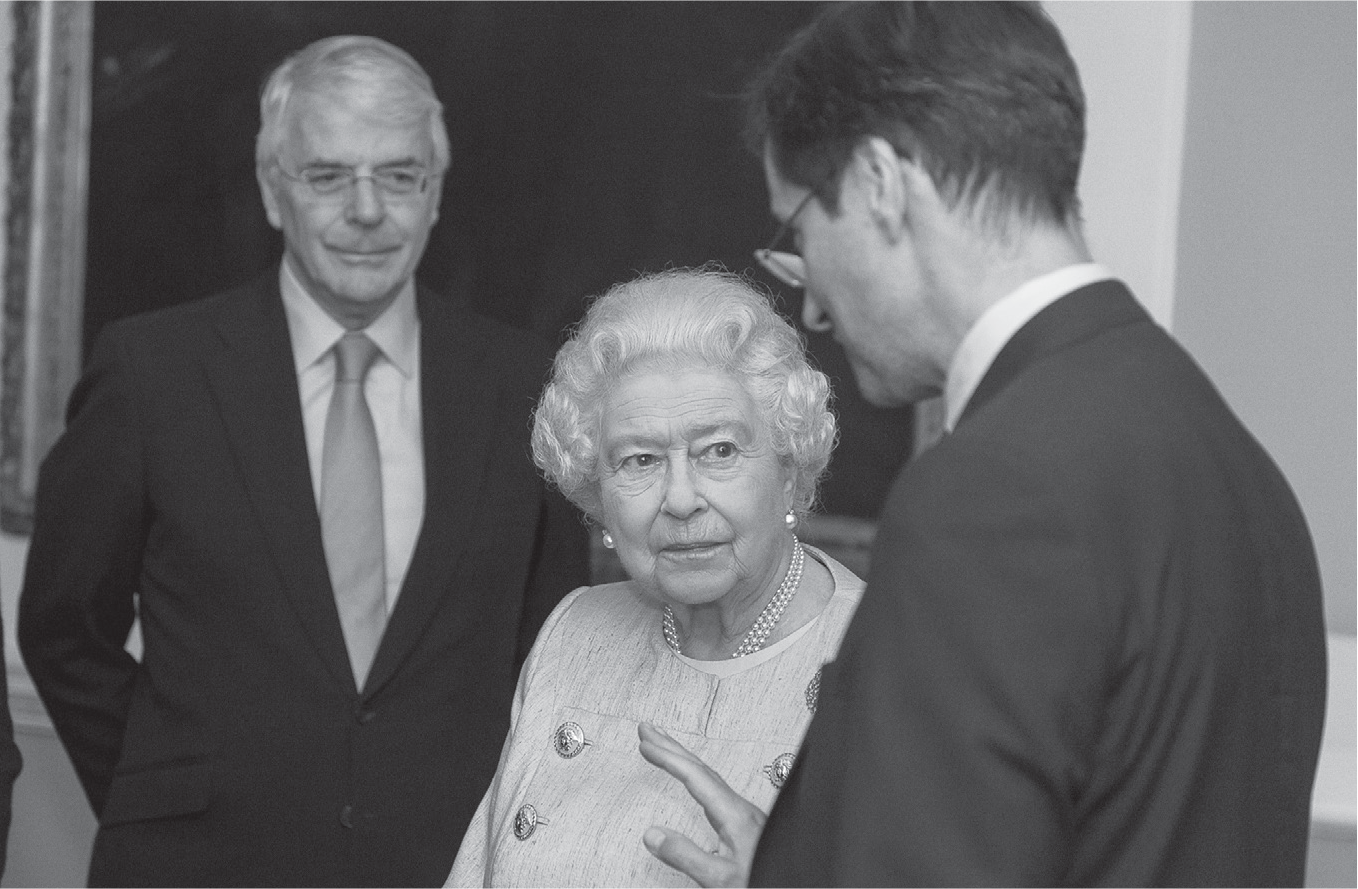
John Major and Queen Elizabeth II
CREDIT: Chatham House (CC BY 2.0)
All narrative art therefore embodies fictional elements. Even the genre distinctions between fiction and non-fiction becomes questionable. Where non-fiction pursues more academic pursuits such as history, or science, there is a question as to whether such literature even rates as art at all. Genre and labelling is reductive, trying to squeeze any artwork into pre-defined categories. It’s diminishing towards the art, the artist and the audience alike, as it presumes to direct their freedom of interpretation. Dame Judi is calling for a labelling, when in truth we are not fully in control of what artistic labels mean. Just ask a Nobel laureate.
Footnotes
Marc Nash is a London-based novelist