




Abstract

FRIENDS AND ASSOCIATES of Salman Rushdie gathered at London’s British Library back in October to celebrate the Booker winner’s work. Rushdie, who is a firm advocate of free expression and contributor to this magazine, lived under threat for decades after Iran’s Ayatollah Khomeini issued a fatwa over his novel The Satanic Verses in 1989. His stabbing in August while on stage in Upstate New York was a shocking reminder that the voices of hate remain. The suspect had reportedly read only two pages of the book. In an act of solidarity, passages from his large collection of writings were read out at the event, alongside various other speeches and recollections. Index has the privilege of publishing Hanif Kureishi’s powerful tribute, printed for the first time here with permission.
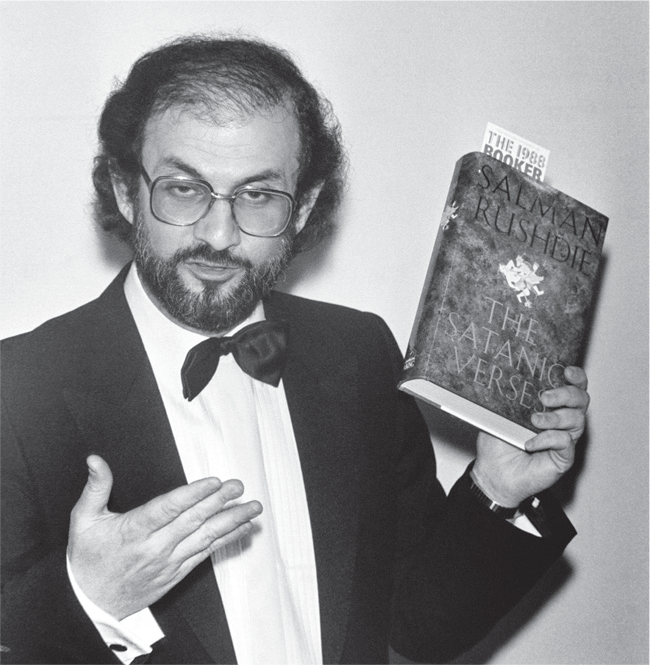
Salman Rushdie holds The Satanic Verses, 1988
CREDIT: Graham Turner/Alamy
THERE IS A spectre always haunting the world. Sometimes it is further away, other times it is close. But it is always present, always a possibility, and always has to be fought.
This spectre is the political and religious idea called fascism. This contamination is, as we know, common in the world, and becoming ever closer and more common, leaving the liberalism and democracy we like to take for granted in its wake.
And fascism, like literature, is personal as well as political; it is inside the human being, as well as outside, as ideology. It can, as we know, become a state of mind, even of our own minds, of course.
And what a mind it is that fascism creates. An arid, one-dimensional place, a terror state stuck in the past, where there cannot be any complexity or doubt, and which separates the internal population into ‘us’ and ‘them’. Nothing new can be taken in. It claims to know everything already. It is a simplified, purged, antiseptic and childish idea of the world which requires the annihilation of all opposition, as well as, in its public dimension, the destruction of journalism, universities, and free thought.
If fascism is all noisy slogans, flags, propaganda and the idealisation of fatuous leaders; if fascism is a dehumanising patriarchal monologue that never ends, The Satanic Verses is the rude contrary of the authoritarian lie. It is resistance to God, who is the ultimate fascist, along with his sycophants, because the novel is, in itself, a debate, a conversation, an argument worth having. The Satanic Verses is a rollicking, whirling, kaleidoscopic book of upsidedownness, and of through-the-looking-glass-ness. It is rich with jokes, wit, dreams, reversals and questions. It is as real and difficult and complex as the world, as it celebrates the importance, necessity and beauty of blasphemy.
In a way, you could say that it is freewheeling literary madness that keeps us sane in this ‘out of joint’ time, and that literature, made from the alchemy of reason and the imagination, reminds us that there always is an alternative, that we can be creative, that we are not at the end, that we can make new things, bringing, as Rushdie puts it, ‘newness into the world’.
In the face of the horror and sadness of what has occurred, we should recall that The Satanic Verses is an essential book, an always urgent and crucial novel which prompts us not to forget that our colleague and friend, Salman Rushdie, has devoted his life to struggling with the spectre of authoritarianism on our behalf.
He has taken responsibility as we all must. And we give him thanks here today, for his bravery and heroism. We wish him well in his recovery. Thank you, Salman, for what you have given us.
Footnotes
Hanif Kureishi is a British award-winning playwright, screenwriter, filmmaker and novelist