




Abstract
We can’t keep kicking important free expression debates into the long grass, argues
SINCE THE PANDEMIC started I have become addicted to the spoken word. From the radio to audiobooks to podcasts, I typically find peace listening to others reading or debating. In recent weeks my latest addiction is a history podcast which has explored every issue from Justianian & Theodora to the Battle of Trafalgar to the impact of James Bond. In each episode the historians inevitably end up touching on the issue of freedom of expression, the role of propaganda, the impact of the printing press or the role of language in conflict. Because the reality is debates around freedom of expression have been a mainstay of our geo-political world for generations.
What is clear is that freedom of expression as a concept has rarely been easy. Regardless of the historical context and associated issues, each culture or community has their own view, each country their own application and each government their own definition. As communications and technology have evolved so has the debate about what is freedom of expression, what needs to be protected, where the lines are and how it is used both at home and abroad – when speech can become a diplomatic weapon.
Since our founding 50 years ago Index on Censorship has been at the heart of these debates as we explore the lines between freedom of expression and hate speech; media freedom and propaganda; academic freedom and respect or tolerance of views and opinions; publishing versus social media. In a world that is increasingly divided, where words are used as armaments and tyrants increasingly attempt to shape the external as well as internal dominant narrative the debate around what is and what is not freedom of expression has been all the more relevant. Which in turn makes Index’s work all the more important.
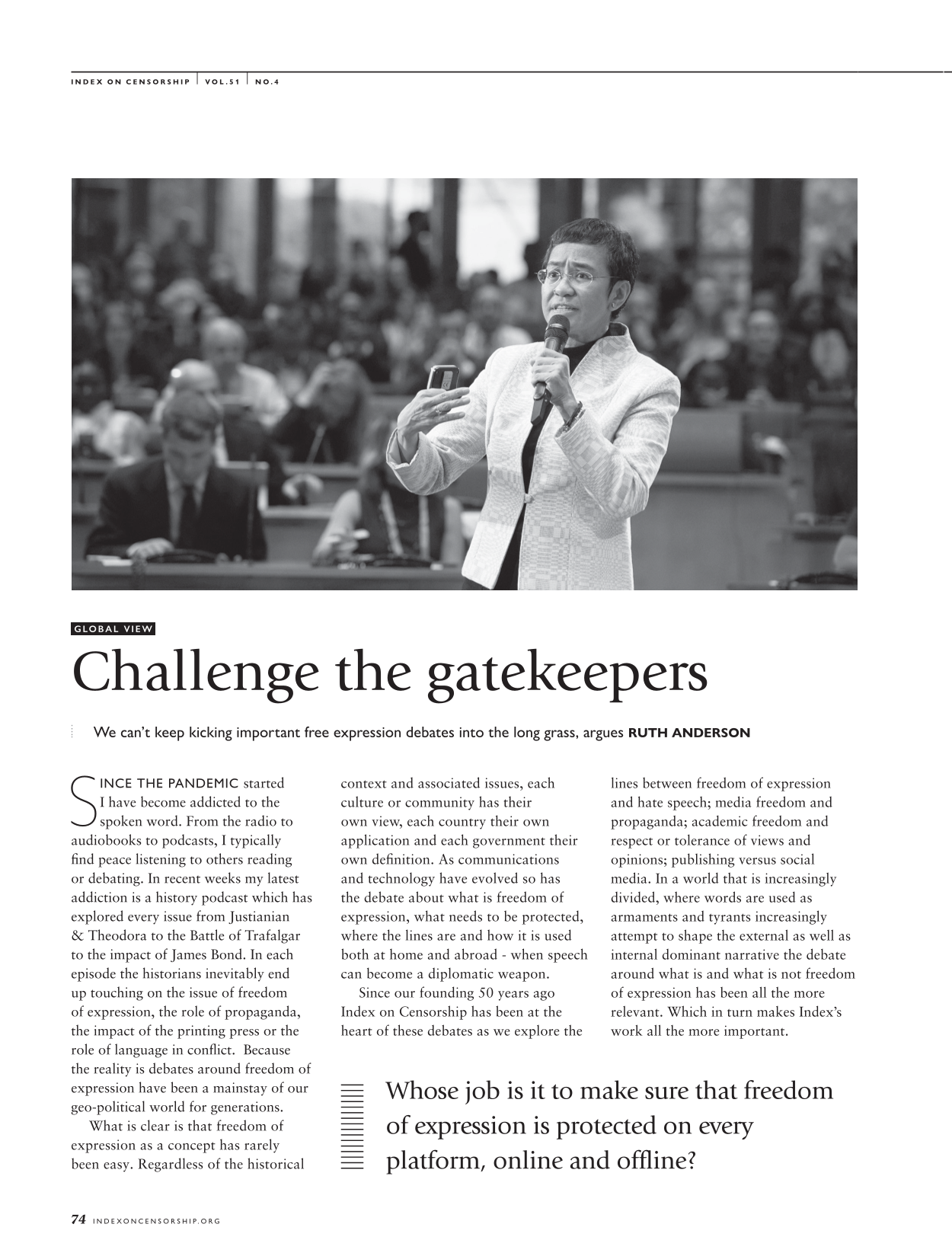
Maria Ressa at the Deutsche Welle Global Media Forum in June
CREDIT: dpa picture alliance/Alamy
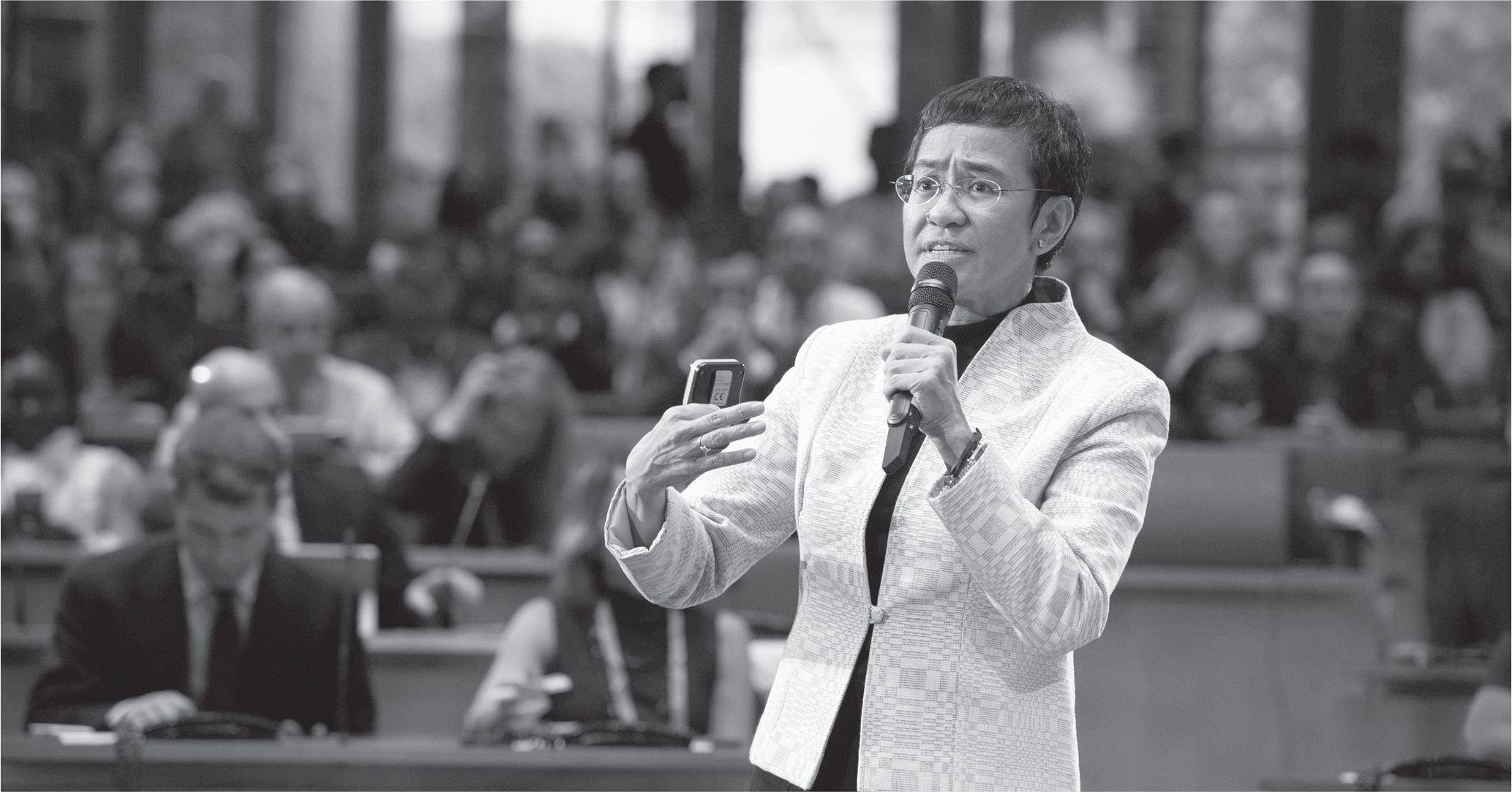
In November, former Index on Censorship Award judge (and recipient of the Nobel Peace Prize) Maria Ressa stated in the British media that: “free speech can be used to stifle free speech”. She is of course right. Some people’s voices overpower others. Some people have platforms that ensure they are heard when others are silenced. Some people use their own freedoms to dismantle the infrastructure that supports the freedoms of others. Governments have the power to limit media freedom and curtail access to the internet and social media platforms daily use algorithms to promote and restrict specific voices. And on too many occasions these collective restrictions are justified as efforts to protect freedom of expression.
Daily people attempt to justify why their human rights supersede others. Why they have the right to offend minority communities but those same communities do not have the right to protest about being offended. Why they shouldn’t be cancelled but someone else should be. Some of the most entertaining debates on social media are when activists or commentators attempt to justify why their opinions have more value than someone else’s, apparently forgetting that freedom of expression is a universal human right and does not include the right not be offended.
In recent weeks these arguments, especially on social media, have been compounded by the words and deeds of the new owner of Twitter, Elon Musk. His approach to free speech is apparently absolute, something Index would usually applaud but in this instance his commitment to it doesn’t quite ring true. Because for Musk free speech can face removal if the account is making fun of him. Such accounts are reportedly being blocked, while parody and satire accounts more broadly now have to come with that label or face sanction. And in an effort to make Twitter profitable accounts will now have the ’opportunity’ to purchase a verified account, but even this has become farcical with people buying other’s names and using them to promote misinformation, including about free medication in the USA. Musk’s dream of a free speech utopia has quickly started to flounder upon being exposed to real life.
So what is the answer in the 21st century to how we promote, celebrate and protect freedom of speech? It’s a question that has never felt more urgent to answer.
In an age when the world moves so quickly and is becoming increasingly divided, we need a level of pragmatism and a meeting of minds. We need a national and international conversation about what the lines of free speech are – or should be – and how, or if, they should vary depending on context and environment. Universities should be temples of debate, for sure, with unfettered free speech when debating and trying to understand the big issues of the day. Academic freedom relies on that precise principle. Social media, on the other hand, is more challenging. We might need to accept some social norms – especially on hate speech, misinformation and propaganda.
So we need to collectively decide, what do we want to protect? Whose voices should be heard? How do we want to amplify speech? Where is speech to be completely protected and where do we need to make compromises? And most importantly whose job is it to make sure that freedom of expression is protected on every platform, online and offline? It’s only then that we will be able to have a better appreciation of why freedom of expression needs to be protected in the 21st century, and how we can make sure that this most vital of human rights is cherished by those that need it most going forward.
One final word: Our last edition of the magazine had a special feature on the Football World Cup 2022 and how football is being used to sportswash the human rights records of tyrannical and despotic regimes. As I write today the Qatar World Cup is underway and every fear that human rights activists and organisations had about FIFA’s decision to host the event in Qatar have come to fruition. Peaceful protests have been banned, the national teams threatened with sport sanctions if they demonstrate solidarity with minority groups. Clothing guidance has been issued and journalists have been threatened.
On this occasion, however, the leadership of Qatar (and of FIFA) have attempted to use a football contest not to improve their global reputation (as we thought they would) but rather as an effort to normalise authoritarianism. This cannot stand. The decisions taken by FIFA and Qatar to undermine our collective human rights to freedom of expression and the right to protest cannot and must not be tolerated. FIFA have discredited world football and as we move forward they must be held to account for their actions both during the tournament and in the aftermath.
Footnotes
Ruth Anderson is CEO of Index