




Abstract

The writer Zinovy Zinik
CREDIT: Immo Klink

ZINOVY ZINIK IS not easy to define. He is a Russian novelist.and short story writer who has written all his best-known works while living in exile. He writes mainly in his native language, but sometimes prefers to express himself in English – as in His Master’s Voice, the story published exclusively in this edition of Index. He was able to escape the Soviet Union to Israel in 1975 because of his Jewish family origins (his real family name is Gluzberg), but he was not brought up in the Jewish faith. As an opponent of the regime, he had his Soviet citizenship stripped from him, but dislikes the term “dissident”.
His portraits of the lives of exiled intellectuals brought him to prominence in Britain in the 1990s, when his novel, The Mushroom Picker, was made into a series for BBC television. But in the years after the collapse of the Soviet Union, he became increasingly popular in Russia itself. His latest publication, from which His Master’s Voice is taken, is a vast 700-page collection of stories from the past 40 years published in Moscow under the title No Cause for Alarm — somewhat ironic in the present circumstances.
Zinik tells me there is a motif running through all the stories in the collection of the individual trapped within an enclosed space. “This enclosed space might be physical. It could be a lift or could be a carriage with its doors shut. Or it could even be the loo. But it could be locked into certain personal circumstances.”
As he saw this motif returning time and again in his work, Zinik asked himself why this real or symbolic claustrophobia was haunting him and realised it went back to his sense of people being trapped in the collectivist, Marxist ideology of the Soviet Union.
“They have been bombarded by the idea that our personality is the product of external circumstances. But I think, to use an old biblical quotation from Exodus, ‘Thou shalt not follow a multitude to do evil’. And I always worry about any collective notion, or the multitude obsessed with a certain idea,” he said.
For Zinik, a person can only find their true identity when they are tested by confronting some form of imprisonment. “You have to find some resources, some roots inside you that are your real self and not some perception of you by a collective.”
His Master’s Voice is inspired by his many decades in exile as a radio journalist for the BBC, especially his time at the Russian section of the World
Service. “My life was divided into my physical presence here and only my voice would reach my old friends and family. So, my voice became a kind of soul. And this division is a very vulnerable one because you can lose your voice in many ways.”
Zinik said the increasing severity of censorship in Russia has not yet extended to literary fiction but felt that “any deviation into the open political field would be immediately noticed”.
“Generally speaking, they still keep on publishing books, great books. What is really amazing is that a lot of editors are now on the run, but because of the electronic age, they are still editing books, which are getting printed still in Russia.”
However, the real problem was distribution. Zinik’s publisher, New Literary Observer, struggled even to get copies of No Cause for Alarm sent to the author.
So how did 24 February affect him personally? “In a way, it was identical to what I felt in 1968 after the Soviet army’s invasion of Czechoslovakia. It had an absolutely devastating effect on everyone with a bit of a brain.”
The work of Zinovy Zinik provides a crucial link between the generation who experienced the reality of the Soviet Union and the tragedy provoked by those nostalgic for that time. His recurring motif of the trapped individual struggling to escape the collective mindset remains a powerful metaphor for Russia’s predicament. X
I HAD NEVER been subjected to any kind of imprisonment in the totalitarian Soviet Russia where I was born and grew up; I had to emigrate to the West and become a vocal symbol of the Free World to be placed behind the bars fifty years later. The interrogation room in my current place of incarceration doesn’t look essentially different from the Corporation’s radio studio from which I, for the last fifty years, have been broadcasting to Russia. Like a radio studio, the cell is well insulated from any audible interference from the outside world. There is even a microphone, fixed to my lapel, for my replies to be recorded and analysed by my case officer as well as by the psychiatrist who sits behind a two-way mirror. Even this semi-transparent wall is not unlike the glass partition separating the sound engineer in the cubical from the broadcaster seated before his microphone. The broadcaster’s voice is sent over the airwaves, reaching those regions of the world from which your physical appearance has been barred by the Iron Curtain for the major part of your life. During the Cold War years, my body was in the West while my voice was penetrating the Soviet jamming devices to reach listeners in the totalitarian East. We existed for Russia on the air only, voices in a bodiless state. In that sense, broadcasting, exile and imprisonment has always, for me, been one and the same thing. The Iron Curtain disappeared, but these prison bars will safely divide me from the rest of the world for some time yet.
Nowadays, my voice can reach the world only via my lawyer. But first, it is filtered through the ears of my investigator and the psychiatrist. The psychiatrist eavesdrops on my conversation with the case officer. The reason for the psychiatrist’s presence is that my lawyer insists I should plead diminished responsibility in order to reduce my murder conviction to manslaughter. But I don’t want to pretend to be some kind of a mentally-challenged nutcase with the diminished brainpowers. I committed murder in full mental capacity. I bear full responsibility for my actions and, given a chance, I would do it again.
The psychiatrist is convinced I hear voices in my head. But he doesn’t comprehend the nature of radio work. It is the listener who hears voices in his head—the voices that we broadcast via transmitters. And the voice is no doubt symbolic of the soul, its shadow. The Corporation’s contract stipulates that you must hand over your vocal identity to its organisation—a kind of unconditional surrender, which emulates the Gothic fairy tale about the man who sold his shadow to the powers of darkness. I am trying to explain to the case officer the story of my voice, lost and regained. It was stolen from me, and came back in a different disguise.
The beginning of the story coincides with the decision of the administration to get rid of me. Nora Bluntik, our Department Head, invited me to her spacious office for, “an informal preliminary chit-chat,” as she put it in her mail, about a possible termination of my life-long collaboration with the Corporation. When I entered the room, she looked at me like a grandma would at her naughty grandchild, masking her malicious intentions with a toothy smile, jaded and hypocritical. Her manly suit and high heels were as charming as a tortoise’s shell. She always exuded an icy corporate charm mixed with a whiff of camphor.
During the Cold War years, Nora Bluntik used to present the station’s music programme where she gave audio dance lessons on the samba, cha-cha-cha and other moves learnt during her youth spent in a North London suburb. The Corporation’s bosses were convinced that in Soviet Russia the only dance technique taught to the population was energetic marching across Red Square to the accompaniment of a military brass band. Now, with the same well-trained enthusiasm, as if she was executing the pirouette of a samba dancer, Nora Bluntik tried to convince me—in the presence of the administration’s lawyer—to accept the golden handshake, the size of which had never previously been offered to anyone. They were bribing me, “one of the most outstanding broadcasters in the Russian language,” as she put it, and praising me hypocritically in a bid to convince me to leave the Corporation quietly and without fuss. Others, the so-called “most outstanding ones” had long gone; their souls crossed through the ether to the other side, to travel indefinitely in the frictionless void of darkness where the stars are as silent as fish in an aquarium.
These days in the shadowy corridors of the Corporation, youngsters with insolent smiles on their spotted faces loiter with intent. They are the newly employed broadcasters from post-Soviet Russia imported by Nora Blutnik, the great enthusiast of all revolutions in the world—should they happen, that is, a safe distance from her cosseted suburban home. I have no doubts whatsoever that all these new Russian employees were once professional journalists in Soviet Russia. Behind Bluntik’s chair hangs a portrait of Sir Obadiah Gershwin, the patriarch of broadcasting to Russia. I had noticed that for some time now, the smile with which Sir Obadiah Gershwin had been observing the goings-on beneath him was no longer an expression of benevolent irony but squeamish revulsion.
At my meeting with Nora Bluntik, I was paralysed with an identical squeamish grimace. She was obviously instructed by her superior to inform me about the Corporation’s great leap into the electronic digital age. I listened to her gobbledygook about virtual reality and interactive websites, about audience-generated content and internet broadcasts, direct messaging from mobile phones and aggressive audio interactions with the use of simultaneous live recording, and it was clear to me she didn’t understand a modicum of this technological drivel. The inevitable conclusion one should draw from listening to this poppycock was clear to both of us. I had been observing Nora’s shifty eyes, her toothy smile distorted by her verbal cha-cha-chas, her demagogic tricks and other sambas of bullshitting, employed in order to fuck up and paralyse my intellect. Out of this fog of audible rubbish two points eventually emerged. Since I was rapidly approaching the age of retirement, and bearing in mind my manifest aversion to the digital innovations in broadcasting, I was considered by the Corporation a relic of a bygone epoch. If the content of a broadcast is generated by the audience, the necessity of the broadcaster is annulled. My forty years of broadcasting had gone to the dogs. I was like an item from the Corporation’s cabinet of curiosities of the Cold War.
Indeed, I was the only one at the Corporation who still used an antiquated editing machine for my recordings. A traditional tape recorder stood proudly next to my desk: I’ve never used computerised editing technique. My desk with its letter trays, a stack of writing paper, stapler and a box of rubber bands looked like a museum installation. Apart from me, and the administration, everyone else at the Corporation was hot-desking, a system whereby no one has a fixed place of work, but instead occupies any free desk available at any given moment. You start by depriving a person of his individual place; you end with him losing his individuality as a displaced person. But in a world where no one is irreplaceable—as Joseph Stalin was fond of saying—there is no such a thing as individuality. You have a broken heart? We’ll replace it.
Bastards.
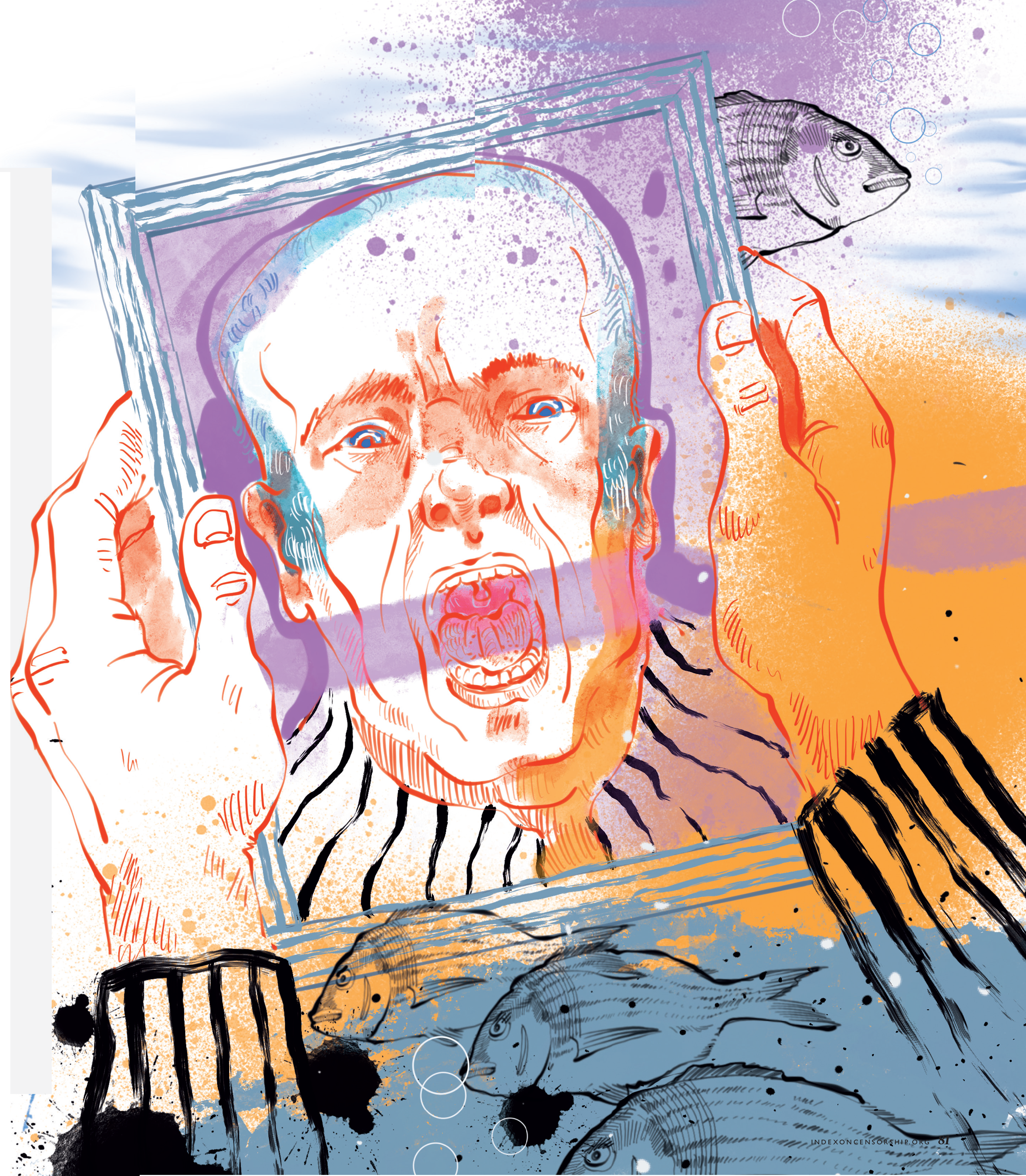
A mutual agreement about my early retirement was reached and signed by me and Nora Bluntik in private and in silence. A massive golden handshake sealed my lips. My mouth was jammed with money. In protest, I’ve sealed my ears. Back home, I’ve switched off my radio, not to switch it on ever again. Why should I listen to the optimistic drivel of semi-educated radio mercenaries polluting the airwaves with their badly-digested ideas and demonstrative populism, cultural mumbo-jumbo, verbal sambas and ideological cha-cha-cha. I was glad my voice was no longer mixed in with these sticky audible substances.
So I thought. Fairly soon after my retirement, however, I was baffled when my former loyal admirers started pestering me with telephone and postal messages, expressing their alarm at my recent broadcasts. They informed me that my voice was the same and as charming as ever, the very one they so much admired, but the content of my broadcasts was totally unbecoming for my honourable reputation. Nobody would ever have imagined, they said, that I, an ironical liberal freethinker, with my encyclopaedic knowledge of world affairs, would bend the ears of my listeners with populist drivel about motherland, native soil, blood bond and God. How and when, my bewildered admirers enquired, did I make a complete u-turn in my political orientation? Had I sold my soul and my voice to the new oligarchic elite and the Moscow ruling mafia?
I was shocked. It was absurd. The Corporation was no longer my employer. I was not part of its output. I couldn’t broadcast any reactionary trash over its radio waves, since my voice had been cut out and my recording tapes removed into their dustbins of history. My voice could no longer be heard on the radio because I lost it – the voice.
I lost my voice a couple of months before my forced retirement. I mean, I’d lost it quite literally. That’s the reason why I was silent when I had signed the retirement agreement. Even if I wanted to contradict the nonsense that Nora Bluntik had been stuffing into my ears, nobody would have heard me. I looked like a fish, floating in the dark water of an aquarium, forever opening its mouth but emitting no sound. Yes, the trouble with my throat had been aggravating speedily for some time before my confrontation with Nora Bluntik. The loss of voice was a good enough excuse for her to get rid of the veteran broadcaster.
I remember the first symptoms of it. I didn’t sneeze or cough. I had no flu or lung disease. One Monday I felt some tightness in my throat and my voice became hoarse and croaky. By Thursday, the day of my weekly broadcasts, the quality of my voice had deteriorated so drastically that the studio manager’s assistant ran to the canteen for a cup of hot milk and honey to repair my broken vocal chords. Hot milk didn’t help. Neither did such home recipes as hot toddies, breathing gymnastics over the evaporation of the boiling potatoes, or the use of earplugs during the night’s sleep. For a while my listeners might have thought I had been replaced by Tom Waits speaking Russian. Gradually, my mouth started to issue into the microphone sounds reminiscent of a scratched vinyl record, or more like an out of tune radio receiver emitting crackling and hissing instead of words. In Moscow, I was informed, my Russian listeners, who live permanently in a paranoid atmosphere of political conspiracies, had decided that the Russian government might have considered the reintroduction of jamming. I had no choice but take some days off and seek medical help.
I was referred by my GP to the local hospital’s Ear, Nose & Throat department, where a specialist with a huge periscope looked into the depths of my throat by introducing, via my nostril, a thin tube with a light bulb at the end. By such invasive means, he was able to establish that there was no alien creature dwelling down there. The doctor then showed me the colour print of the insides of my throat. I must confess, what I saw resembled vaginal folds in a state of erotic arousal. No wonder the psychiatrist, attached to my criminal case, recently tried to investigate my familiarity with oral sex in my adolescence years, as well as other aspects of my uncertain sexual orientation. The word ‘psychosomatic’ was mentioned.
The doctor gave me some lozenges to suck and a set of seven straws for breathing exercises. She advised me to blow through one straw every day as if it was a trumpet, simultaneously contracting my belly muscles. I grabbed these straws as a drowning man might, but my voice didn’t come back. Was it snatched by some bacilli? These mysterious ailments, if they don’t go away on their own volition, stay forever, regardless of how you treat them—just like drunken Russian guests. Every morning, I looked in the mirror to see the familiar features of my ageing face but when I opened my mouth, I couldn’t recognize my voice: instead, a monstrous stranger hissed maliciously back at me. I attempted to explain away my handicap to my acquaintances by telling a Baron Munchausen’s story about my trip to Russia as a broadcaster, where my voice got frozen and hung, as it were, in the air so I couldn’t extract it and put it back into my mouth, and so returned to London voiceless. I was a joke, of course, because I had not been to Russia since the day of my emigration to the West nearly half a century ago.
Not many people, though, were willing to listen to my predicament, since I could now express myself only by erratic and barely distinguishable syllables. The truth is that like the man without a shadow, the one without voice is shunned and ignored by fellow humans. The man without a shadow seeks places where fog or dimness blurs the border between light and darkness so his lack of shadow is not immediately noticeable. Similarly, I began to frequent noisy pubs where nobody could hear anyone because of the deafening music, and everyone communicated through gestures only. That suited me well. I began drinking heavily, but the clarity of my mind had not been impaired.
***
THE INVESTIGATOR RETURNS again and again to the same point of inquiry: why was it that during the encounter with my victim did I happen to have a razor in my pocket? My interrogator pressed this point in order to prove that the murder had been premeditated. I kept on explaining again and again to my investigator, who is a computerised person of the digital age, that as a broadcaster I used to work not with digital files but with tapes and material objects. I belonged to that generation of broadcasters who edited tapes mechanically, cutting out unwanted sections with an editing razor and splicing ends together with transparent scotch. Once upon a time, these editing razors were kept in open boxes in every office and they were available to everyone. Each razor was encased in a kind of cardboard wrapping and easily snapped open. Editors like me had quite a few of them kept casually in our pockets, ready to use when needed. I used such a razor in an attempt to recreate my voice artificially.
Having gone temporarily silent but not yet forced into retirement by the Corporation, I decided to listen to my old archive recordings when my voice had been good and fair. I was enjoying the nostalgic sound of my old self, my velvety baritone, and it felt like being simultaneously my own Echo, and Narcissus too, hearing in these tapes an audible reflection of my personality. I should consider, I thought, cutting up my old recordings into separate words and readymade miniature blocks, from which a new broadcast can be pasted together each time I needed it. Like Dr Frankenstein who created his Monster by stitching together bits and pieces of dead flesh, I would create an ideal version of my speech by sticking together bits of live recording. After all, the spoken life of an individual consists of a set of cliches, so that from these prefabricated bits one could construct any sentence fancied, with proper pauses in between. In the audio archives of the Corporation there is even a section labelled ‘Pauses’. These ‘pauses’ are used to recreate certain atmospheres of a place, or to link different bits of a tape as if they were recorded in the same place.
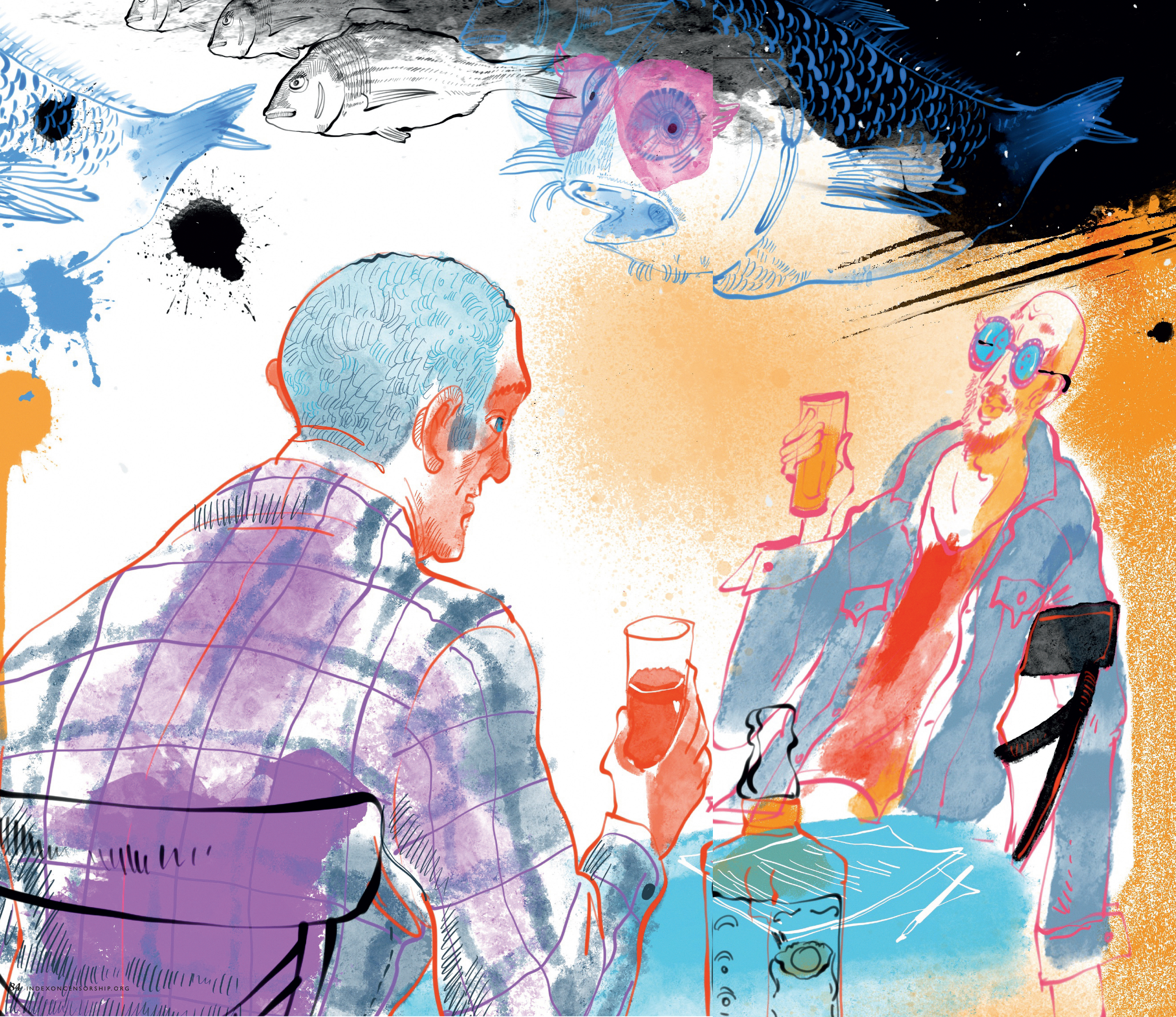
All these fanciful plans for restoring my vocal self were totally futile: my broadcasting days had been numbered. My voiceless self became a metaphorical archival pause of that kind.
It was one of those evenings when, still silent and already unemployed, I sat alone in my apartment and watched the soundless sunset over the noisy metropolis from my window. The landline telephone rang; I picked up the receiver and heard the sound of my own voice. It was so bizarre that at first I thought I was hearing my pre-recorded answering phone message. The voice on the line suggested that we should, if I didn’t mind, meet up at the Corporation’s bar. Would I be free this evening? Stunned and intrigued, I hissed something affirmative. The voice replied how glad he was to hear it. He would be eagerly anticipating me and waiting at table no. 101, the one near the fish tank.
The moment I appeared at the entrance to the bar, a young man jumped up from his seat and ran towards the door to greet me with excessive enthusiasm. Smiling almost obsequiously, he led me to my seat next to the fish tank. He ordered a large and expensive whisky: the Russians are proud to know the best labels of malt. I ordered my usual, a Bloody Mary, well aware the effect the spicy mixture would have on my irritated throat. Everything about his appearance was alien to me. His semi-shaved, piggish face had smatterings of trendy stubble. He was dressed as they all do these days: like an adolescent boy who had overgrown his old school uniform. Tight jacket, skinny jeans and pink sneakers instead of proper shoes. As it usually happens with those dedicated followers of fashion from Russia, their immaculate image was ruined by some erroneous detail. In this case it was his unbelievably preposterous glasses. Armani spectacles with a garish frame, studded with fake diamonds and embellished at the corners with golden angelic wings made of plastic. He exuded a rehearsed ease in his manners, but it was immediately clear that once he had your attention, it wouldn’t be easy to break free. The moment you saw him, generic as his face was, it was impossible to wipe his intrusive and unpleasant features from your memory, whatever feeling one had hearing his voice. And his voice, as I said, was absolutely identical to mine. It was a horrifying revelation that my voice could be identified as that of the person sitting in front of me now.
Having scrutinised his face at leisure, I realised that I had seen the man before. I didn’t remember the exact circumstances, but it must have been somewhere in the corridors of the Corporation. Since the collapse of Communism, so-called “visitors from Moscow” had been meandering around our offices unhindered, observing our work, watching me at my desk and in front of the microphone through the glass partition of the studio manager’s cubicle, rather like I was an exotic fish. I refused to be photographed. In my era of broadcasting, there were no websites packed with publicity photos of broadcasters. I used to be the invisible man with a magic voice reaching Russia from behind the Iron Curtain.
As if eavesdropping on these very thoughts, my host told me, with sycophantic reverence, that many years ago at the early stages of his professional life, my anonymity had inspired him and his mates to try imagine what I looked like. Avid listeners of my broadcasts, they debated whether I resembled a Victorian scientist dressed in tweeds, or perhaps a Wildean bohemian with a green carnation in his lapel. Others of his compatriots pictured me as Sherlock Holmes with his familiar pipe or a retired general with a waxed handlebar moustache. My interlocutor, who introduced himself as Victor Chertkoff, was now observing intensely every aspect of my outward appearance as if I was a museum exhibit.
In reality, I did not in the least resemble any of the English gentlemen they pictured. As the years progressed, my paunch had grown bigger and my baldness more and more prominent, creating a steep and shining forehead similar to that of Sir Obadiah Gershwin, the Corporation’s founding father. In the later part of my life I had become fond of light grey suits and brogues that Sir Obadiah used to wear. Gradually, I would, like him, stick to the habit of donning a bow tie. I knew that my colleagues sniggered at my old-fashioned appearance, calling me Sir Obadiah’s doppelganger behind my back. They spread malicious gossip about me as a usurper of his manner of speech. He would talk into the microphone as if he was delivering a stage soliloquy, carefully articulating every word in rhythmic cadences. Sir Obadiah understood the role that the diaphragm plays in the work of the broadcaster. I followed all these mannerisms impeccably. I have polished and improved his method.
And now, this puppet—this cheeky Russian upstart—was lecturing me on my vocal characteristics. He was, of course, delighted to see me in person, face-to-face, he said. The invisibility of the broadcaster emancipates the listener’s imagination, he said. Like in a science fiction novel, the disembodied voice acquires the shape and features which are dearest to the listener. It was exactly because nobody knew what I looked like that my appearance in people’s imagination could assume any shape, form and style, he said. And therefore, paradoxically, my real appearance was irrelevant. Anonymous in appearance, as all members of the Corporation, we were also strongly discouraged from making any personal statements live on air. My personality was incorporated. Does it really matter who the broadcaster is in real life? Does it really matter what he says? The only real aspect of the broadcaster is his voice. And since our voices are identical, people might even think—following Mr. Chertkoff’s logic—that I looked like him. (I visibly shuddered at this suggestion). And this is very important, he repeated, for our project. Which project? Our project? I was bewildered, but didn’t say a word, just opened my mouth in a silent question mark, waiting for him to elaborate.
My voice was, of course, legendary in Russia. He grew up listening to my voice emanating from radio receivers in every decent household in Moscow. Days and nights, nonstop, he kept on trying to hone his voice to be indistinguishable from mine, tracing every turn and twist of my vocal delivery. By that time he was a mature graduate of the school for professional radio journalists, with a considerable experience in the Soviet media, busy disseminating mass disinformation.
And then, a few months ago, something happened. He remembered the date: Labour Day, the first of May of two thousand and eleven. He came to the studio of the World Service of Radio Russia, opened the microphone and the producer immediately ordered the studio manager to stop the broadcasting. They thought that somehow the Corporation’s radio waves had infiltrated and overtaken the Russian broadcasting system and that it was I, not him, with my voice from London, speaking directly to the Russian listeners!
Shocked myself, but silent, I registered in my mind the date of his transformation (or epiphany). It was the very date when Nora Bluntik managed to remove me from the broadcasting schedule, using the chronic loss of my voice as a pretext. It gradually had been dawning on me as to where my voice might have gone: into Mr. Chertkoff’s voice box. One shouldn’t be surprised too much at the absolute similarity of our voices, my vocal doppelganger said, because our voices are no longer unique and irreplaceable. It was useless for me to argue with him, telling him that for me the voice was a physical extension of my personality, like my hand, or my eye or my ear; it is inseparable from me.
No, one should not be too sentimental about it, he retorted. Your voice ceases to be part of you the moment it leaves your lips. Via microphone, it travels by the cable to the transmitter that spreads it all over the world to be recorded, copied and disseminated in audio files and many other formats. It no longer belongs to you individually, it could be multiplied and broadcast by the push of a button. Different radio personalities can use that voice as their own. There was something Gothic in what he was telling me. Your voice is a shadow of your soul, and its audio copy—like an echo—is a shadow of your voice. The Corporation trades in the shadows of its broadcasters. One such shadow was sitting in front of me, pontificating about something sinister he kept on calling our project.
We both, as he put it, belonged to the school of the speech delivery as developed by the inimitable Sir Obadiah Gershwin. He meant Sir Obadiah’s stage-like manner of talking into the microphone, his Oxbridge accent. Politically neutral by nature, this manner of speech was a lingua franca that liberated the broadcaster from his complicated past, his complex origin and political affiliations. The manifested neutrality of that mode of speech was, according Mr. Chertkoff, the essence of universalism, humanism and tolerance— cornerstones of the free world. That’s why even ordinary Russian housewives would stop in the middle of cooking their borscht in order to listen to your broadcasts, he said.
I kept on listening to his overblown praise of my radio work, trying to uncover a hidden motive behind his obsequious paeans to my broadcasting gifts. Too much attention is paid to the significance of words, Mr. Chertkoff said, to the meaning of what one says. Is the content of one’s speech really important? One we say one thing, but tomorrow we say the opposite, with the same intensity and no lesser conviction. We are familiar with these perennial inconsistencies without consciously realising them. It’s like with medical opinions: one day they declare the thing lethal, the next day they say it’s essential for longevity. And we obediently follow such idiotic and self-contradictory advice, so long as we believe the person who advises us. A private doctor in the nineteenth century was paid for his reassuring bedside manner, all the while proscribing his patient nothing stronger than an innocent placebo. Our faith in a doctor depends not on what he says, but how he says it: the tone of his voice and the voice itself. By having a voice and intonation identical to yours, he said, we would simply refill its message with new content without diminishing its effect. The people of Russia would swallow the whole— hook, line and sinker—with the same enthusiasm they’d been nourishing every sound bite of Sir Obadiah in the past!
Shush! Shush! Reacting to the nervous twitching of my mouth in my efforts to raise voiceless objections, he stretched his hand in front of my face like a policeman barring entrance. Whatever you want to say, I will say it for you. I am your voice! He said this brazenly, knowing that I was unable to utter a squeak. I was boiling up with inner rage, but only capable of moving my mouth silently, in a fish-like manner, with my lips distorted, caught between an icy smile and a grimace of revulsion. Then he said something that made me shudder. They’ve been thinking for some time now of getting rid of the likes of you, he said.
I leaned back in my chair, paralysed. He started to elaborate, pacing his sentences rhythmically and in a well-balanced way, but at the same time with authority and resolution. According to Chertkoff, my generation of broadcasters with our subtle irony, diffident scepticism, and our ardent defence of civil liberties, had created a climate in which ideologically provocative ideas were encouraged. These irresponsible broadcasts might bend the fragile moral staples that underpin the spiritual life of newly born, post-Soviet Russia. According to Mr. Cherkoff, my well-balanced voice sounded, to Russian listeners, like the Trumpets of Jericho knocking the country off her feet in a historical moment when she’d just risen up from her knees. Chertkoff declared that his mission was to save me, personally, and the process of liberalisation of Russia, in general.
It turns out that my informers were right when they had warned me that somebody in Moscow was using my voice to broadcast ideas totally alien to my worldview. Chertkoff was clearly not alien to those ideas. Yes, he said, but there is nothing wrong with an idea per se, even if it sounds like a fascist idea. It is not the idea, but its implementation that matters. And such an implementation depends on who is interpreting that idea. But you wouldn’t compare Hitler with Shakespeare, he said, although the latter was also talking about the native soil and blood bonds, as did Heidegger or Emil Chioran. One would not dare to repeat in a polite society certain ideas that the Russian genius Dostoevsky had propagated during certain periods of his miserable life. One cannot demand from all of us to be like Emmanuel Levinas or Simone Weil! It would be better if he, an enlightened broadcaster, rather than some freak with his crypto-Nazi views from Mars, aired the ideas of national roots, blood bonds and religious orthodoxy. Because we cannot pretend any longer that these, “so-called fascist ideas are just temporary delusions instigated by some lunatics.” Ordinary people, hoi-polloi, the populace, are the real rulers of the new social media, expressing themselves by ‘liking’ whatever they fancy on Facebook, fed up with the liberal establishment and its strictures of political correctness, with victims of colonialism and sexual minorities. They are fed up with our irony, moral ambivalence and theological paradoxes. Ordinary people don’t want to be affiliated with a sceptical minority of dissident liberals. They want to belong to something bigger than themselves, to preach ideals that are rooted in something firm and permanent, in a collective power and basic moral principles propped by the massive popular support and cheered by ever enthusiastic Facebookers. This transformation of public opinion is already irreversible and those who resist this historical momentum will be crushed under its wheels—with no one left to care about your unique personality, your personal uniqueness.
The individual is doomed to perish because he is the mortal one, Chertkoff continued. It is the collective that survives. And he finally put forward a proposal for which he evidently had planned in advance for me to hear. He suggested that we should initiate the process of ‘collectivisation’ of my legacy as a legendary broadcaster. He wanted me to grant him the full rights for the entire output of my radio work collected in the Corporation’s archives. He would start rebroadcasting them with my lost voice (that is, with his own voice, identical to mine), but with some imperceptible modifications, changing the content ever so slightly here and there, giving it a different spin without altering the manner of delivery. He knows how to frame my ideas in such a way that not a single proto-Fascist activist in Russia would ever think of harming me as a dangerous libertine and degenerate. But the enlightening influence of my voice on the masses would be as strong as ever, because, he said, it is the intonation, those well-balanced cadences of my voice, that convey the real message. The inimitable, “on one hand… on the other hand,” will resound forever, filling in between whatever is politically correct and demanded in the hour of need by the collective consciousness. While talking to me, Mr. Chertkoff took a sip of his malt whisky from a crystal glass the same way I used to sip water from time to time during my broadcasts.
Don’t listen to him, don’t listen to him, my inner voice kept on telling me. But I couldn’t help but listen to him as if hypnotised. I heard my voice, there was no mistake about it, but it was being taken from of me and put into somebody else’s mouth. I wanted to prize his jaws open and to stare into his throat, to see the vaginal folds there that gave birth to these invasive sounds and intrusive thoughts, to analyse the mechanism of his larynx, his vocal chords, to find out how the person, whose features were so repulsive to me, was capable of issuing a voice so identical to mine. My mind was enraged by what it was saying, but my soul, inseparable from my voice, was succumbing to its tidal comings.
At this moment, he turned his attention away from me removing from his inside pocket some papers and a pen. The documents bore the Corporation’s letterhead and looked like a copy of a formal contract. Catching now his face side on, I suddenly remembered where I had first encountered him. It was in the days before my departure from the Corporation, in the gents on the fifth floor, next to the recording studio. Due to the aging male’s problems with the prostate and bladder, I had been taking a little time to detach myself from my place in front of the pisser’s bowl, when another man moved in to relieve himself next to me. I tried, as we all do, not to glance aside, but my eye couldn’t avoid the sight of his mighty tool. He quickly finished pissing with a jolly bursting noise, but instead of leaving he started masturbating, calmly and energetically. In no time I was made a witness to a powerful erection. I was aware that he knew, surely, that I was watching him. I could swear that under the cover of his faddish facial growth, an insolent and triumphant smile of a young and strong barbarian made its fleeting appearance.
The same imperceptible smile was again roaming his thin lips as we sat together now in the bar. He took out his pen and laid out the contractual papers in front of me while prattling on non-stop, trying to convince me of the brilliance of his strategy. But I wasn’t listening any longer. I had stopped listening for some time. Instead, I was staring at the fish tank next to our table. With his voice still droning on, I longed for silence and the fish were the only creatures in the entire building that were capable of being soundless. The ichthyologists would say that fish also talk: they communicate with one another on ultrasonic wavelengths. Or maybe on some other wavelength, I’m not too sure. The point is that as far as the human ear is concerned, fish are mute because we cannot hear them. This, to my mind, is their great gift to the world. Ah, silence is golden! I remained silent.
I remember how these fish looked in the golden old days, when the bar still resembled an English gentleman’s club complete with worn leather armchairs, oak panelling, high ceilings and a whiff of cigar smoke clinging to the carpet. Back then, the aquarium stood proudly in the middle of the room with its tropical denizens, as exotic and delicate as rare butterflies, like emblems of the British Empire’s rich colonial past. Only the rustle of newspapers and the clinking of ice in glasses disturbed their magical silence. But with the passing of time, the bar, too, succumbed to the onslaught of television monitors and their incessant din. Then the deafening pop-music was added to the noisy banter of drunken plebs. Remarkably, as the interior design of the bar grew more democratic and optimistic, the appearance and demeanour of the fish became ever dourer. Like the humans around them, they seemed to become more fretful, aggressive and agitated in response to the ambient cacophony.
But the real turning point came when half of the bar was separated off with a partition, behind which a gym was installed. The aquarium was also divided, with one of its glass sides looking out onto the noisy new generation of radio broadcasters at the bar and the other onto the broadcasters building up their muscles in the gym (perhaps in order to be able to hold heavy microphones more steadily, or to keep their mouths firmly shut). This event signalled the beginning of an irreversible metamorphosis in the aquarium. Suddenly the fish became markedly fewer in quantity, while appearing to grow individually in size. In other words, half of the fish tank was learning to socialise, while the other half was learning to work out. Which side would prevail?
Now I saw it all clearly. A handful of gigantic fish were circling the aquarium in moody silence. Grey scales glinting like gunmetal, they passed one another with sidelong glances of hatred, slowly opening their mouths as if to emit a string of foul expletives. Their eyes gleamed with the rapacious greed of pikes. And I understood that, under the influence of the surrounding environment, the fish in the aquarium had been devouring one another, evolving into a new cannibalistic breed. I could imagine how the last exotic colourful and fragile creature cried for help. Only humans might have helped it, but humans hear neither a fish’s cries nor their laughter.
Having thus contemplated this silent metamorphosis, I’ve arrived to a striking conclusion. It dawned on me why all these newly-recruited professional employees of the Corporation—proteges of Nora Bluntik—had arrived under the disguise of the open international borders of the digital universe, of cultural cooperation, and all that poppycock. My free world, made up of different kinds of exotic and exuberantly colourful fish, was being invaded by the uniformly grey pikes of foreign propaganda.
Bastards.
Silently, I beckoned Mr. Chertkoff with my finger, inviting him to have a closer look at the denizens of the aquarium’s muddy waters. I opened the top lid that is used for feeding the fish, prompting him with a gentle nudge to lean over the fish tank to observe the grey, scaly monsters moving around in a kingly fashion under the scum. He couldn’t comprehend what I wanted of him, but for politeness’ sake leaned with me over the aquarium edge, expressing a modicum of interest in its fishy content. Simultaneously, my right hand fumbled the contents of my side pocket; I traced and grasped firmly between my index finger and thumb a miniature razor blade that radiomen like me used for cutting and splicing audiotapes.
Without much ado—for he clearly didn’t expect any violent gesture on my part—I grasped the back of his head with my left hand, bending his head slightly and, at the same time, deftly, with a single swift swipe of my right hand, slashed his throat with the razor blade.
He didn’t have a chance to emit even the expected groan when I pushed his head face down into the fish tank, a solid construction on the cement base that didn’t even shake. His hands embraced it as if he was about to dive in for a swim. Underwater, his face bore an expression of utter puzzlement. His half-open mouth emitted air bubbles that were greeted with the bubbles issued by the keen grey fishes as they rushed forwards hopeful of a new prey but immediately recoiled sensing an alien intrusion. I relished this encounter for a short while: my enemy, now dead, meeting the piscarius creatures of the aquarium that looked like his metaphoric doubles. Clouds of blood unravelling under the water made the fish retreat into the farthest corner of the aquarium. Like them, the drinkers around us stood up and silently moved away from me. They’d been staring at me in panic, as I stood in the middle of the bar with the miniature razor in my fingers, my sleeves sprinkled with the blood from my doppelganger’s larynx, his vocal chords. At the far corner Nora Bluntik, my former Department Head, stood looking like a copy of Edvard Munk’s picture; the black hole of her mouth, wide open in the middle of her deadly white face, emitted no sound. Instead, the ghastly whining voice of some pop group’s star kept on repeating a chorus line of some samba or cha-cha-cha, as if asking me through the loudspeakers, How Can I Sleep With Your Voice in My Head? Then, suddenly, the music was switched off.
In the total silence that followed, I crossed the expanse of the synthetic red carpet and approached the bar. I asked the barman to call the police. “I want to report the murder that I’ve just committed,” I said. My voice—that legendary velvety baritone—restored miraculously to its full glory, sounded, as in the golden years of the Cold War, rich in undertones, with impeccable rhythmic cadences and clear articulation of every syllable, as required in a good stage delivery, when your well-trained diaphragm makes your voice box free of any constraints. X
Footnotes
Martin Bright is editor-at-large at Index on Censorship
Zinovy Zinik is a Moscow-born author who has been living in London since 1976. He has published 14 books of prose including novels, short story collections and essays. His short stories and his novel Russian Service were adapted for Radio 3 and his novel The Mushroom Picker was made into a film by the BBC (1993). Zinik’s shorter prose appear in The New Yorker, The Spectator, The Guardian amongst others