




Abstract

Acclaimed writer
UKRAINE’S MOST CELEBRATED writer Andrey Kurkov is known for his sense of humour, but since Russia’s invasion of Ukraine earlier this year he said he’s almost lost it. It’s been rekindled courtesy of new jokes that have emerged in the country, ones that poke fun at Russians and display Ukrainian resilience.
“It’s very good, I’m very happy about this development,” Kurkov tells me over coffee. Obviously I’m keen to hear one and he’s more than happy to oblige.
“A Ukrainian is asked ‘Are you ready for the nuclear end of the world?’ and the Ukrainian responds ‘Yes, I am ready and I have plans for six months afterwards’.” He lets out a wry chuckle.
We’re sitting in a crowded cafe in central London. It’s a privilege to be with him, not just because he’s the titan of Ukrainian literature (and he really is – his work is the most translated into English of any living Ukrainian writer, alongside some 30 other languages). Also because of how in demand he is. Since 24 February, Kurkov has become the go-to for editors seeking analysis on the country. For a man who has stayed put in Ukraine even though he was displaced from his home in Kyiv earlier in the war, he writes and speaks with impressive regularity. All the while his Twitter feed provides one of the most insightful records of the war, a sombre chronicle of life under Russian bombardment with a light-hearted garnish (on 8 November, for example, he tweeted about the opening of a new McDonalds in a village outside of Kyiv that is the first to come with its own bomb shelter. “Stay safe and order cheese-burger!” he wrote).
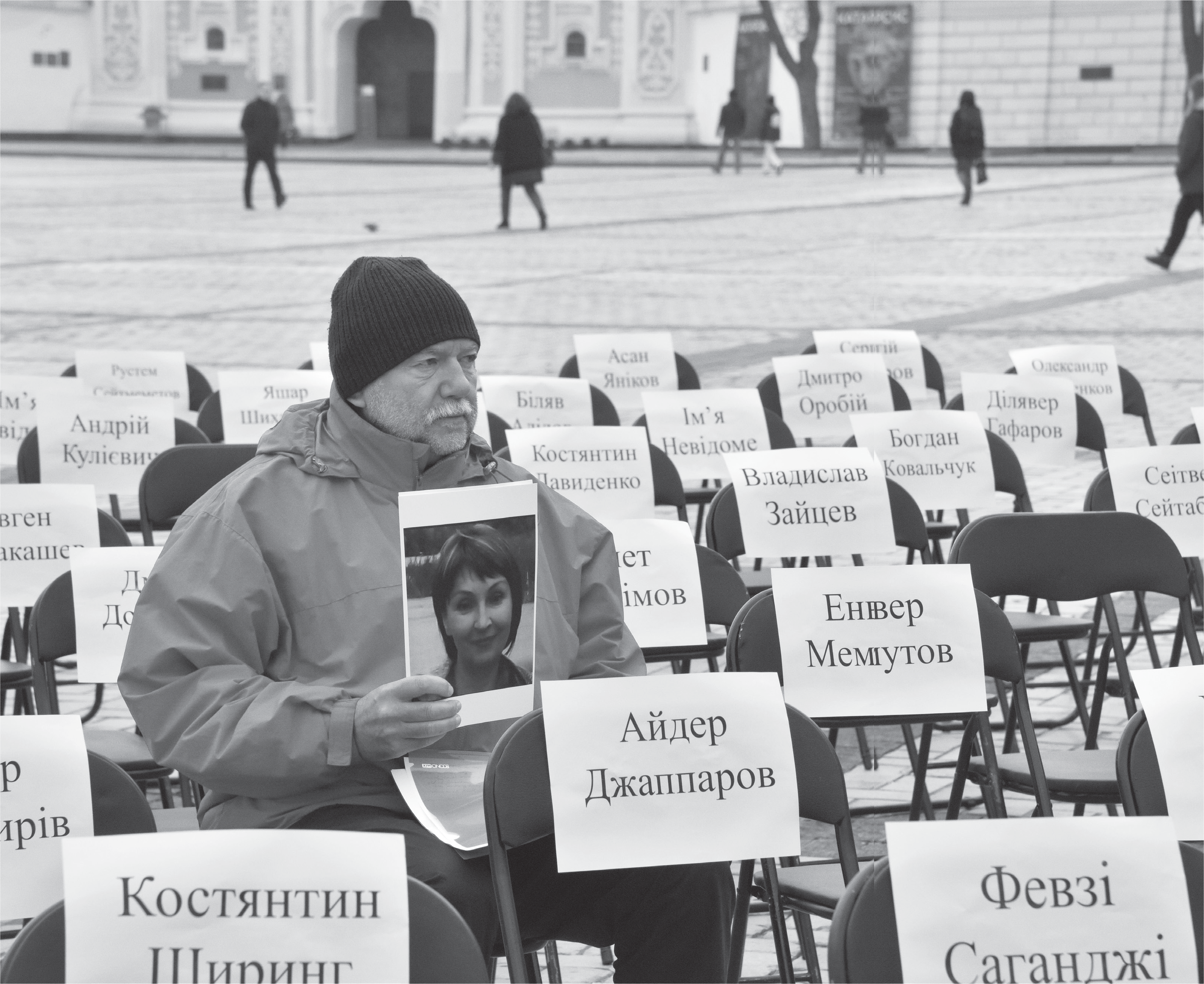
Andrey Kurkov in Sofiiska Square, Kyiv on 15 November 2021 during the Vacant Chairs rally held in support of Ukrainian political prisoners illegally imprisoned in Russia and its occupied regions
When we meet, at 10am, he’s already been on Sky News and will soon head off on a book-signing tour at a dozen bookshops across London. None of these are even the day’s main event. He’s in London to attend the Index on Censorship Freedom of Expression Awards in the evening, at which he is very much the man of the hour – the winner of the Trustees Award for his contributions to free expression. It’s a richly deserved award and one that feels very personal to Index; we were the first to publish Kurkov in translation, back in the early 1990s, a fact he will not forget himself.
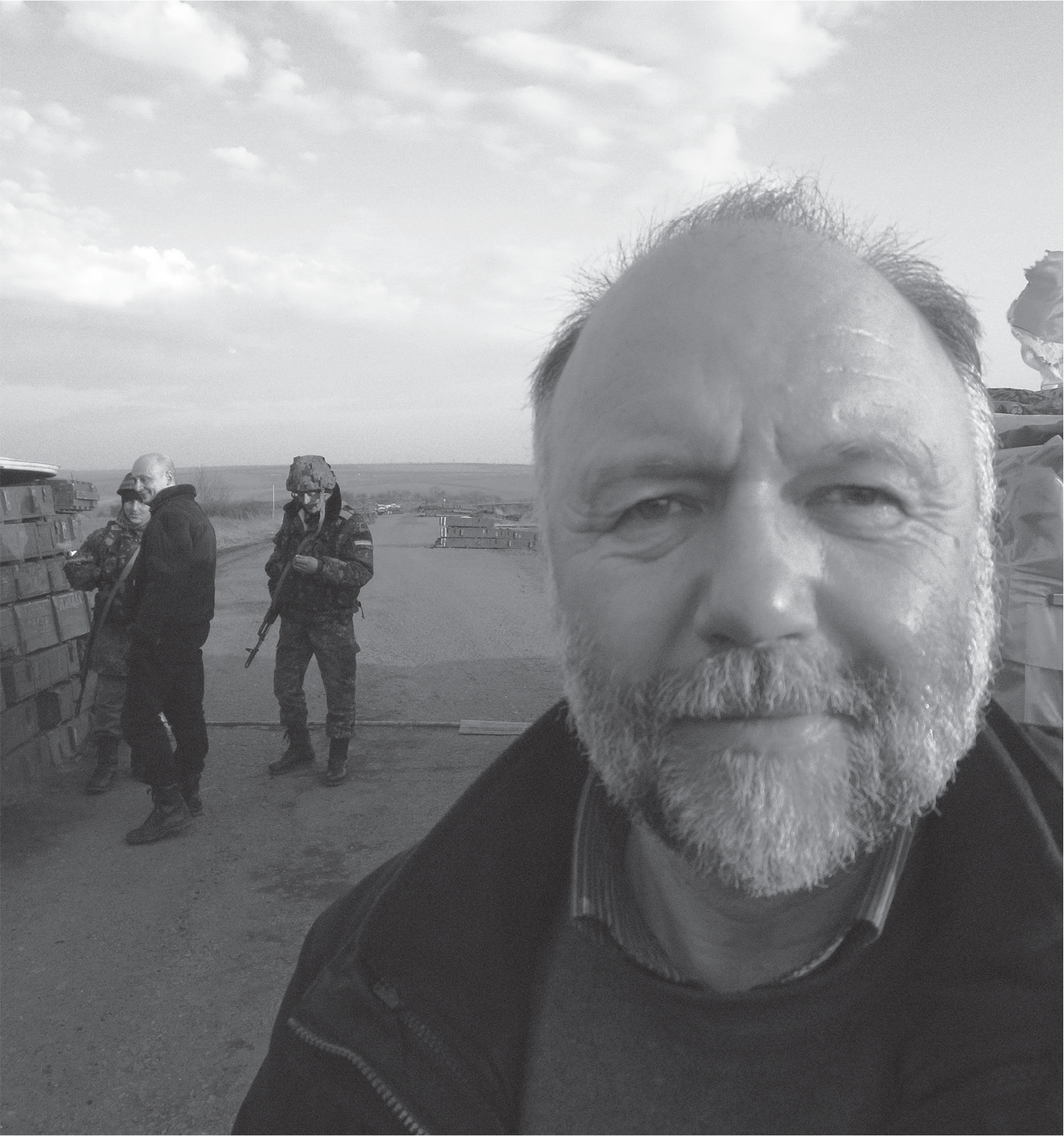
Kurkov at a checkpoint as he went west from his home in Kyiv
CREDIT: Andrey Kurkov
Kurkov’s experiences of and contributions to free expression are vast. Born in 1961 in the Leningrad region before moving to live with his grandmother in Kyiv (she was a doctor and lived in the grounds of a children’s tuberculosis sanitorium), Kurkov remembers lots of children’s books about Lenin, “ideologically correct ones”, and chose to read medical books on surgery instead because they were “better quality; the illustrated ones were much more bright and horrible.”
While Kurkov’s earliest experiences of writing date to childhood (aged seven he penned a poem imagining the life of his deceased hamster), his first formal foray into writing was when he was a prison guard in Odessa in the 1980s. There he wrote children’s stories by way of “mental escape from prison”.
His sharp, acerbic prose didn’t fit the Soviet agenda and Kurkov’s own story quickly morphed into the classic author tale of rejection after rejection, with a Communist twist.
“I got rejection letters from everyone. And then I gave The Favourite Son of Cosmopolitan to the head editor of a publishing house and two weeks later he said that it’s a brilliant novel but it will be never published because it’s not Soviet literature.”
He did though find “illegal success” through the samizdat network. His texts were circulated widely – as far as Vladivostok on Russia’s far eastern coast – and he’d tour the Soviet Union, doing readings in underground venues. In one instance he read a book of his in a single four-hour sitting. None of this was ideal of course, but to my sheltered ears it has an air of romance.
“It was romantic,” he said in agreement. “It was a very exciting time. I was invited because of my manuscripts to come to Riga in the Baltic States and I was staying in the houses of people I’d never met,” he added.
Was it dangerous, I ask? Kurkov shakes his head.
“My brother was a dissident. He was arrested and given a suspended sentence and given the diagnosis of schizophrenia as a punishment. His friends were arrested and some of them died in detention, but among my friends we never had problems. We knew we were followed and some were reported but nothing happened. Because it was fiction, satirical stuff.”
The idea that fiction offered writers a level of protection comes up again when Kurkov tells me about the years immediately following the Soviet Union collapse, when Ukraine became “a criminal state”. Kurkov found himself flogging his books on a busy street in Kyiv. There he was approached by a man from a protection racket who offered to protect him for free.
“The mafia had respect always for artists and writers,” he said.
Of course fiction could only offer a level of protection and Kurkov was not immune to the struggles Ukraine was facing. His first $100 he made from publishing a book was used to purchase a bullet-proof door for his home, for example (Soviet doors were no use, made “almost of paper”). Kurkov also had to deal with the very tangible problems of there being no publishing houses in Ukraine and, worse still, no paper. This paved the way for one of his wilder tales, in which he borrowed $16,000 and bought six tonnes of paper from Kazakhstan, which he used to print 75,000 copies of two of his books (Bickford’s Fuse, and the children’s book Adventures of baby-vacuum-cleaner Gosha). A gruelling process, the printers were apparently drunk all summer. He then stored the books in his apartment in tunnels that looped from sofa to toilet to kitchen, all the while heading to busy streets in Kyiv to sell them.
“I made myself cardboard with an inscription ‘I am the author’,” he said. I wish he had a photo (he sadly doesn’t).
It took him a year to flog the books and from this he earnt a profit of $700, which he duly spent on his first computer.
Kurkov writes mostly in Russian and is fluent in many languages including, somewhat surprisingly, Japanese. He could have gone down many different, less difficult paths. But he tells me he knew he always wanted to be a fiction writer. His life did become easier when his novel, Death and the Penguin, was published in 1996. It went on to become a bestseller and was translated into English in 2001. And while Ukraine’s history continued to take twists and turns, the drama provided a good stage for his work. His 2018 book Grey Bees, for example, imagines the conflict raging in his country through the adventures of a mild-mannered beekeeper.
But when Russia invaded Ukraine earlier this year it was one step too far for his creative spirit. Kurkov was in the process of writing a new novel, which was immediately aborted and hasn’t been picked up since. The escapist impulse that drove his first book is impossible to muster today, he tells me. So he concentrates on non-fiction instead.
“I write every day about what is happening in Ukraine. Every morning I get in touch with my friends in Ukraine in different places. I am in touch with people who are under occupation. I am following what is happening and I am writing about the issues which I consider the most important – not about battles because I am not an expert – but about the life of civilians. This is the only thing I can do professionally,” he said.
Kurkov does not appear unhappy to be a spokesperson for the nuances of his country. Indeed he almost looks offended when I ask him if it’s a heavy burden and directs the conversation towards how the war has changed the Ukraine language. Military jargon has infiltrated conversations about Russia, while a rise in hate speech has made vocabulary more charged.
“There is an attempt to force everyone to agree with the same formulas and same narratives in counter propaganda,” he said, listing calls to cancel Russian culture as one example.
“This is a very hot issue and it creates immediately very heated discussions. And the issue of not taking part in events with Russians, even if they’re against Putin, and we’re all against Putin.” He mentions a meeting with Mikhail Shishkin, the bestselling Russian novelist, and the hundreds of attacks that ensued. Kurkov was called a collaborator, a traitor and a Russian agent.
It seems farcical that such labels would be used against Kurkov. He’s president of PEN Ukraine and has spent his life promoting Ukraine literature and culture abroad. Fortunately the name slinging hasn’t stopped his commitment to Ukrainian culture. Writing in Index earlier this year, Kurkov outlined the various ways it had been attacked in the 20th century and how “today’s Ukrainian intellectuals face the same danger”. Russian bombs were raining down on museums; libraries were being destroyed and ransacked, shelves cleared of books written in Ukrainian; intellectuals were being arrested and killed. Months on from this article, and despite the turning tide on the battlefield, Kurkov says the situation has not improved. The work to protect Ukraine’s culture remains as urgent. Just days before we meet, Kurkov says they’ve received news that the body of Volodymyr Vakulenko, a children’s book author who was kidnapped back in March, had been located.
“We found mention of his name in the book of a local mortuary, which said that he was buried in grave number 319, so a couple of days ago this grave was opened,” he said. A body was found there, though it later turned out to not be his. The search continues.
Before he was kidnapped, Vakulenko had hidden a hand-written diary in his garden under an apple tree, which has been found. It will, pending permission from the author’s son, be published and Kurkov wants people to read it.
He also wants people to learn about Crimean Tartars, a Sunni Muslim indigenous ethnic group whose roots in the region go back to at least the 13th century. They’ve been a particular target of Russia since the annexation of Crimea in 2014 and yet their story has been forgotten. Kurkov is aware of around 15 Crimean Tartar journalists and activists who are in Russian prisons accused of things that they never did. One of them is minority rights defender and father of four Nariman Dzhelyal, who was sentenced to 17 years in jail this September. He has already been in jail for a year and without international pressure, he will likely be deported to a very remote prison, out of reach from anyone.
All of this is a heavy burden and yet the pretext of our meeting is celebratory – to honour him in person with his Index award. It feels too light on one level, an award during a war. But that doesn’t denigrate it.
‘It’s very important. This is probably the first appreciation I get for what I do,” Kurkov said. And with that he is gone, off to his book signings and the many other requests for his thoughts on the war.
Footnotes
Jemimah Steinfeld is editor-in-chief of Index on Censorship