Abstract
Nine years into his leadership the world has remained silent on Modi’s failed democracy. It’s time to turn up the temperature before it’s too late, writes
It was not until a tip-off came in November though that we took a much closer look. We were told about a longtime TV presenter who was becoming a lone critical voice. They feared for their job. Did we want to be put in touch? We said yes, only they were too scared to talk on the record. Then they lost their job and didn’t want to talk at all.
This whiff of a story was the spark that turned into a flame and from it our special report. We ascertained that on every key marker of a democracy Modi’s India fails. The press, once vibrant, is being strangled; the judiciary is no longer independent; laws have been amended to throw protesters in jail; opposition figures are harassed; minorities live in fear. Statues of Modi go up, ancient mosques come down. A hyper form of ethno-nationalism that we’d more associate with interwar Europe is the doctrine of the land. There is no room for tolerance.
This matters in general and it particularly matters in India, which is set to shortly overtake China as the world’s most populous nation and which will head to the polls next year. Why is the world largely silent? Sure, Modi’s name will appear on a list with the other so-called “strong men” of today, but the red carpet is rolled out. No one talks about sanctions. Salil Tripathi has a guess in his impassioned essay on India’s “flawed” democratic experiment, in which he discusses Modi’s long-term goal of a unitary state with a singular faith. A cast of other excellent journalists then take us through the challenges as they live them on the ground, from talking honestly about sex when assault is rife to New Delhi being the most surveilled city in the world.
Perhaps the BBC documentary on Modi – both its content and India’s censorial response to it – has been a wake-up call. We hope this report moves the dial even further.
Elsewhere in the magazine we publish an essay from Nariman Dzhelyal, who is the leader of the Crimean Tatars, written from his prison cell. Celebrated Ukrainian writer Andrey Kurkov introduces Dzhelyal and explains why he is such a formidable character. The academic and author Kerry Brown wades into the contentious issue of whether we should ban Confucius Institutes, while Jo-Ann Mort talks about the inventive tactics used by US organisations to fight abortion bans. Finally, Martin Bright reminds us of those Afghan journalists still living under Taliban rule. It’s easy for the world to move on to the next disaster, the next big story and that is why Index exists – to not forget.
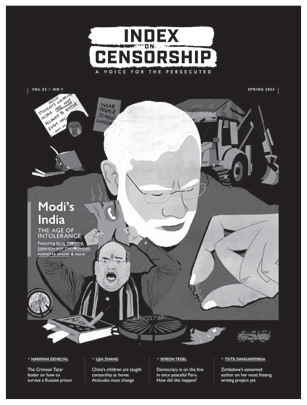
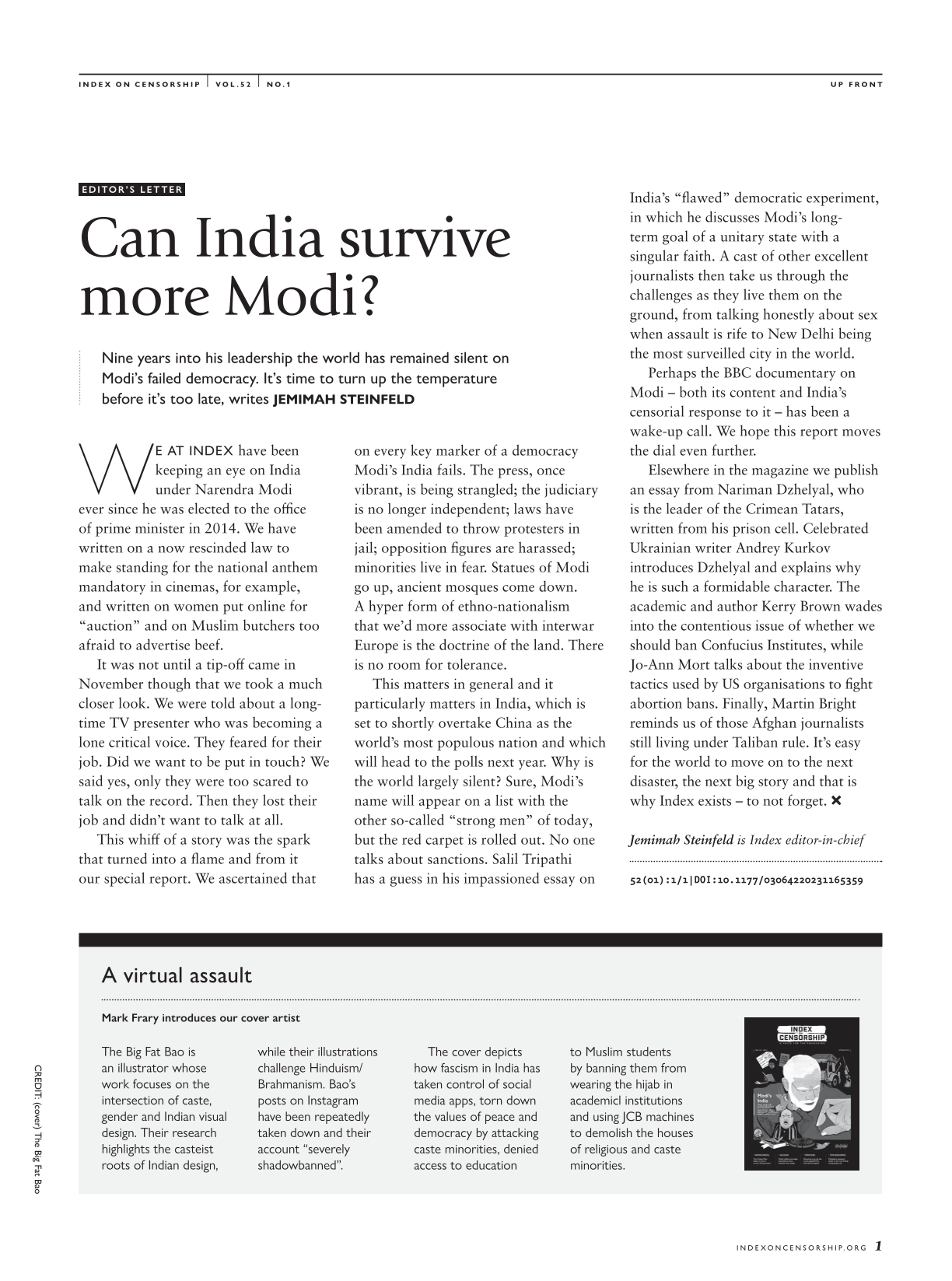
The Big Fat Bao is an illustrator whose work focuses on the intersection of caste, gender and Indian visual design. Their research highlights the casteist roots of Indian design, while their illustrations challenge Hinduism/ Brahmanism. Bao’s posts on Instagram have been repeatedly taken down and their account “severely shadowbanned”.
The cover depicts how fascism in India has taken control of social media apps, torn down the values of peace and democracy by attacking caste minorities, denied access to education to Muslim students by banning them from wearing the hijab in academicl institutions and using JCB machines to demolish the houses of religious and caste minorities.
CREDIT: (cover) The Big Fat Bao