




Abstract

Artists are under attack in the Egyptian capital, where the government has scrubbed all signs of the revolution from the streets.
Today, when you visit Tahrir, the once grassy circle at its centre has been replaced by a looming Pharaonic monument. There are words printed on it, but you cannot read them because a round-the-clock security force aggressively prevents you from approaching. This is, in a way, the perfect metaphor for the present situation in Egypt. A revolutionary history enshrouded. Words that cannot be read. The manifest expression of state control.
It is worth noting that “tahrir” is Arabic for “liberation”, which is ironically absent from the square.
“Did you notice how many cameras there are?” asked a prominent Egyptian artist I spoke to during a recent visit to Cairo who, for safety reasons, will be referred to as “Salma”. I had just mentioned an abundance of new planters and other obstacles that had been installed throughout the square – obvious attempts to make mass congregation impossible.
“Every building has two or three cameras,” she said. “They completely eradicated any trace of the revolution. They aggressively removed all graffiti. They removed all the police booths – the historic ones – because we used to spray-paint them. Those are gone.”
Graffiti, which was once a common expression of social change in Egypt, is conspicuously absent from the walls of downtown Cairo. Not only has the revolutionary street art been covered up but those who would wield paint to create it receive harsh punishments – as do many other politically vocal artists and figures in Egypt which, according to human rights groups, currently holds as many as 65,000 political prisoners in jail.
A graffitied wall blocks access to the Ministry of the Interior near Cairo’s Tahrir Square, during a time of mass protests in 2012
CREDIT: B.O’Kane /Alamy
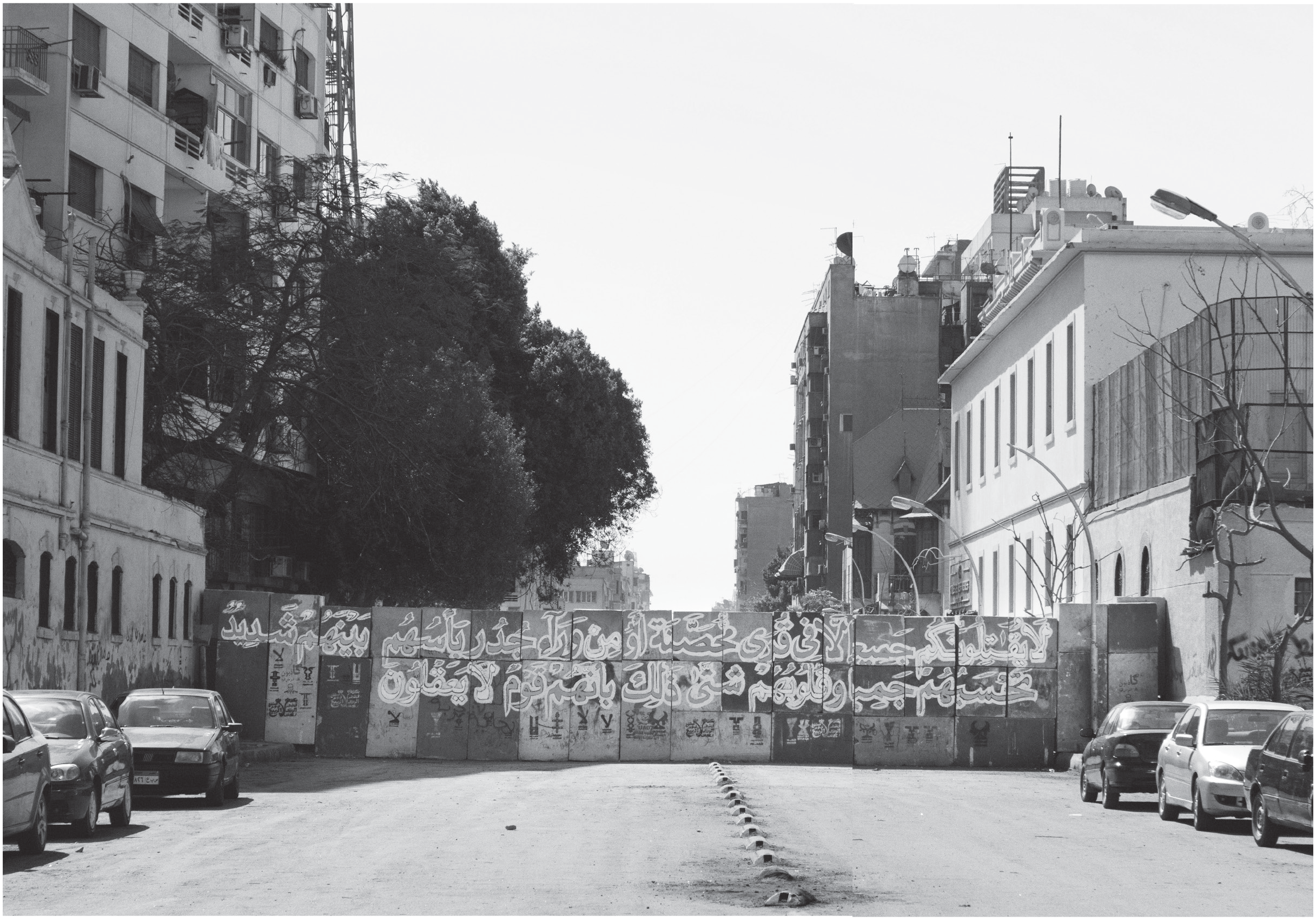
Sentences can be long and uncertain “depending on the medium and the kind of insult”, Salma explained. “If it’s political graffiti and it’s critical, it’s up to four years in jail and a fine. And the offences are very loose: insulting religion, breaking the law…I mean, breaking the law can be translated to any form they want. They shift it based on their mood.”
For an example of these “loose” punishments, take the story of poet Galal el-Behairy. Back during the first revolution of 2011, musician Ramy Essam penned a song called Irhal (“Leave”) that became regarded as the anthem of the protests. More than half a decade later, he collaborated with el-Behairy on a song criticising Sisi entitled Balaha, which they released via a music video that bore the names of its production team. The crackdown was swift. El-Behairy, who wrote the lyrics, was imprisoned for the “crimes” of blasphemy, insulting the military, contempt of religion, dissemination of false news and a range of other trumped-up charges. Essam was forced to flee into exile. And the video’s director, Shady Habash, was arrested and died in prison under dubious circumstances.
Avant Garde Lawyers, an organisation which provides legal aid to artists under attack around the world, came to el-Behairy’s defence and managed to argue what began as a potential life sentence down to three years. But at the conclusion of his sentence, when his family went to retrieve him from prison, they were told that he had disappeared. Eventually they learned that he had been moved to another prison, where he remains to this day, regardless of his now long-finished sentence.
El-Behairy had broken the number-one rule for artists under the regime which, according to Salma, is: “Don’t criticise the president. Say nothing about their philosophy and their outlook, which is ’building a better future for all of us’ – from their point of view.”
All of this is part of the government’s counter-revolutionary efforts.
“They’re spending a lot of money on that,” Salma said. “They are literally erasing all traces of the revolution. We have to keep the story because they are systematically erasing everything aggressively. It’s an agenda. Collective amnesia.”
Artists who attempt to tell the story or push back against the government agenda receive a harsh rebuke. Actors Amr Waked and Khaled Abol Naga were both banned from Egypt and now live in exile in the USA for criticising Sisi’s recent changes to the constitution, which will allow him to remain in office until 2034. And for political artists in the country, the prospect of prison poses a very real danger.
The Egyptian state press centre did not respond to questions about the imprisoned and exiled artists.
Before leaving the country, I attended the Art Cairo event, at which a number of artists spoke on the topic of artistic censorship – among them, Egyptian-Lebanese artist Lara Baladi.
According to Baladi, the struggle is “to navigate the censorship in a way that we are pushing the boundaries but we are not falling off the cliff”.
She added: “We have to go all the way and push all that we can, but also protect ourselves and make sure that we are still able to express ourselves. That’s a very fine line. It’s almost like walking on a thread between two mountains. It’s a constant challenge. Censorship and challenge are exactly why we are artists, in a way. It’s a very important aspect of being creative.”
Her advice to artists creating under oppression is to understand the environment and how to navigate it so they can do their work.
“If you confront something that is prohibited, you’re bound to end up in jail or be shut down, or even exiled,” she said. “It’s a matter of being subtle about what we do so that we can actually continue to express ourselves.
“It’s very difficult to be censored – it’s not constructive – because, ultimately, what this means is that nobody sees you. So it’s more important to try to say things without being provocative than to be provocative and end up in a war.”