




Abstract

Reflecting on the recent protests,
In the Islamic Republic of Iran, where Sharia laws demand that women be covered up with hijabs, these were potent acts – not just illegal but liable to expose the women to arrest and even death. Protests at the abusive treatment of women, minorities and students have become commonplace in recent years, but never before have women shed their headscarves and burnt them in public in such a show of pure rage.
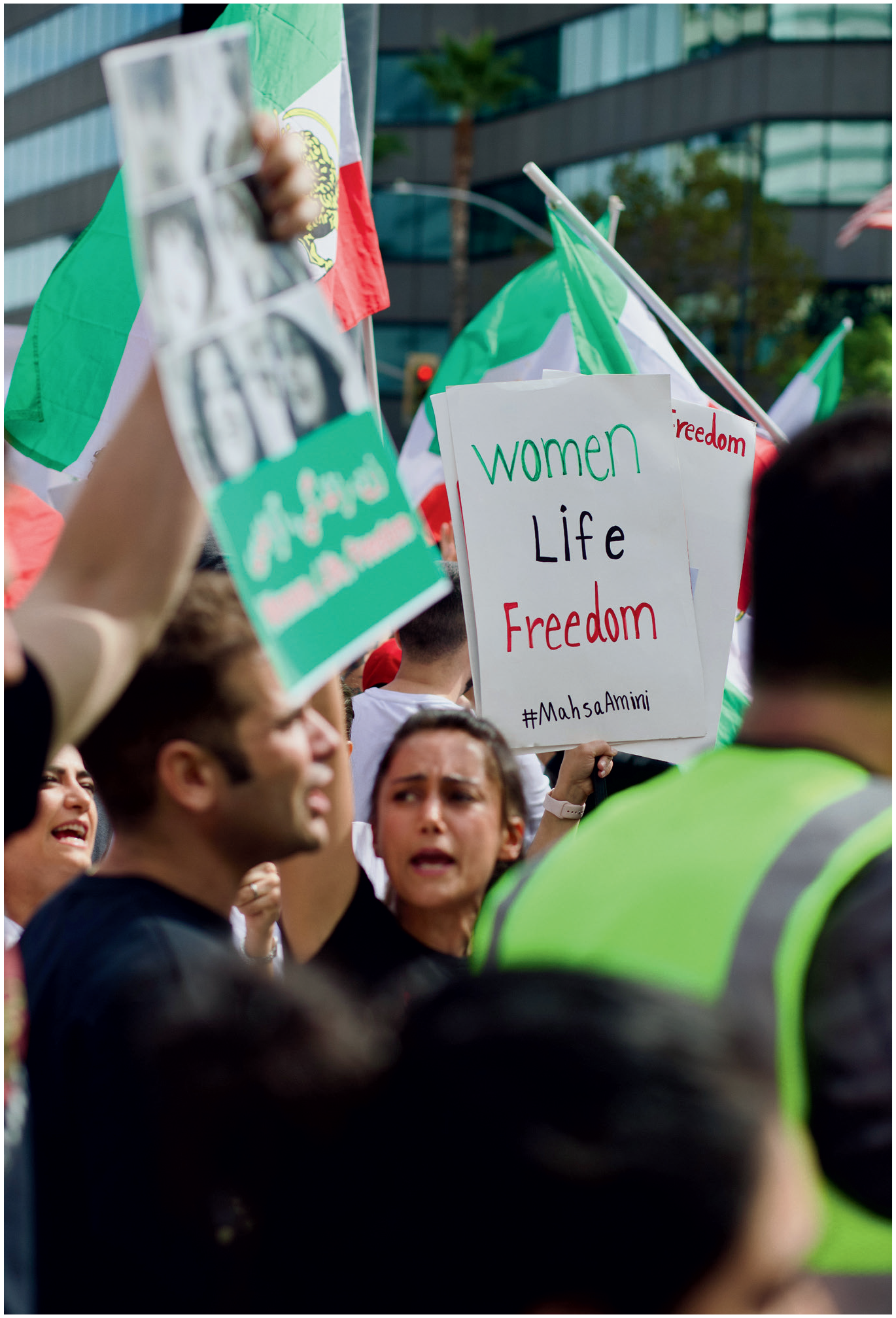
The protests erupted spontaneously after the death of Mahsa Jina Amini, a 22-year-old Iranian Kurd who died while in police custody after being arrested for “improperly” wearing her hijab. The Kurdish freedom cry of “Woman, Life, Freedom” has since become the dominant chant.
While the brutal treatment of Amini was the spark, the real heat comes from decades of oppression of any viable opposition to the hardline clerical regime, a free-falling economy, mass corruption, and disgust at the hypocrisy of the ruling elite. This elite refuses to engage with Iranians’ simplest demands, even as their own children post pictures of their luxurious, scantily-clad lives on social media. They enjoy the pilfered resources of our country while ordinary Iranians struggle to make ends meet with multiple jobs and frequent power outages in the freezing winter.
The headscarf being waved by Iranian women is, for the young people of the country, no longer anything to do with Islam but a symbol of regime oppression.
The women of Iran have been demanding their rights ever since Ayatollah Khomeini took power in 1979. The first demonstration against the mandatory wearing of the hijab took place just three weeks after Khomeini’s arrival. Before the revolution, Iranian women had some of the most liberal laws in the Middle East: they had been voting since 1964 and had equal rights to divorce and custody of children. The marriage age for girls was 18.
I grew up in Iran in the 1970s and lived in a world in which my mother and aunties wore what they liked (mostly mini-skirts) and where they fully expected that we, the young girls, would go to university and work when we grew up. The Shah’s father had forcibly unveiled women in the 1930s, a top-down imposition of his modernising values which meant that many conservative women preferred to stay at home than appear in public “naked”. But for many others, the policies of Reza Shah, and subsequently his son, were liberating – allowing women to attend university and work outside the home, bringing literacy even to rural areas.
And with the implementation of the Shah’s White Revolution in the early 1960s, women were given the vote. This was the first time that Khomeini, then an important cleric and religious scholar, denounced the Shah’s policies – in particular with regards to women’s liberation. Giving women the vote was, he said, tantamount to prostitution. Khomeini was jailed by the Shah and finally sent into exile.
Perhaps it should be no surprise that the first thing Khomeini did after taking power in 1979 was to repeal the Family Act of 1976 – the most progressive in the region – and plunge the marriage age for girls to nine. It now stands at 13 after decades of activism by Iranian women.
The fact that women in Iran enjoy the right to work and vote and appear in public spaces is testament to their relentless fight for their rights in the Islamic Republic.
Of Iran’s population of 87 million people, with a literacy rate of over 86%, women make up 65% of university graduates. But these are people whose word in court is worth half that of a man, and who cannot sing, dance or show their hair or body in public.
Significant uprisings in Iran led by women have taken place since that first Women’s Day march in March 1979, most notably in 1999, 2005, 2009 and in 2017 – the Girls of Revolution Street protests – when Vida Movahedi stood silently on the street with her head uncovered and her headscarf held out on a stick, inspiring other women to do the same. Some 29 people were arrested but it happened again in 2019, when the regime blacked out the internet and 1,500 protesters were killed.
Of the most recent protests, doctors and nurses have reported that security forces target women protesters’ faces, genitals and breasts when shooting at them, while male protesters are shot in the legs and arms. And yet Iranian women are not cowed; there are increasing instances of civil disobedience including going about their daily lives without the hijab. And in spite of four executions – and many more protesters condemned to be killed – the courage and bravery of ordinary people in Iran continues to drive this movement forward and keep the protests alive.
Whatever happens now, the protests show that Iran and its people will never be the same again. After decades of trying to reform the regime and its more repressive laws, they now want nothing short of regime change, and the protests are morphing into new forms of civil disobedience and online activism as well as protests and strikes.
And these protests have significance beyond Iran’s borders. Already the women of Afghanistan are protesting against the Taliban’s discrimination and openly naming their Iranian sisters as inspiration.
Last December, when the Taliban banned women from attending university, Afghan women turned out to protest in force the next day, citing the Woman, Life, Freedom movement, and men in Afghanistan committed acts of civil disobedience in solidarity with the female protesters, emulating Iranian men. About 50 male university professors resigned their positions, while some male students reportedly refused to sit their exams.
A protest takes place in Los Angeles in solidarity with protesters in Iran
CREDIT: Craig Melville/Unsplash
What is happening in Iran today is the frontline of feminism – young women taking back the right to their space and bodily autonomy, even at the cost of their lives. And, given the global assault on women’s rights, this is a struggle that touches us all.