




Abstract

As Christians face an increasing number of attacks in India,
The inconsolable Pinky still can’t understand why she has lost the love of her life, even two years later. Hailing from the Sitamarhi district of the eastern Indian state of Bihar, the 25-year-old (who chooses to use her first name only) and her husband were attacked by a radical Hindu mob which targeted them for conducting prayer meetings in the area.
The frenzied crowd broke into their home while they were praying, severely beating them. Pinky suffered serious head injuries but survived. Her husband did not.
After his death, she was forced by local Hindu extremists to leave her home and now lives in another village several kilometres away.
Pinky blames Vishva Hindu Parishad (VHP), a Hindu extremist organisation close to the ruling right-wing Bharatiya Janata Party, for the murder. “He was killed by the goons from VHP who showed no mercy,” she told Index.
Members of the VHP, an organisation tacitly supported by the governing BJP, envision making India a Hindu Rashtra – a country for Hindus – and are often involved in violence against minorities in the country. Hindu right-wing groups such as this one accuse Christians of converting Hindus by luring them with money and other benefits – a claim vehemently opposed by the community, which forms merely 2% of the country’s population.
In the northern Indian state of Uttar Pradesh, some 300 kilometres away from Pinky’s home in Bihar, the family of 25-year-old Roshan (who also wants to be identified by first name only) faced similar violence. Roshan’s father Ram Kishan, a pastor, was attacked at his home by around 30 members of Bajrang Dal, the youth wing of the VHP. Rather than taking action against the perpetrators, the police arrested Kishan and it took his family six months to secure bail from the court. “We are very afraid,” Roshan told Index. “We feel like we can be attacked again. There is no security for us.”
Religiously motivated attacks like those on Pinky and Ram Kishan are increasing in India. The discernible uptick in violence against marginalised communities has come alongside controversial hardline Hindu nationalist Prime Minister Narendra Modi’s rise to power. There have been reports of attacks on prayer meetings and several instances of churches and Christian missionary schools being vandalised across the country.
Thousands of Christians have been forced to flee from their villages as mobs ask them to recant or leave. Earlier this year, in the central Indian state of Chhattisgarh, a mob of several hundred extremists summoned the Christians from one village, beat them and chased them out of their homes.
United Christian Forum, a nongovernmental organisation that documents violence against Christians in India, claimed that last year was the deadliest so far for the community in India. According to the organisation’s annual report, India saw more than 500 incidents of violent attacks against Christians in 2022, the highest number since the group started documenting them in 2014.
“In almost all incidents reported across India, vigilante mobs comprising religious extremists have been seen to either barge into a prayer gathering or round up individuals that they believe are involved in forcible religious conversions," the UCF said in its report. “With impunity, such mobs criminally threaten and/or physically assault people in prayer before handing them over to the police on allegations of forcible conversions.”
Police stand alert near St Lukes Church in Srinagar, India on Christmas Day 2021
CREDIT: Credit: SOPA Images Limited / Alamy
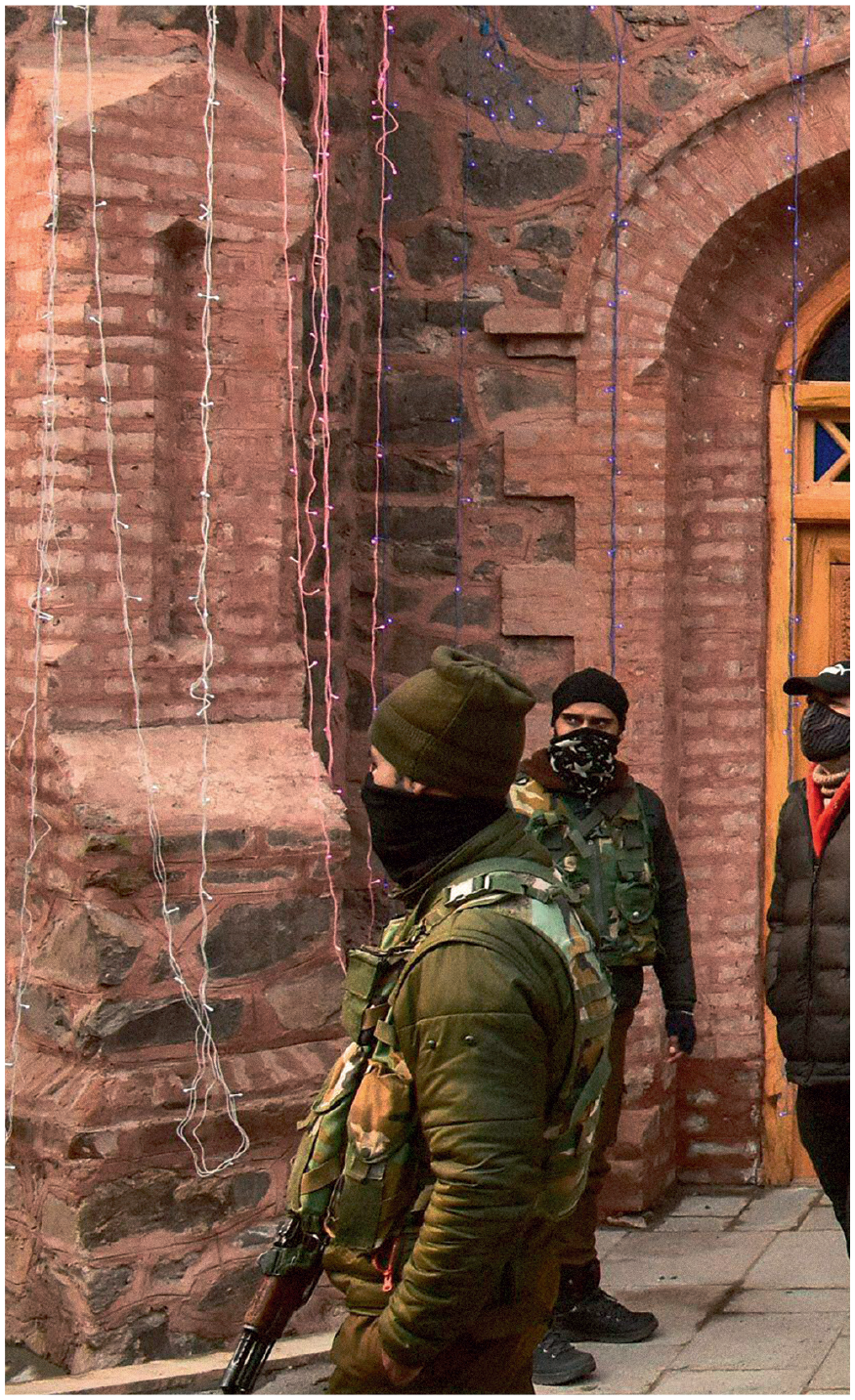
Experts blame the government for the persecution. Delhi-based journalist Hanan Akram said: “The government is actively supporting the mobs that attack Christians. It provides them space to operate and never takes any action against them.”
Open Doors, a transnational Christian organisation that documents violence on its global community, has ranked India as the 11th most dangerous country for Christians in its 2023 World Watchlist. The report said: “Since the current government came to power in May 2014, pressure on Christians has risen dramatically. This has also seen rise in Hindutva, an ideology that believes only Hindus are true Indians, and that Christians and other religious minorities have ’foreign’ roots and must be expelled. Hindu extremists attack others with impunity, using extreme violence in some areas.”
An increasing number of states in the country, mostly those ruled by the BJP, have introduced anti-conversion laws to “regulate religious conversions” and critics of the government say they are being used to frame minorities under frivolous charges. “Anti-conversion laws are being misused by right-wing nationalist Hindu groups to target Christians and to use them as a tool of harassment, because it’s very easy for anybody to put an allegation against the pastor or a Christian worker and get them arrested,” said Vijayesh Lal, general secretary of the Evangelical Fellowship of India.
And for Pinky, who now lives alone and is consumed by the loss of her husband, the very real impact of persecution has left her at a loss.
“Nobody helped me. Everyone told us that it was our fault,” she said. “But what was our fault? To be Christians in this country?”