




Abstract

Narendra Modi’s rule in Jammu and Kashmir has seen buildings dismantled in line with people’s broader rights.
People in Jammu and Kashmir hold up documents related to land ownership amid demolitions due to an anti-encroachment drive, 31 January 2023
CREDIT: Waseem Andrabi/Hindustan Times/Sipa USA/Alamy
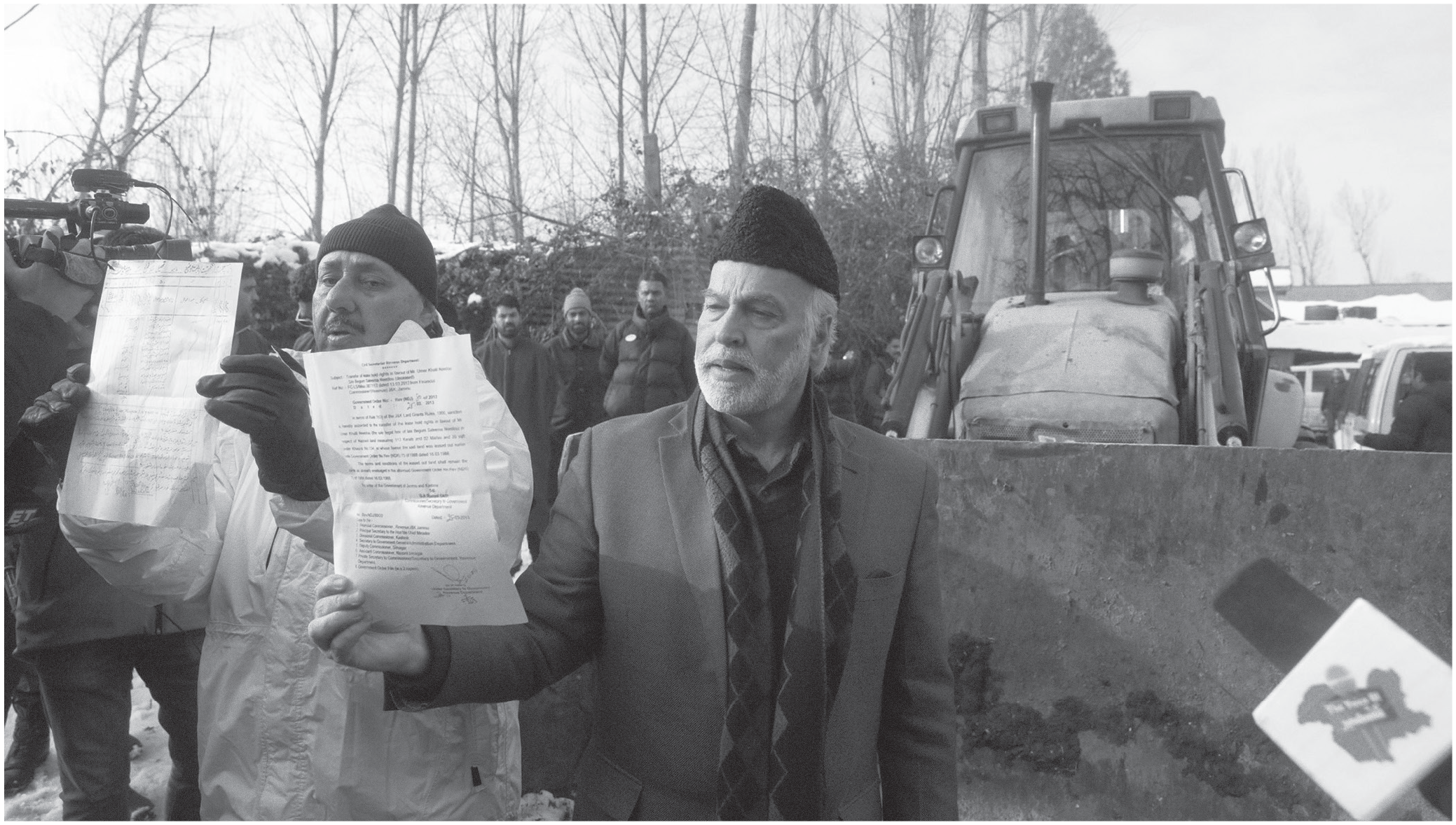
Through the local administration, the Indian government has recently launched an “anti-encroachment campaign” in Jammu and Kashmir. Locals claim to have lost their businesses and homes without any prior notice from the government. Despite possessing documents proving their ownership, they are not allowed to argue their case even as authorities begin bulldozing their properties.
“Before resorting to using a bulldozer to demolish a structure, it is crucial to provide individuals with an opportunity to prove their ownership and present relevant documents,” Guroo told Index. “Building a structure is not easy and takes a lifetime for many to complete.”
The policy has generated huge controversy as opposition parties claim that the poor and political opponents are being targeted. They claim that 99% of the demolitions are taking place in Muslim-dominated areas. Last year, the administration demolished the homes of Gujjar and Bakarwal – marginalised tribes in Jammu and Kashmir – in Jammu city, the winter capital. The families said the officials arrived without notice to demolish their houses. It was not the first time such a demolition drive had targeted the communities – a similar thing had happened in 2021.
Aakar Patel, Amnesty International India’s chair, said: “These demolitions could amount to forced evictions, which constitute a gross violation of human rights.”
Jammu and Kashmir Peoples Democratic Party President Mehbooba Mufti said: “There is gunda raj (“rule of goons”) in J and K. It is being destroyed like Afghanistan.” The police later detained her.
The destruction of buildings on land occupied by people for generations has sparked protests, with arrests being made for stone-throwing in Jammu. A volunteer at a mosque, who wished to remain anonymous, told Index that on one occasion prayer was banned for the day as they feared what would happen should the protests spill over. But with the exception of a few, most people are too fearful to speak out publicly.
More than three years have passed since the Indian government revoked the constitution that provided limited autonomy to Indian-administered Jammu and Kashmir, and New Delhi is directly ruling the region. These evictions are just one of many limits on people’s lives and livelihoods that have been imposed in the region. From media freedom to internet access, restrictions affect every aspect of life.
As a majority Muslim region, religious freedom is particularly targeted. India’s constitution guarantees freedom of religion, with no discrimination or state meddling, but conditions for Muslims here have deteriorated under Prime Minister Narendra Modi, especially since 2019. The partial shutdown of the region’s most revered mosque – Jamia Masjid, the grand mosque of Srinagar – is a case in point. It is now closed on Fridays, the main day of congregational worship, and has faced extended closures for months since August 2019.
Ulfat Majeed, a researcher at the University of Kashmir, told Index he had to be extremely careful when drawing boundaries on maps. After its limited autonomy was rescinded in 2019, the state was divided into two Union Territories – Jammu and Kashmir, and Ladakh.
“I started my research with the study area of the state of Jammu and Kashmir, and now I have to take care and write twin Union Territories of Jammu and Kashmir, and Ladakh," he said.
Even some of those who once supported scrapping the limited autonomy now feel betrayed. An engineer-turned-educational reformer in Ladakh, Sonam Wangchuk was an admirer of Modi and a strong supporter of creating a new Union Territory in August 2019. Initially, the Bharatiya Janata Party government gave assurances regarding the inclusion of Ladakh under the Sixth Schedule of Article 244 – a legal provision that provides the autonomous district councils with full legislative, judicial and executive authority. But Wangchuk said this had not become reality.
“We were better off [when we were part of] Jammu and Kashmir than today’s Union Territory,” he said in a video posted on YouTube.
Wangchuk staged a hunger strike in January to raise awareness about the lack of protection for people, land and the wider environment. During his protest the local administration put him under house arrest. It was alleged Wangchuk had signed papers stating that he would not make public appearances, speeches or videos – papers he denied signing.
A legal consultant, Moshin Dar, told Index that the document given to Wangchuk had zero legality and was intentionally vague, so it could not be challenged in court. Regardless, Wangchuk was forced to carry out his protest at home, which diminished its impact.
“The attention of the government of India should be on protecting the culture, environment, language and tradition of the citizens of India rather than on suppressing the voice of Wangchuk and the other people of the country who are supporting his demand of inclusion of Ladakh under the Sixth Schedule,” said Dar. “The government of India should protect the rights of the citizens so that the democratic structure of our country will be cherished.”
Meanwhile, the situation has stifled creativity and is diminishing the region’s cultural diversity.
Abdur Rehman Rahi, possibly the most famous poet from Kashmir, died aged 97 in Srinagar this year. Revered by many, some criticised him for what they believed was self-censorship. Indeed, he avoided writing on the contemporary political situation. His daughter, Mir Noosheen Nighat, told Index that her father actually did write on the contemporary situation of Jammu and Kashmir but just through figurative language to avoid reprisal. He used metaphors to express his views rather than stating them directly.
A filmmaker from Srinagar, Bilal A Jan, who directed The Poet of Silence, a documentary on Rahi’s life, agreed. He told Index that Rahi had confided in him about instances where he was threatened because of his work.
Unsurprisingly, the desire for secession remains strong. But to speak outwardly of it is dangerous. Last year, a Kashmir University scholar, Abdul Aala Fazili, was arrested for promoting the secession of the now Union Territory through his writings a decade earlier.
Back outside the shop, Guroo hopes that one day the long night will end. But at the moment, he says, in order to survive it is better to remain silent.
“Speech is silver, silence is golden.”