




Abstract
In a country where sexual violence is abundant and sex education is taboo,
“Talking about rape as the worst thing to happen to a woman and not the worst thing done by a man gives the message that, in India, a woman’s ’purity’ is her sexual trademark and if that is ’lost or violated’ there’s nothing more to the woman [or her life]," Madhavi Menon, the director of the Centre for Studies in Gender and Sexuality at Ashoka University, told Index as she reflected on the incident.
Around the same time as the Singh case, conversations about sex were also being widely held in India. Paromita Vohra, a filmmaker, writer and educator, told Index: “We saw a lot of content that developed in India was totally taken from the West, imposing a language and context that may not really be culturally relevant.”
With this gap in mind, eventually Vohra founded the multimedia sex education project Agents of Ishq, which discusses sex, love and desire through videos, comics, podcasts and other creative mediums. Quizzes and memes sit side-by-side with an erogenous-zones quiz. The website outlines sex education basics, understanding consent and personal stories alongside the Our Erotic India series.
The need to address this gap in the Indian context is especially relevant now, given the rise of the Hindutva ideology that guides the current regime, aiming to establish India as a majoritarian nation with a singular Hindu identity, Menon explained. It hitches to the mythological wagon of Lord Rama, with Hindutva’s suspicion over women’s sexuality and focus on servitude to their husbands reflecting the way Sita, Rama’s wife, is often depicted.
With the emphasis on a specific interpretation of Hindu mythology, the boundaries around sexuality in India – and transgressing them – have varied implications given the diverse identities. The consequences for women who are Muslim, Dalit or queer are also grave.
This is evident in the routine harassment and frequent instances of the sexualisation of Muslim women in India. In 2022, a Muslim journalist discovered that she and dozens of others had been put up for auction online by right-wingers. Similarly, Dalit women are historically disproportionately affected by sexual violence. And for queer women, their expression of desire can mean being forced into dangerous practices such as conversion therapy.
Cultural contexts
Seema Anand, a mythologist, sexual health educator and storyteller, underscores a unifying experience that women in India face: talking about pleasure itself seems to be a major problem, especially if a woman leads the conversation. This, she told Index, is because “if a woman becomes articulate, that unbalances the status of power”.
A look at India’s diverse cultural, religious and social traditions challenges the narrative that the Hindu right is centring. Menon, who has captured some aspects of this idea of multiplicity in her book Infinite Variety: A History of Desire in India, echoes what many others feel. “We are steeped in a certain colonial mindset of women’s sexuality as prudery, and ironically it is encouraged as native to our culture,” she said.
The need for a nuanced approach to talking about sexuality is exactly what has informed the work of Agents of Ishq. Vohra said that they operated on a decolonial paradigm, to break the binary approach overall. She invites people to rethink the idea of “smashing” taboos as such. Context has become key to effectively communicating about sex, and for including vast audiences. Vohra joked: “Agents of Ishq is the Shahrukh Khan [a popular Indian actor] of sex education in India,” and noted how it uses joyful and celebratory elements of the Indian cultural framework.
Anand, too, delves into the Indian cultural context, highlighting the importance of the Kama Sutra and concepts such as Shringar Rasa, which is the aesthetics of eroticism and romance. She said: “There’s an entire vocabulary of pleasure that unfolds with stories associated with each word and act. This helps us understand how, for example, wearing a certain piece of jewellery related to sex. How that jewellery moved on your body taught you how to perform that position.”
Anand often shares tales from Indian mythology and makes them accessible to wider audiences. But for those who diverge from the ideal of a chaste woman, expressing desire invites silencing and shaming.
Censoring sex education
Social media has become an important tool for sex educators in India, who seek to reach vast audiences with limited resources. But it is also where censorship quickly gains ground. Anand said that she has had a very different relationship with her audiences since the Covid lockdowns, when social media became a more important platform. Although a few people within her immediate social circle already shamed her for her work, social media has led to unending attempts at silencing and intimidation.
Vohra, too, has battled with online censorship, but in a different form. “With 90% of our posts, promotions get refused. Because they see sexual content, it is considered as soliciting or pornography,” Vohra explained, describing Meta’s community standards policies.
Another hurdle is the algorithmic push for polarised views. These policies mean restricted access to information for many, but violence against women remains. Anand found that for many women in her audience, sexualised language is being used as a weapon. She said: “This is not only through direct sexualised threats that the general population hurls at them. They are slut-shamed, called [derogatory terms for] sex-workers, for wanting to even educate themselves.”
The road ahead for safe and pleasurable sex lives for women in India remains a long and tricky one. And the idea that it is a woman’s role to preserve “honour”, for both the state and society, is not limited to India under the BJP, nor is it unique to the country.
“Growth or change doesn’t come from simplistic ideas of reform, where some proclaim Indian culture to be great and perfect while some proclaim Indian culture is oppressive and needs to be smashed. Rather the truth is somewhere else – in liberation from these binaries and building on people’s complex, lived experiences," Vohra said.
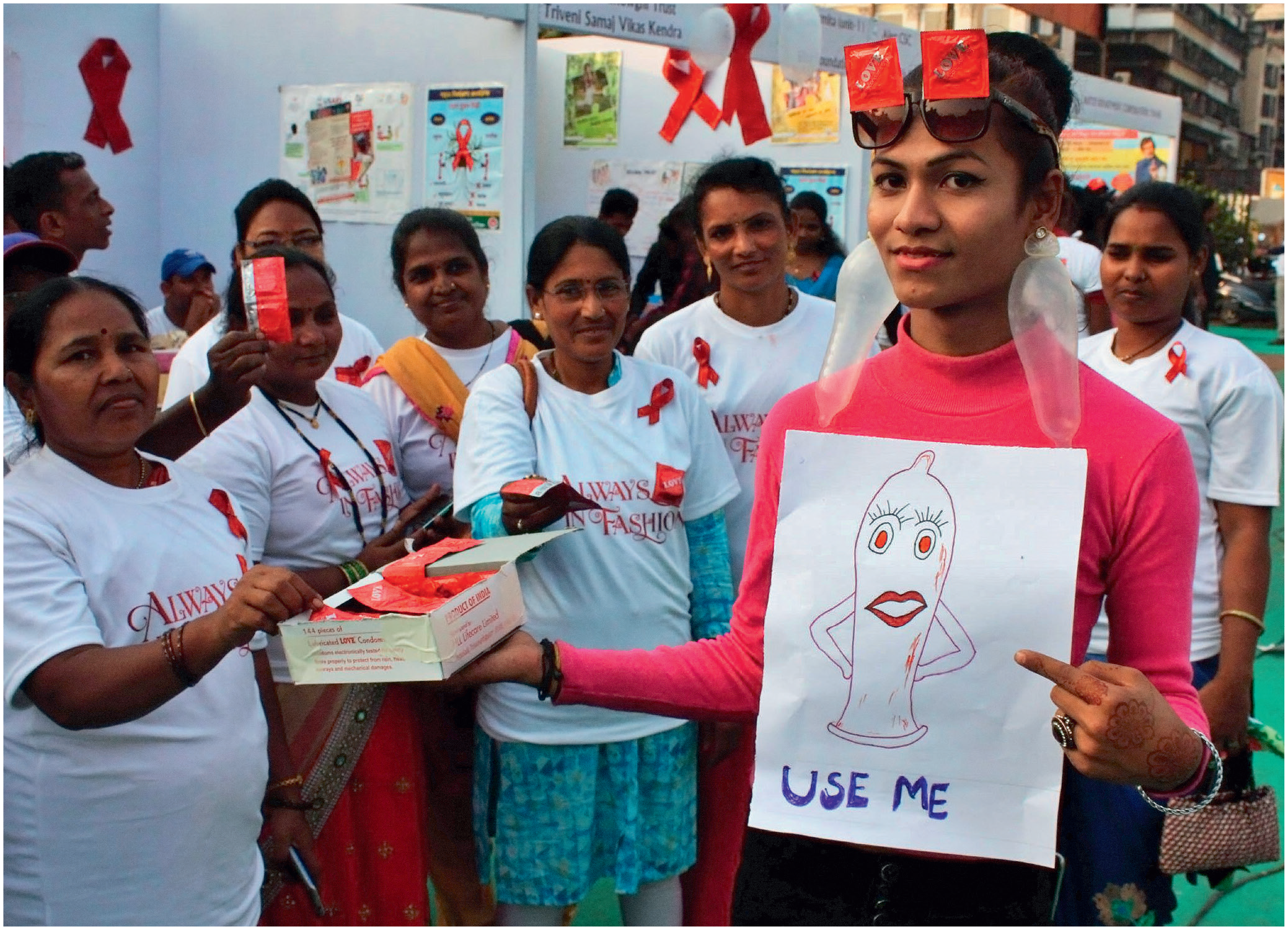
A rare moment of openness – participants in a drive to increase awareness about contraception on World Condom Day 2019, Thane, India
CREDIT: Praful Gangurde/Sipa USA/Alamy
Beyond this, she drew on a powerful belief that Agents of Ishq holds: “If violence is a dictatorship, pleasure is a joyful democracy. The politics of pleasure counters violence.”