




Abstract

Can you imagine a world without statues? And what might fill all those empty plinths?
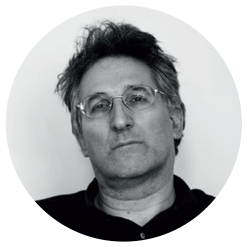
Author Marc Nash
CREDIT: Barbara Bessac
“Statues can represent different things to different people. Eric Morecambe was a hometown hero. I think it’s legitimate to memorialise that after his death. Whereas Stalin, Lenin, Saddam Hussein, fill in any dictator you want, it’s in their lifetime and not done as a memorial, it’s done as a statement of power. To me, it is a completely illegitimate use of statues.”
Nash is a London-based novelist focused on literary fiction. Described as devoted to the experimental, his novel Three Dreams in the Key of G was nominated for the Guardian’s 2018 Not The Booker Prize.
The title of his new short story, written exclusively for Index, is a portmanteau of iconoclasm and cataclysm. It refers to the spate of statue removals (by different methods) sparked by the worldwide protests following the death of George Floyd, and the subsequent division it caused. Broadly speaking, to one side history was being airbrushed, on the other it was being revised. Or, as some argued, history was even being made.
Nash wrote the story following a left-field idea.
“I thought the way round this issue is just not to have any figurative art on display, that the plinths and pedestals should just have some abstract sculptures on them," he said.
“I think it’s worth recognising people who made contributions to humanity. However, the nature of power, however well-meaning and intended, means politicians and leaders are making decisions that affect people’s lives for the worse. Why should they get a memorial?”
Nash calls the statues of slave traders “manufactured history”, but questions whether their removal will have any impact on the narrative of history.
“It’s the wealthy person’s version of history, and it’s only just now [that] the narratives of slave traders as great men who built our cities is being widely challenged.”
“I suspect it will be business as usual, as these movements will be crushed somehow, so the history of pulling down statues will have a hooligan narrative. However, history is made by the winners, so if these protests successfully continue, they can proudly talk about hauling down statues," he continued.
Finally, Nash says statues are more about the message than the art, so would he criticise the sculptor of a statue he disagrees with?
He said: “I can criticise, but I can’t say they have no right to. If I was asked to create a statue of Mrs. Thatcher, I would refuse in the blink of an eye, but the next sculptor might need the money!”
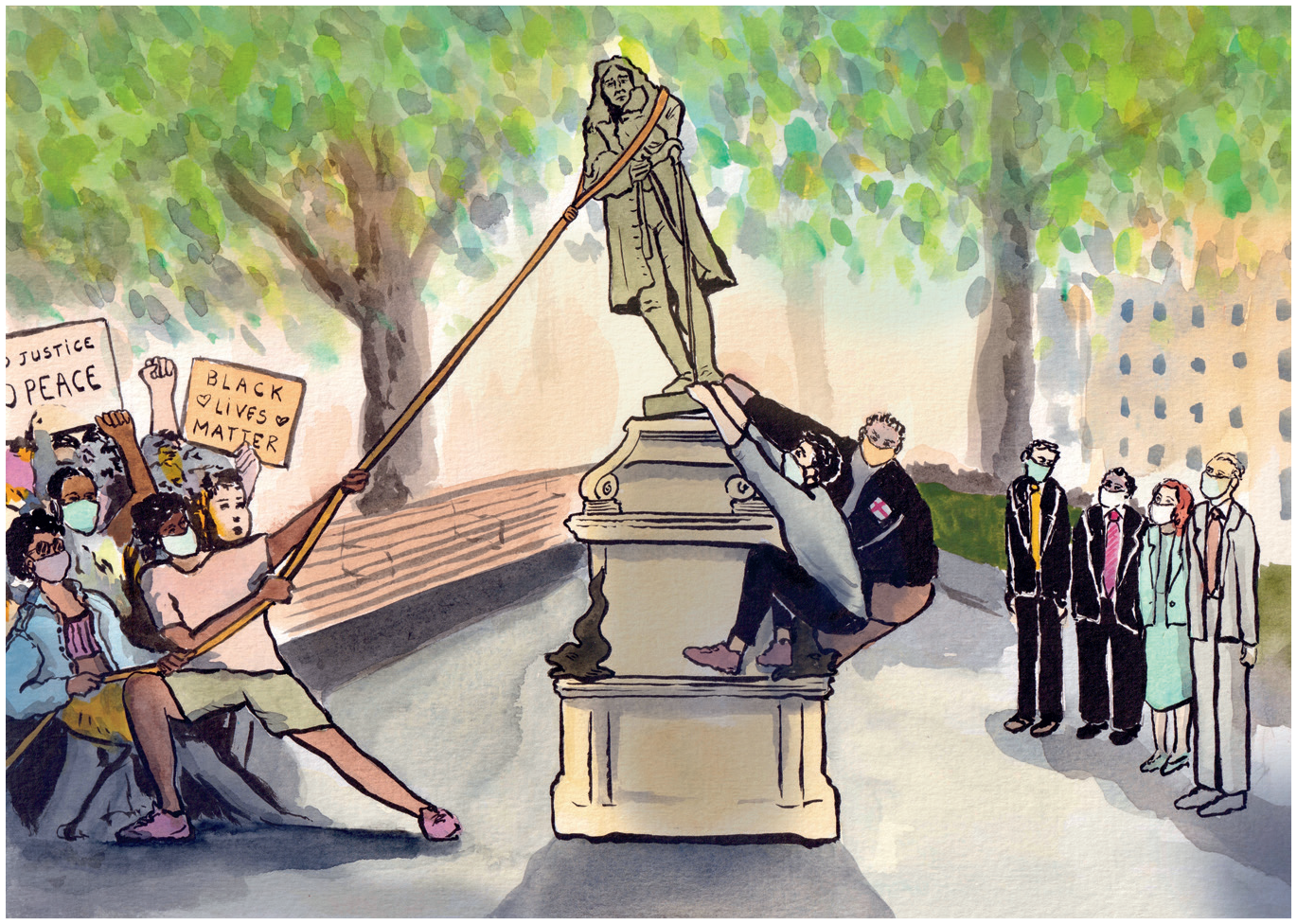
Iconoclasm became the new optimal selfie opportunity. Photobombing the toppling of an erstwhile big cheese, lariat around the neck being tugged by hipsters with cordage braced around their hips. One hundred and seventy-five po-faced likenesses of Queen Victoria were abdicated from their podiums up and down the country, where all were amused. A pressgang in Plymouth made Sir Francis Drake’s bronze walk the plank and plummet to the Hoe, with the cheering being heard all the way back in Cadiz. But very quickly dissenters jumped to the defence of the effigies, protesting that such acts were erasing British history.
“If only that were true, if only we could reset our shameful, inglorious past,” proclaimed the reverse-lynchers. “But what we can no longer permit is to rub the victims’ noses in it every day they walk past and have to see this suppurating eyesore.” “I think you’ll find that what you call ’suppurating’ is in fact bird droppings and verdigris.” “Even more of a marker of their antiquated and obsolescent nature and the need for a cleansing then,” came the retort.
A dissenter bound himself to a targeted statue in an attempt to stay its execution. The symbol of a white man in chains tethered to a slave trader incensed the crowd and they redoubled their efforts, hoping to bring the heavy marble down on the semiotically obscene squatter. But like greenhorn lumberjacks, they were ignorant of Newtonian mechanics and only succeeded in conferring life-changing injuries upon two of their own.
Why confine orgies of destruction to those of so-called high moral tone? Those whose moral compass failed to acknowledge by degrees the relativity of there being three different northerly points. Anyone can become self-appointed. Rivalrous small towns made sport of removing their neighbours’ venally venerated mayors and other dignitaries’ likenesses, whom not even the host population could have named. Football fans snuck off to their local rivals to cull their sporting gods minerally memorialised. There were only two exceptions to this; one for the captain of the World Cup winning team, local divisions soothed and displaced by international triumph, as touted by Lord Palmerston and George Orwell, both of whose statues also succumbed to the rampant decline and fall; the second for a rendering in sandstone by a journeyman mason, of a millionaire mercenary of renowned prowess who’d laid his Beanie hat there for a few seasons, which was so aesthetically displeasing that it not only bore no resemblance to the subject, but barely matched the notion of a human form at all. Thus it was spared.
A public debate similarly opened up over The Angel of The North. Ultimately it was agreed that since the angel was not any injudicious commemoration of a real person it ought to be preserved for its aesthetic appeal. The community of sculptors and metal casters were irate since they viewed every last one of their commissions as artistic. Yet they bit their tongues, for they knew they would soon be cashing in on whatever replacements were deemed suitable for the now empty plinths.
Nevertheless, elevated art and exalted artists still suffered from the razing frenzy. In Stratford-upon-Avon, Shakespeare’s statue was bowdlerised from its pedestal. The three fictional characters from Robert Louis Stevenson’s Kidnapped were themselves snatched from their perch in Edinburgh, without any ransom being demanded. Norman Wisdom’s memorial on the Isle of Man took a final pratfall (and was quietly shipped off to Albania in response to a request from authorities there), while Eric Morecambe’s statue in, well, Morecambe, was given no more sunshine as it was eclipsed and tossed into the sea to harvest cockles.
Nor were great thinkers and innovators immune. Newton’s effigy was rusticated from the chapel at Trinity College by the Kulturkriege mob, while his memorial in Grantham was pelted not by apples, but by sledgehammers. They were egged on by a group of German tourists, who, it later emerged, were members of Gottfried Leibniz’s appreciation society seeking restitution after three-hundred and eleven years. A somewhat hollow victory, since they were unaware that their own man’s image in Oxford had also come a cropper as part of the cognoscenti cull. Jeremy Bentham’s auto-icon briefly gave University College students pause for thought, as they deliberated whether it actually constituted a statue, or was more of a mummy. In the end they decided upon a utilitarianism of being safer rather than sorry and set fire to it, the wax head going up like a Catherine wheel. A certain queasiness did abound over the optics of black holing Stephen Hawking’s bust, even though the depiction didn’t include his wheelchair, but he too was launched over the event horizon.
Now, a statue is a statue, which is why even though this surge of Jacobins largely inclined towards the Left of politics, they proceeded to attack Karl Marx’s bronze and marble, giving him a rare distinction of being vandalised by both sides of the political spectrum. It thus disproved his switching up of Hegel’s dialectical idealism to his own brand of dialectical materialism, since an attack on the mineral embodiment of him as somehow representative of his philosophy failed to expunge it from history. The same could not be said for his tomb, now lying in shards; the primitive but persistent technology of hammers and chisels having succeeded, where two attempted bombings had failed in the 1970s.
Came the time when all the plinths, podiums and platforms were devoid of statuary. Even Nelson’s Column only offered up his missing eye and amputated arm, reducing it to an uninhabited giant stylus. A spokeswoman emerged from the ranks of sculptors and metal casters champing at the bit with their chisels and forges. She suggested that to avoid any such revisionist repetition wave in the future only non-imgurative forms should adorn the vacant mountings. No one could object to that. Cones could happily coexist with cubes and cylinders. And thus was the legacy of Euclid honoured and esteemed, even without a single direct sculpture of his likeness in existence.