Abstract

We’ve come a long way in relation to talking about neurodiversity, but there is still a long way to go says
Given this, the Index team wanted to know whether neurodivergent people felt that the new term and the movement around it was helping them to have more of a voice and more agency? We wanted to know if old stereotypes were still rife? We wanted to know if information on and the perception of neurodiversity had improved? And if not was that because of censorship, overt or subtle? Finally, we wanted to know about all of this in a global context. Our team set to work.
Our first priority was to put neurodivergent voices front and centre, so the majority of articles here are written by neurodivergent people. From these articles a fascinating picture emerges. Many said they did have more of a voice and that awareness had shot up. They greeted the word “neurodiversity” as empowering and welcomed a growth in onscreen representation.
At the same time it was clear that conversations around neurodiversity were playing out along society’s current fault-lines and were far from immune. Social media has significantly improved connection for those who might otherwise feel sidelined, but as Morgan Barbour says it has given rise to a faker movement, to endless disinformation and to a lot of animosity. The latter was echoed by Nick Ransom, who highlighted social media pile-ons directed at “Autism Moms”. Ransom added that autism continues to be used as a slur, only now often by those on the right to silence those on the “woke” left. And the actor Lillian Carrier told us of the fierce debate about who should represent a neurodivergent person on-screen. Sadly in this debate sometimes the decision is no one.
Assumptions are also still being made about who is neurodivergent and who isn’t - women’s voices continue to be dismissed write Ashley Gjovik and Meltem Ariken - and certain views of medical best practise dominate, silencing those who wish to challenge the orthodoxy and propose alternatives.
As somewhat expected, the picture in places like Brazil and Turkey was more bleak. The most alarming article came from Ugonna-Ora Owoh in Nigeria. He interviewed dyslexic people who had been taken to their local church to be exorcised, a trauma most had not shaken off.
Such a large topic ultimately needs more space than we have been able to give it. Still, we hope it challenges thinking about who and why certain people have a voice and what we collectively can do. More importantly we hope it’s a launchpad for further enquiry and talk on neurodiversity. If we had one single takeaway from our research it would be that while conversations are happening more today than yesterday plenty more are needed still.
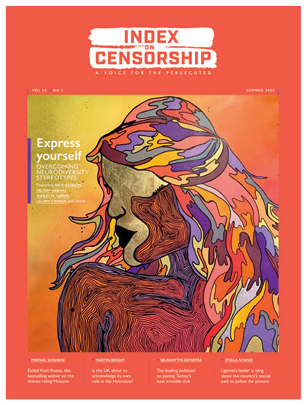
Charlotte Crawford, from Berkshire in the UK, rediscovered her love for art during Covid. “I had no job and my mental health was at a very low point,” she said. After ending up in hospital, she was diagnosed as autistic aged 21.
She says, “There is a lack of knowledge and understanding when it comes to autism. More and more people are aware of the struggles autistic people face on a day-to-day basis but there is still a long way to go.”
“’Powerful’ is a mixed media artwork. I created this using minimal lines and bold blocks of colour. The repetitive lines were intended to mimic a fingerprint. I see links between the lines in the art and the natural lines in the centre of tree trunks.”