




Abstract

The Mexican government no longer wants to hear about the femicide crisis facing the country because it is politically inconvenient. But obscuring the truth doesn’t make it go away, writes
Mexico is a country that is no stranger to brutality. There have been 151,708 murders since President Andres Manuel Lopez Obrador - known as Amlo - took power in 2018. Much of the violence can be squarely blamed on the drugs war that is tearing the country apart - a civil war bubbling just out of sight. But a vein of aggressive chauvinism that runs through the country has led to thousands of women being killed simply for the crime of not being born male. Many of these killings are never investigated. Most are perpetrated simply out of anger against women.
The World Health Organisation defines femicide as “intentional murder of women because they are women”. Here, this is a crime that happens every few hours.
The brutality against women, which is almost casual in its frequency, is as shocking as any cartel killing. In February 2020, 25-year-old Ingrid Escamilla was found skinned. In the same week, seven-year-old Fatima Aldrighetti was kidnapped, raped and murdered. Debanhi Escobar took a taxi home from a party in 2022 and was found almost two weeks later, her corpse hidden inside a water tank.
The Secretariat for Protection and Security of Citizens states that 3,890 women were killed by homicide (which in Mexico includes cases of manslaughter) in 2022, of which 2,808 were murders. Of these, only 1,075 were classified as femicides. Killings reached a peak during the pandemic, with 10 women a day losing their lives. Officially, 2022 saw an average of “only” three women a day killed in femicides - and the government says that numbers have decreased 35% since 2021.
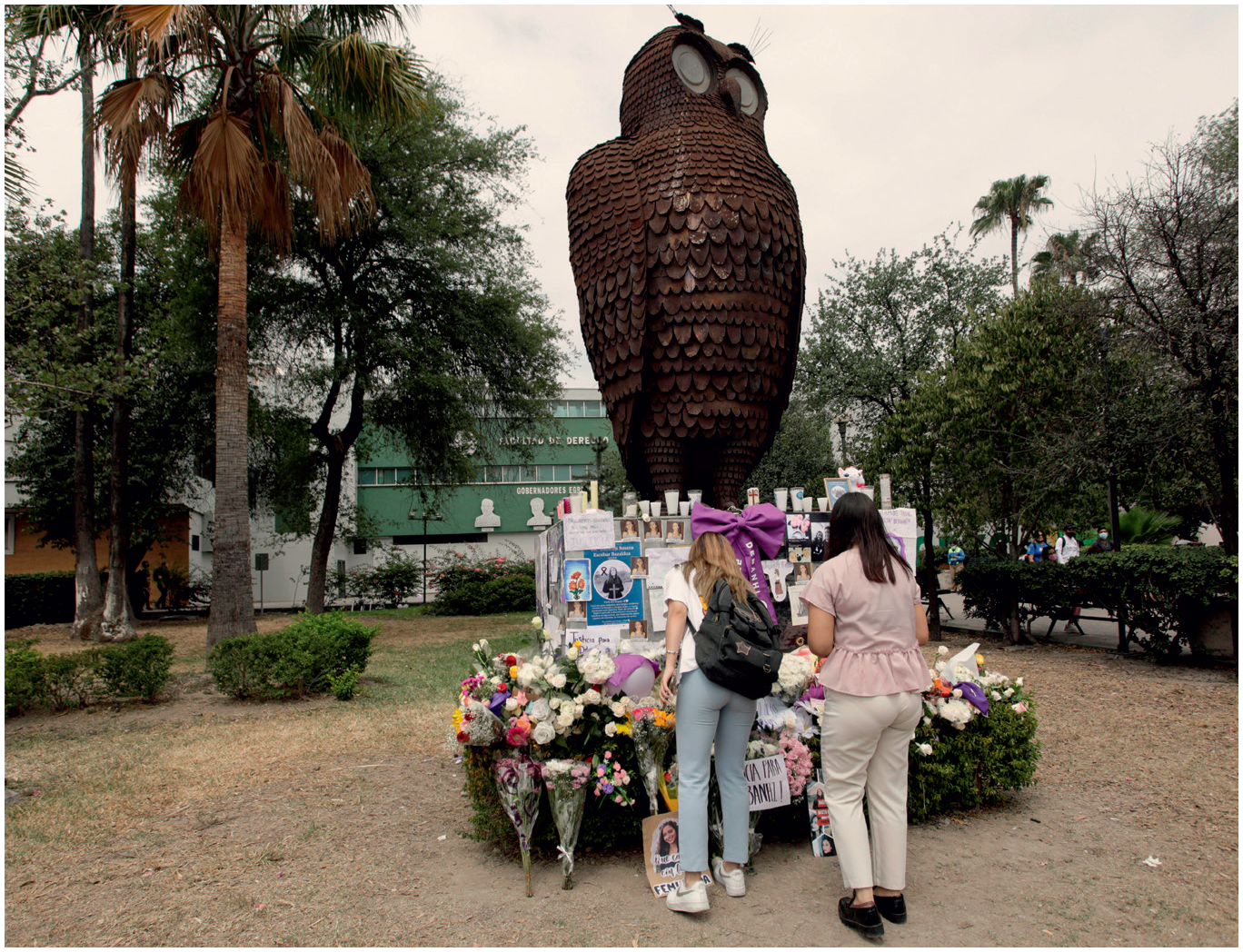
Friends of Debanhi Escobar, an 18-year-old law student who went missing on April 2022 and was found dead inside a water tank, amid a spate of disappearances of women in Mexico, pay homage to her, 25 April 2022
CREDIT: Daniel Becerril/Reuters/Alamy
As with so many statistics in Mexico, this is little more than propaganda. While the headline number is down, this is not necessarily reflective of the situation that women find themselves in. The femicide problem has reduced since Obrador took office, but not before first rising to record-breaking levels. More than 4,000 women have officially been killed in femicides since he assumed the presidency.
Government sources happily report the reduction in killings compared with the 2018 levels, but deliberately fail to mention the significant overall rise that has marred the majority of the Amlo administration. And this number is still inaccurate, as many such crimes are never reported or do not fit the legal definition of what can be considered a femicide.
Women hold a protest ahead of the Day of the Dead against gender violence and femicide in Mexico City, October 2022
CREDIT: Raquel Cunha/Reuters/Alamy

Mexico introduced femicide laws to combat the rising wave of killings under former president Enrique Peña Nieto. These laws were designed to provide a framework for prosecutors to lay more serious charges but have, in effect, had an exclusionary effect on cases of femicide that do not fit the model. Women who work on the front line of the femicide epidemic are exasperated by the barriers to justice that exist in a legal system that often does not care about what is happening.
The murder of a woman - whether by an intimate partner, a co-worker, a man in a position of authority or even a brutal attack by a stranger - is often not considered as a possible femicide by authorities. Many times, even killings that do fit the criteria are simply ignored.
Alexa Mendivil, a criminal lawyer from Mexico City, explains that despite the fact the government treats femicide cases differently, the law itself is fundamentally unable to capture the extent of the violence being perpetrated.
“The problem in Mexico is not only impunity but apparent incompetence,” she said. “On many occasions, I have experienced policemen and prosecutors failing to take immediate action and they do not keep the offended informed of their fundamental human rights.
“As a litigator, I have experienced at first-hand the lack of resources and the inability of the police to investigate a crime … most of the time leaving the burden of proof to the offended.”
The government released updated guidelines in April, increasing penalties - especially against those who attack children - but many of the reforms will take time to implement, and there is little to compel police and prosecutors to act.
Cristina Flores works as a psychologist in a woman’s prison, and often deals with the aftermath of violence. “It is much easier ... for the government to classify these [killings] as murders, because if they are catalogued as femicides it affects government statistics,” she said.
“In cases where murders are reclassified as femicides, it is because the family of the victim, or the friends of the victim, or the neighbours of the victim, fight for a long time and raise their voices to say: ‘This wasn’t a murder, this was a femicide and you have everything you need to classify it as such’.
“It seems to me that it is a lot easier for the government to classify [a death] as a homicide because that way it does not put in danger the way that the rest of the world sees Mexico because of the levels of femicide.” Flores says that women who fight off their attackers often find themselves jailed for assault, while the men walk free.
Ultimately, the problems in Mexico persist because the government aggressively rejects negative publicity. There is little action that the president is willing to take lest it detract from his legacy, other than to deflect and blame opposition politicians for lying about achievements, or promoting defective moral values that lead to these killings.
Those who question the official narrative are derided as enemies of Mexico. Amlo himself has accused those who protest femicide of being “conservatives” and of being agents employed by nefarious forces opposed to his government.
Mendivil feels that there has been a deliberate campaign to “to minimise the Mexican feminist movement [by] arguing it has become a conservative movement and opposition to his administration”.
“[Amlo] lacks empathy for women’s causes, which he does not comprehend and therefore fails to sympathise with. In a live conference, he even mistakenly equated femicide with homicide and attributed its causes to family disintegration on the International Day for the Elimination of Violence against Women,” she said.
This dismissal of campaigners is effective. A recent survey of the president’s popularity found that he was by far the most popular among those with no or sub-primary education.
The survey also reported that 51% of Mexicans have full confidence in him and believe entirely in his mission. A further 17% of respondents said they generally had confidence in him.
This confidence means that he retains the ability to determine what 68% of Mexicans believe to be the truth. As he has downplayed the extent of the violence facing women, he is able to convince the majority of citizens that femicide is an issue that is used by an immoral minority determined to carry out a personal vendetta against him.
A recent leaked audio file directly links the president to efforts to close the National Institute for Transparency for the remainder of his term as president.
Obrador has also announced that he intends to abolish national news agency Notimex - which, while imperfect, provides a comparatively impartial news service. He has said the company is unnecessary as he now gives a personal news conference every weekday morning.
A recent survey by the National Institute for Statistics revealed that Mexicans felt significantly safer in 2023, despite the fact that violence is once again rising in the country. This sexenio - the six-year presidential term - has already been the most violent on record, and there are almost two years remaining.
Murder has risen in the first half of the year, but without free access to information the problem can be ignored. Unfortunately for thousands of women each year, pretending the problem does not exist will not be enough to save their lives.