




Abstract

For decades autism was avoided on screen. But a new cohort of producers, directors and actors are opening up conversations, and representation.
“The writer, Josh, himself reached out to me and asked if he could create a character around my specific autism to make it as authentic as possible,” Carrier told Index. “And that’s how you get true, authentic representation. You can’t say it’s not real, because it’s everything that I feel and go through.”
The character’s personality and the scenarios she faces come from the creative minds of the writers, but the autism is based on Carrier herself. While auditioning for Matilda, she wore a calming sensory item — a donut-shaped chewable necklace, or “chewy” — and the jewellery became a part of Drea’s ensemble. She worked with the props and costume team to find things that fit Drea’s character, but also suited Carrier’s own sensory needs. They brought in the compression shirts she wears, fabrics that were comfortable for her and chewable toppers on all her pens to stop her ruining them. The dog in the show is Carrier’s own service dog.
“He couldn’t tell when I was having a real panic attack or a fake panic attack. He just did what he was supposed to do,” Carrier explained. In one touching scene where Drea declares her love for Matilda, her dog Duke presses his paws against her chest as she lies down.
“The way she experienced the world was so different from the other autistic characters in the show, to show that there are multiple ways that autism presents itself,” Carrier said. Drea is proud of who she is, and comfortable being autistic.
Alongside helping to build her own character, Carrier consulted on the show, deciding how best to represent the autistic community, which she admits was a tough task. But having grown up without seeing herself fully represented on screen, this was a chance to change the landscape.
“I think the closest I related to it was often those shows that had aliens trying to be human. They didn’t understand the social nuances, they often had their own experiences where sound bothered them or whatnot,” she said. She related to Spiderman too, because he had sensory and social difficulties, and while she enjoyed the fact this was channelled into a superpower, she wishes the stories had touched more on his struggles. “Those were the things that I connected to, which was this imaginary fantastical side. So having a character that truly is in this real world, where you can say ‘That’s me!’ is an amazing feeling.”
In Everything’s Gonna Be Okay, audiences learn from Drea. When she says cruel things that she doesn’t necessarily mean, Carrier says viewers are willing to open their hearts to her. “When I said those cruel things as a kid and didn’t know they hurt people, people were mean to me,” she said. The show is removing those stigmas.
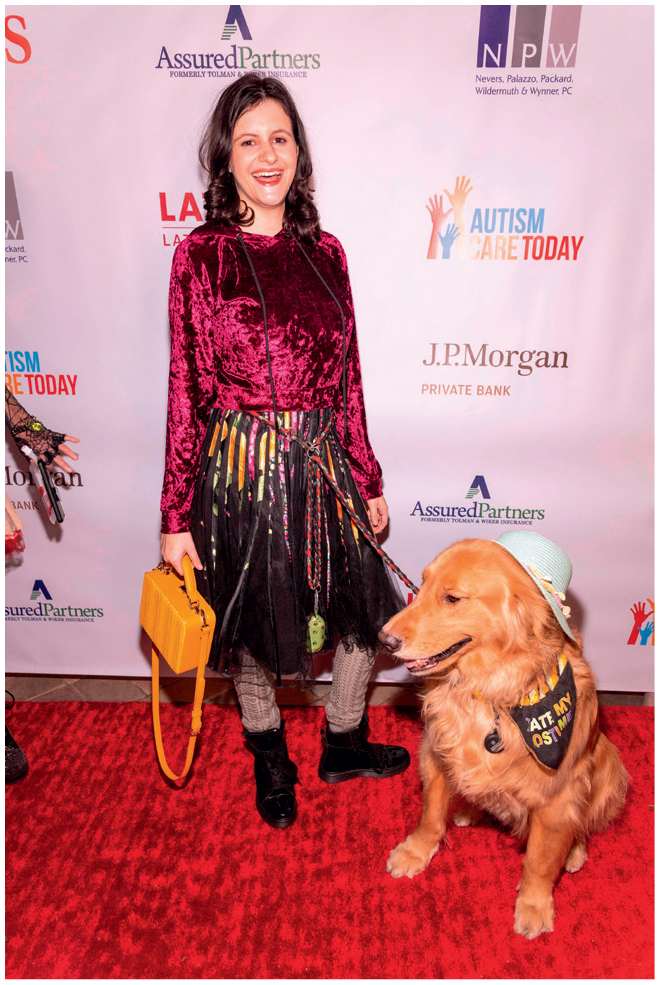
Lillian Carrier attends 1st Annual All Ghouls Gala Fundraiser for Autism Care Today in California, October 2022
CREDIT: Eugene Powers/Alamy Live News
She feels that the TV and film industry is moving in the right direction in terms of getting autism representation right, but there are still big things to work on.
“I think the thing that specifically our show did right is we had autistic consultants themselves. And we had autistic actors. And we have autistic writers. And bringing those things in brings that realness,” she said. “In the past — and still [now] — those artists and consultants are often ‘experts.’ And as much as they can read about autism in a book and meet people who are autistic, they’re never going to understand the true lived experience of what it’s like.”
When neurotypical actors play autistic characters, Carrier worries that it can feel like a mockery.
“Some of them do it brilliantly. They did their research, they were very respectful,” she said, highlighting the Power Rangers movie and Fantastic Beasts And Where To Find Them as positive examples. She is keen not to discourage representation, so her criticism is delicate. “But yes, it can go very wrong, very easily. I don’t want to blame the actors themselves, because they’re doing the best they can, but sometimes it comes across very ableist.” It can be harmful, she said, when studios get it wrong.
There is another problem with neurotypical actors being cast in autistic roles — the belief that autistic actors aren’t capable of playing themselves. Carrier calls this “dehumanising and debilitating”.
“We used to have blackface — it’s gross and uncomfortable,” she said. “[Being neurodivergent] is a lived experience, it’s something you can never understand unless you are in our bodies.”
Where Power Rangers and Fantastic Beasts triumph, Atypical and The Good Doctor do not. Although Carrier supports the fact that the shows were made, she is disappointed in how they represent autism. In Atypical, she sees the main character’s negative experiences being linked with his autism, while his positive experiences are a result of him overcoming it.
“Stories are the most impactful thing there is,” Carrier said. She highlights how the film Rain Man was the only representation of autism for years, and even now continues to affect the community.
“At the time, it was ground breaking and amazing. And I still think it’s good representation. The problem is when it’s the only representation, everyone thinks it’s what autism is,” she said.
“When you’re telling a story, and you include this sort of representation, you have to truly get it right. And you have to really take on that responsibility, which I think scares a lot of people out of writing our stories,” she said. Hiring autistic actors, writers, consultants or directors removes that burden.
Carrier also founded the organisation OurTism, which has a mission to listen to, empower and validate autistic adults and teens. Even though she runs a non-profit herself, when working as an autism consultant she said the biggest obstacle is getting hired in the first place.
“People would rather hire that expert rather than the autistic consultant who also happens to be an expert,” she said.
There’s another concerning trend, which Carrier says people have been unable to talk about. “I have consulted on a few scripts that when they are picked up by studios they asked for the autism to be removed,” she said. She doesn’t blame the writers, who need to make a living, so she has always agreed to it. But she describes these moves by networks and producers as harmful. Carrier wasn’t told the reasons for the censorship, but she believes companies are scared to touch particular subjects. “I think often, that’s why there’s so many coded characters, because networks won’t let them have those characters.”
On Twitter, autism consultant Amy Gravino wrote: “One year ago, I was asked to consult on #SharpStick, because the main character was written to be (yet never identified as) autistic. Right before I was set to meet with the lead actress and Lena Dunham, a decision was made to no longer have the character be autistic… because there “wasn’t any time” to consult with me about it. I had the opportunity to read the script, and the character was still clearly coded as neurodivergent/autistic.”
Even in the production of Everything’s Gonna Be Okay, which Carrier sings the praises of, she felt restrictions. “Gay sex scenes. Our autism moment, between Drea and Matilda, we had a little bit more going on in the original script and that was cut down to be more off screen,” she said. “But they had a straight sex scene, and they showed almost everything. But when the two of us were on screen, they barely let us kiss.”
Ultimately, she doesn’t want people to be scared to represent autism. There was a backlash against musician Sia’s film Music, which centred on an autistic character and which Sia was accused of going about in the wrong way and as a result being “ableist”. (Interestingly, in May 2023, Sia revealed she has been diagnosed as autistic.) Carrier believes this reaction left people afraid to end up in the same situation.
“For the most part, we weren’t attacking the movie, we were attacking certain moments of it. We were so happy it was made. But what then angered the community is the response,” she said. She explained that the response to criticism was “aggressive” and “defensive”.
“The response was, ‘Well, we didn’t hire an autistic actor because they’re not capable,’ rather than, ‘Oh, we tried. We’ll do it better next time. Thank you so much.’ That’s all we wanted to hear,” she said.
She’s still happy that shows like Atypical and The Good Doctor were made, because they paved the way for Everything’s Gonna Be Okay. What frustrates her are repeated mistakes.
“If you make mistakes, it’s okay,” she said. “We are gonna be okay with that. Because you’re moving in the right direction. And you’re trying and we will give feedback — we’re an honest community. We are brutally honest. But it comes with love.”