




Abstract

When a woman is arrested for making an online slur against Macron it’s time to sit up.
Does this vocal and global defence of the “right to blasphemy” mean that France is a champion of free expression? According to a survey released on 5 May in the centre-right daily L’Opinion, 54% of French people (and 69% of the far right) think that “freedom of expression in general is no longer guaranteed” in Voltaire’s country. This malaise is partly driven by highly polarised controversies on laicite (secularism), ‘wokeism’, migration and French identity. The ardent arguments around the conviction for hate speech of journalist and far-right presidential candidate Eric Zemmour, as well as a number of cases of cancel culture at French universities against “politically incorrect” intellectuals, undergird these perceptions.
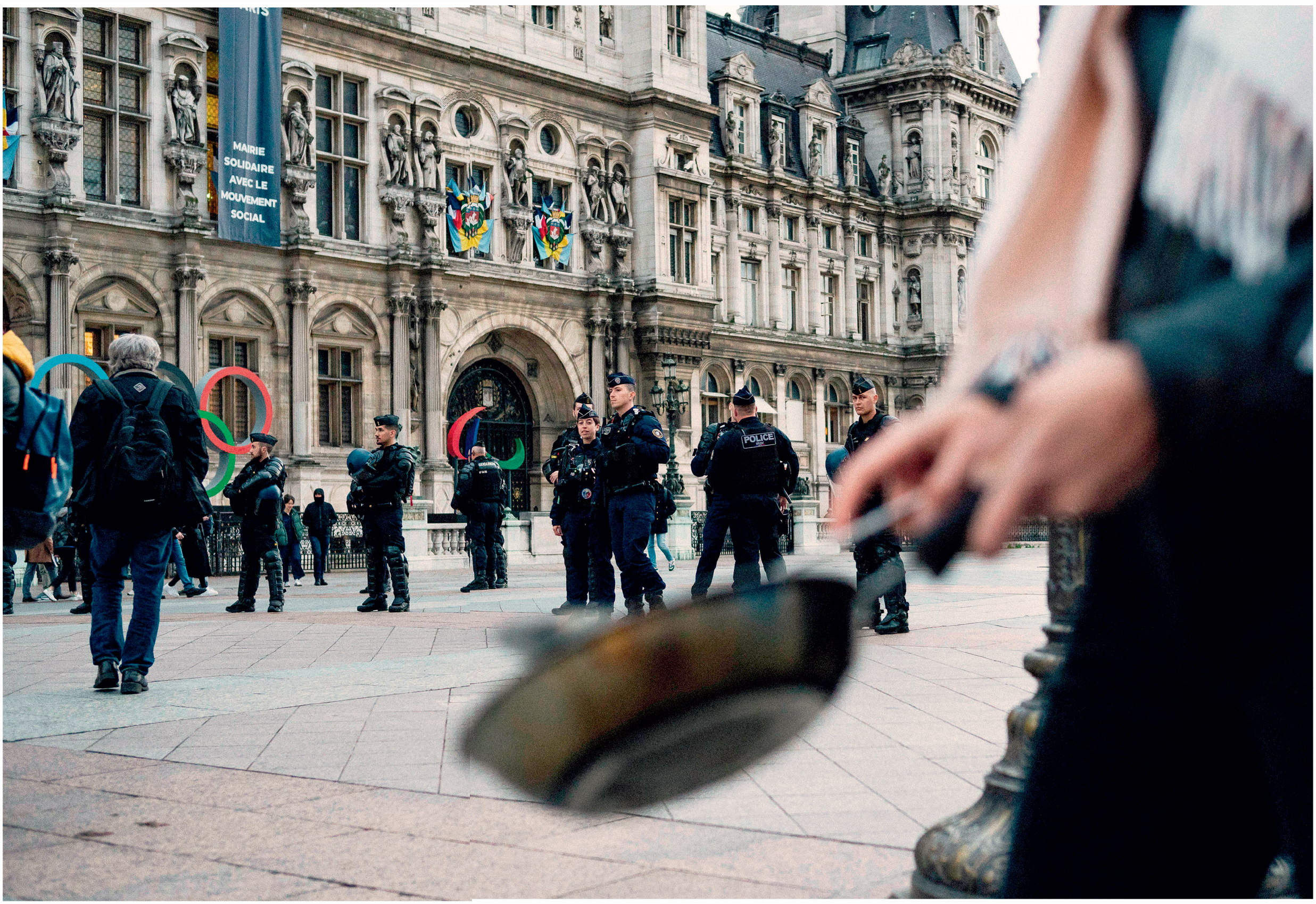
These perceptions are also related to the response to those protesting the government’s controversial pensions reform plan. In March, a woman from Northern France was charged with insulting Macron after describing him as “filth” in a Facebook post. In April three people in Alsace were notified that they would face trial for allegedly shouting abuse at the president. In a number of departments, overzealous prefects have also tried to ban so-called casserolades (saucepan concerts), a staple of anti-Macron protests.
“The defence of liberties has become the most urgent issue of the time,” warned Patrick Baudouin, the president of the League of Human Rights on 3 May. The venerable LDH, which was founded in 1898 during the emblematic Dreyfus Affair, has itself been underhandedly threatened with losing its state funding.
And what about press freedom, the canary in the mine? The press has had a hard time covering clashes between demonstrators and the police. According to the main journalists’ union Syndicat National des Journalistes, “reporters have been targeted by the security forces and prevented from doing their work”. And journalists highlight a number of other issues. “One major concern is the growing concentration of media ownership in the hands of a few press barons with big stakes in economic sectors outside of the media,” Reporters Without Borders’ general secretary Christophe Deloire told Index. Press freedom groups also complain about the political instrumentalisation of public prosecution by the government and the repetitive recourse to SLAPPs (strategic lawsuits against public participation) against investigative journalists.
Demonstrators gather beside police in Paris in April 2023. The protesters carry pots and pans - a staple of French protests - which several districts are now trying to make illegal
CREDIT: Jan Schmidt-Whitley/Le Pictorium/Alamy
“Since our launch in 2008, we have had more than 250 lawsuits!” Edwy Plenel, the president of the left-liberal online investigative news site Mediapart, told Index. “State secrecy is another critical issue,” he added. In December, three journalists of major news outlets (Radio France and Disclose) were summoned by the directorate-general of internal security for their reporting on alleged influence-peddling in the military. In 2019, three other journalists had been called in for a story on the use of French weapons in the Yemen war. Besides, Plenel notes, “the current executive is devoid of a liberal political culture with a president who assumes the right to criticise the press.”
Is France’s free speech landscape and press freedom doomed? In an interview in the left-liberal weekly L’Obs, political scientist Philippe Corcuff cautioned on 8 May against a “verbal exaggeration in the criticism of the government” and, although admitting “a backsliding of the rule of law”, he rejected the qualification of “illiberalism”. This is in part because newsrooms and journalists’ organisations have pushed back vigorously and, as Edwy Plenel told us, “they have been protected by the strong guarantees provided by the 1881 press law and by independent judges. In 15 years we only lost in five lawsuits, on questions of detail.” The courts have also quashed the prefects’ protest bans and the administrative services of the interior ministry have themselves admitted in an internal memo that such bans, “outside of the justification of a terrorist risk, are a misuse of procedure”.
However, despite these checks and balances, “seen from abroad, Macron epitomises the authoritarian drift of power in the country of Enlightenment,” warned Thomas Legrand in the centre-left Libération. In fact, the recurrent images of unbridled violence at protests reinforce the perception that France is on a wrong track, with Black Bloc’s (Antifa) vandalism and a riot police that, in the words of sociologists Olivier Fillieule and Fabien Jobard “follow an authoritarian model (of law enforcement) at loggerheads with France’s European neighbours”.Liberals inside and outside of the government also fear that interior minister Gerald Darmanin’s rugged “law and order” rhetoric and at times casual interpretation of the law bring Macron’s government dangerously close to the Rassemblement National (Marine Le Pen’s National Rally) mantras on freedoms.
France appears drawn into a form of “authoritarianism of atmosphere” which feeds the polarisation of the democratic debate and reinforces political groups and their leaders, from LFI’s Jean-Luc Melenchon to Rassemblement national’s Marine Le Pen, with little patience for freedom of expression. France seems to evolve in a “moral atmosphere”, to quote Austrian writer Stefan Zweig’s remarks about Europe in the 1930s, where the public space shrivels under the blows of mutual intolerance. It’s where the title of a famous essay by US journalist Nat Hentoff ominously resonates: “Free Speech for Me, But Not for Thee.”