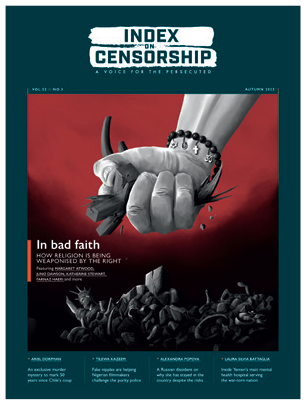
Abstract

The religious right is gaining ground, and free expression cannot survive in its shadow, writes
This might be true, but it’s happening in tandem with a different trend (and maybe even because of the Nones) - the re-emergence of a politically charged, religious right.
Consider just these few examples: a loose coalition of theologically and politically conservative faith groups successfully pushed for the overturning of Roe vs Wade in the USA last year; in January, Pakistan extended its already harsh blasphemy laws; this August, Denmark proposed a law to make improper treatment of the Koran or the Bible a criminal offence punishable by up to two years in jail; a fast-growing group of religious conservatives allied with Israel’s Prime Minister Benjamin Netanyahu is currently trying to neuter the country’s Supreme Court.
A binary of “religion bad, no religion good” would be inaccurate - scripture can promote tolerance and injustice happens in the name of atheism, too (just look at North Korea). Still, it is a sad reality of today that there are many who, in the name of faith, are preaching and imposing intolerance, and the direction of travel is not good.
We explore all of this in the Autumn issue. While the religions are different, they all bear a strong family resemblance. Embattlement is at the core, with followers engaged in a conflict with enemies whose values seem inimical to theirs. Identities are built around a reclamation of certain doctrines and practices of the past. These meld with the best tools of modernity and appeal to modern ideals of religious freedom. Here, though, religious freedom is enlisted to support an antidemocratic project. Free expression is lost.
In the special report, Rebecca Root charts the increased imposition of blasphemy laws around the world, talking to some of the victims, including the wife of a man who is in jail in Nigeria serving a 24-year sentence. From India, Salil Tripathi talks about how even Hollywood film Oppenheimer has caused offence in the increasingly Hindu nation. Kaya Genç writes on the bitter legacy of the Salman Rushdie affair and the secular foundation still feeling the heat in Turkey. Experts on the religious right - author Margaret Atwood and journalist Katherine Stewart - offer their take on what is happening and why.
“The church must be reminded that it is not the master or the servant of the state, but rather the conscience of the state,” Martin Luther King Jr. said. Let this report be a reminder.
Outside the special report, we have something else very special - a new story from the esteemed playwright Ariel Dorfman. A tale within a tale, borrowing characters from Dorfman’s other work, it’s very meta, as the kids would say, and has a murder mystery at the core. Dorfman’s story is one of two pieces to mark the 50th anniversary of Augusto Pinochet’s coup in Chile and the bloodshed that ensued. The other looks into how the general’s popularity remains stubbornly resilient today.
Of the cover image Khan said “the illustration takes a lot of inspiration from political and journalistic cartoons.” Khan continued: “There was a strong sense to depict the destruction that comes from an authoritarian “right” that looks to exert power over minorities and liberties, as has always been the case for a fascist ‘modus operandi’”.