




Abstract

Protest art has come under fire since Peru’s political crisis hit breaking point, writes
This year, there was one that stood out among the traditional religious scenes and motifs: a minimalistic design featuring a large black cross with the words “No Mataras” - “Thou shalt not kill” - and “December 15, 2022”.
The carpet referenced the killing of 10 civilians by the army in Ayacucho, a day after president Dina Boluarte authorised the armed forces to intervene in ongoing protests against her government, even though military personnel are not trained to deal with civilians in the context of social unrest. Their response included using helicopters to drop tear gas and firing live ammunition at unarmed protesters. The youngest victim was 15 years old.
“We had the carpet made to remind everyone that Holy Week was not holy, that it was tainted by all the blood that had been spilled and the lack of justice,” Ruth Barcena told Index.
Barcena is the president of a collective formed by relatives of those killed and wounded on 15 December and organised around a demand for justice and accountability.
Barcena’s husband, 32-year-old driver Leonardo Hancco, was among those fatally injured by the army. He’d joined the protests, carrying a sign demanding a new constitution for his country. Barcena recalls rushing downtown after hearing he’d been injured.
“It was like being in hell,” she said. “They were running after people and shooting them in the street.”
Hancco died that day and, shortly after, the pregnant Barcena lost the twin babies she was carrying.
Commissioning a carpet to commemorate the deaths was a way of dealing with the paralysing grief she still struggles with. After unveiling it, however, the group was immediately surrounded by police.
“They trampled all over it. We were too scared to fight back. We were afraid we’d be killed as well,” Barcena recalled. “All we could do was stand to one side and cry.”
The police detained those involved in the making of the carpet and threatened them with prosecution, although all charges were eventually dropped. Nevertheless, the incident highlights a worrying trend by the government of censoring forms of symbolic and creative protest, stigmatising those in opposition and curtailing freedom of expression, according to the protesters and human rights activists who spoke to Index.
The ongoing political crisis has had grave consequences for basic civil rights in the country. Between 2022 and 2023, Peru fell 33 positions on the latest World Press Freedom Index and is currently ranked 110th out of 180 countries. In the last two weeks of July, at least nine journalists suffered police violence or were subject to arbitrary detentions while covering the latest wave of anti-government protests, according to Reporters Without Borders.
Filmmaker and photographer Kenty Aguirre was detained and held in police custody for 43 hours and was left with bruises and abrasions on his body. Just a few days earlier, a university student was arbitrarily accused of writing “Dina Asesina” (“Dina the murderer”) on a wall and, whilst detained, suffered a serious asthma attack, requiring hospital treatment.
In June, political cartoonist Cesar Aguilar, along with students and fellow professors from the National University Diego Quispe Tito in Cusco, created a float for the city’s annual university parade.
Named La Descarada - a play on words that means both “the shameless woman” and “the faceless woman” - it referenced Boluarte by depicting a woman dressed in military garb, stepping over skulls.
The float became a viral sensation throughout the country, which might have contributed to Aguilar reportedly facing ongoing threats by the authorities. When La Descarada disappeared the day after the parade, he said he learned from other professors that it had been taken by university personnel and burned.
Political cartoonist Cesar Aguilar’s La Descarada float joins a parade, and has now been destroyed
CREDIT: (left) Comfort Booth/Instagram; (right) César Aguilar
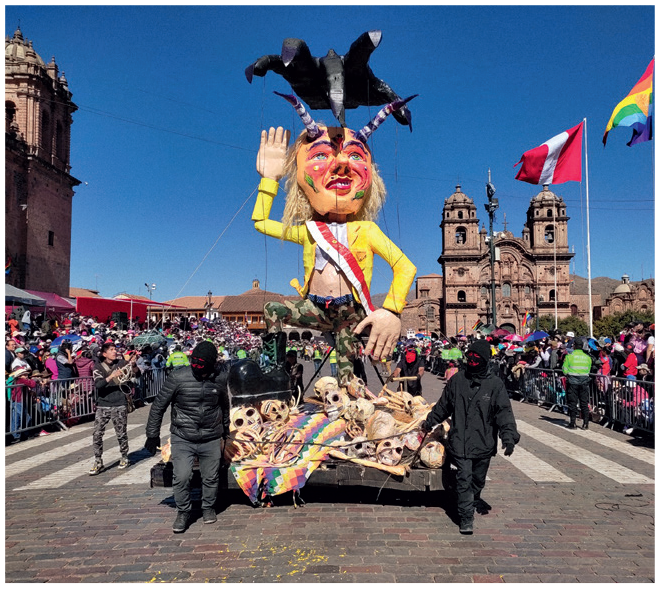
“The minister of education then pressured the university to force me to sign a public letter apologising to the president and the government,” he told Index. “After I refused to sign, the university started a new recruitment process for my position halfway through the academic year, which is entirely irregular.”
Aguilar also denounced censorship against El Muro (“The Wall”) - a grassroots organisation he co-founded that highlights topics of civic interest by posting printed news, political commentary and art on a wall in downtown Cusco.
Despite working without interruption for the past two decades, he claims that police now prevent them from conducting their usual activities, effectively limiting freedom of expression in a country where many still don’t have access to social media or other forms of online discussions.
Activists and protesters from Lima, the country’s capital, have not been spared this form of censorship and prosecution, either. In January, shortly after the police fatally shot 18 people in the city of Juliaca, young actress Leonor Estrada staged a theatrical protest in solidarity with those killed.
Donning a wig and a presidential sash draped over an oversized suit, she trampled and danced over a Peruvian flag during a small demonstration in the upscale district of Miraflores. Assuming the persona of Boluarte, Estrada shouted at police: “Do you want to shoot? Go ahead! Shoot them! Aim straight for their bodies!”
Shortly after, a group of lawyers brought her case to the attention of the judiciary on charges of insulting patriotic symbols. The offence is categorised as a criminal charge and carries a sentence of up to four years.
Estrada’s lawyer, Gabriela Paliza, told Index that the investigation was still ongoing. “We argue that this does not constitute an attack only on freedom of expression but on the right to exercise your craft,” she said. “Leonor is a performance actress, but this is extremely difficult to explain in Peruvian courts.”
Jennie Dador, the executive secretary of the National Coordinator of Human Rights coalition, underscores that these actions collectively constitute a clear effort to curtail freedom of expression and dissenting voices in the country. Dador said prosecutors were well aware that these charges were likely to be ultimately dismissed or archived.
“Still, the person is subjected to unreasonable and draining investigations that can stretch for multiple years,” she told Index. “Ultimately, this exerts a self-censoring impact on society as a whole, acting as a sort of disciplinary mechanism to regulate what can and cannot be said.”
Aguilar agrees. “We are internalising the notion that it’s best not to disturb power - to just mind your own business.”
State efforts to stigmatise symbolic dissent, however, can sometimes backfire, leading to widespread mockery.In March, police in Lima seized makeshift shields employed by protesters to protect themselves against tear gas and rubber bullets during protests. The shields are often made by members of the Primera Linea, a loosely-organised collective of protesters inspired by the tactics displayed in Hong Kong. Seen as either anonymous heroes or dangerous agents of terror, they often rush to deactivate tear gas and don’t shy away from physically clashing with law enforcement.
At a press conference, police commander Jorge Angulo proudly showed one of the seized shields, adorned with red, black and yellow letters that spelled “BOYKA” - purportedly referring to the name of an American-Bulgarian martial arts film franchise. Gesturing towards the shield, he said: “Semiotics enables us to decode messages through symbols and colours. In this case, the red letter signifies violence, the black letter signifies death and the yellow letter signifies happiness. This is by no means coincidental.”
11 January 2023 in Juliaca, Peru, people commemorate protesters who were killed after heavy clashes with police two days before in the same city. The protests were directed against the government of interim President Boluarte, with the demonstrators demanding her resignation
CREDIT: Denis Mayhua/DPA/Alamy

The statements made by the facetiously-labelled “semiotics police officer” led to widespread mockery on social media. However, a member of Primera Linea - speaking to Index on condition of anonymity - said they felt more concern than amusement.
“It almost feels like they hyperfocus on things that are not really a threat to them. Graffiti, words, symbols, shields… they’re trying to repress even harmless dissent.”