




Abstract

Rohingya Muslims thought they were reaching safety in India, but under Narendra Modi their future is precarious.
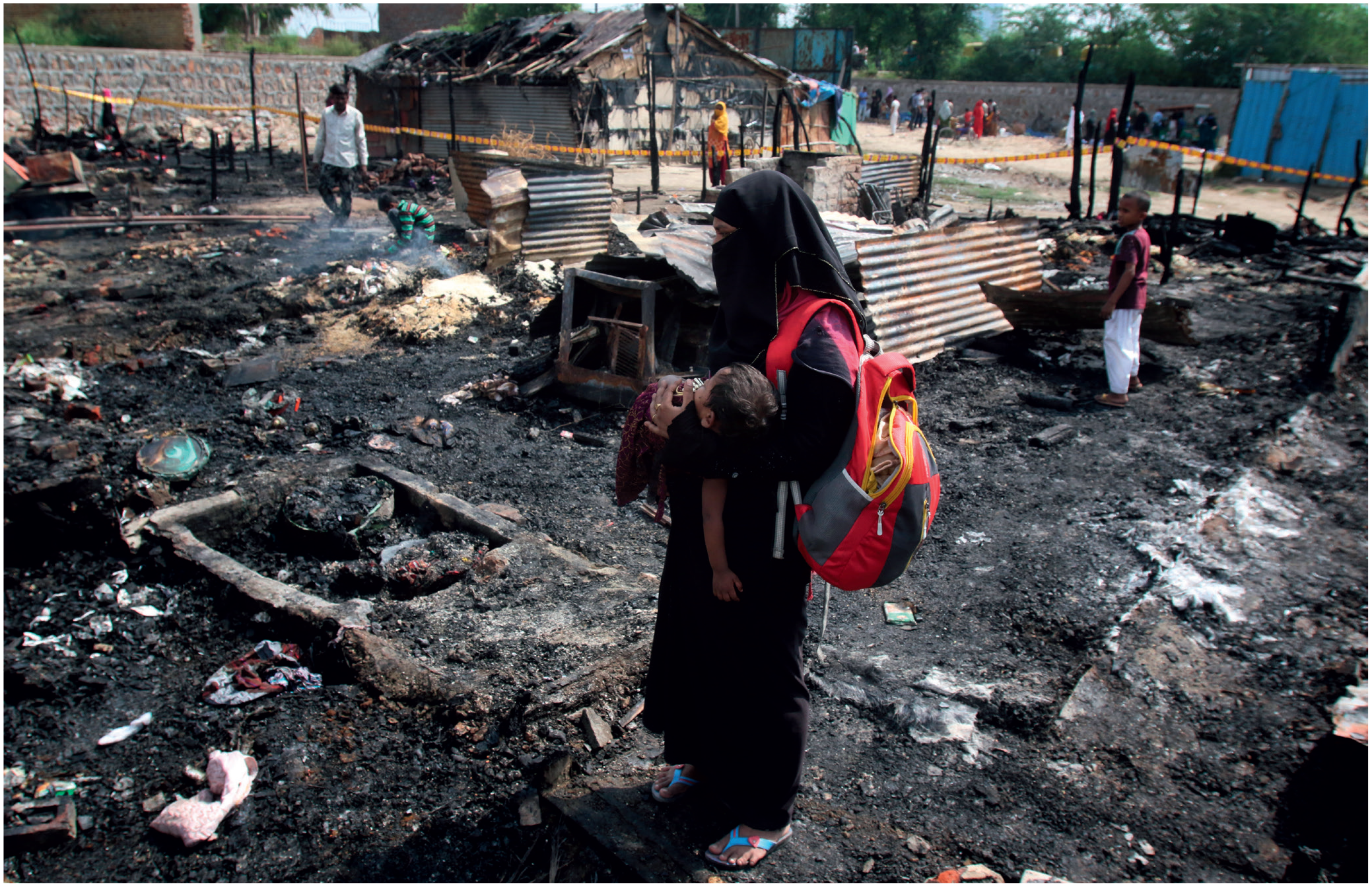
Over 50 shanties were gutted after a fire broke out at a Rohingya refugee camp in New Delhi, India on June 13, 2021
CREDIT: Pankaj Nangia/Anadolu Agency
Three years ago, like many other Rohingya refugees in India, his parents were taken by the police from their camp.
“My sister had offered prayers and prepared tea at around seven in the morning. Along with her husband, they were about to begin their breakfast when a community leader knocked on the door asking them to come along because police had asked for both of them to show up at a metro station,” recalled Sabira, the elder of the two sisters.
Once at the station, according to Sabira, the couple were bundled into a car, never to return. They were taken to a detention centre, despite possessing a refugee card provided by the UN High Commission for Refugees, and for years were not allowed to meet their child. Only now are they allowed to see him, but he is still somewhat inexplicably not allowed to live with them.
Of course what most pains Sabira and others in the family is the impact it has had on Sulaiman, a child being kept away from the love and affection of his parents at such a young age.
“Sulaiman often weeps and asks ‘When will my mother come?’“ said Sabira of a boy who has little confidence and who barely speaks in front of strangers.
Saying goodbye to the lush green fields of Rakhine, a state in Myanmar, to move to a fetid slum such as the one they are in today in Delhi was hard, but essential for Sulaiman’s family. The Muslim Rohingya have faced extreme and regular discrimination due to their distinct ethnicity, religion and language compared with the majority Buddhist Burmans.
During 2016 and 2017, a genocide unfolded, resulting in the deaths of around 9,000 Rohingyas, who had endured discrimination for decades. The Rohingya community was subjected to appalling atrocities, including forced labour, torture and disappearances. The US State Department’s report in 2018 shed light on these heinous acts and the violence extended to the brutal rape, abuse and murder of Rohingya women, leading the UN to label them as the world’s “most persecuted minority”.
Calm before another storm
For many Rohingya Muslims, who reached India before the right-wing government of the Bharatiya Janata Party led by Prime Minister Narendra Modi came to power, things went smoothly without any fear of deportation. They got work and, more importantly, refuge from persecution.
“When I reached Delhi, I took a deep breath, feeling a sigh a relief. I was sure now things will be good because I had heard about Nizamuddin Dargah [a mausoleum for a Muslim saint in Delhi] in my younger days,” said Fareed, who is now in his mid-30s.
Fareed got a job, saved some money and then got married. “The initial phase in India was good. There was no threat of deportation and we were going about our business as usual,” he said.
But once vigilante justice was stirred up on social media under Modi, with Muslims being lynched in broad daylight, the call for deportation of Muslims who came from Myanmar grew louder. Fear set in. Many started wondering whether they had made the right choice.
Fareed recalled one incident: “One day after BJP came to power in 2014, a Hindu man who used to work with me as a labourer said: ‘We will keep you suppressed’.”
The people who spoke to Index did not want to use their full names in case of repercussions, but they all told similar stories.
“Many people of our community were killed, along with my father in Myanmar. He was in his shop at around 11pm when he was killed by the police,” said Ismaiel, who came to India via Bangladesh back in 2012. Still, life in India today is tough.
“The opportunities are not here,” said Ismaiel. “We are not able to teach our children the way we would have wanted.”
The camp that he and Fareed, Sulaiman and Sabira are in has been set on fire several times. Conditions are squalid, food scarce and security lax.
All the while, India refuses to recognise Rohingyas as refugees and intentionally stirs up xenophobia. Last September, the central government denied documentation for a Rohingya woman and her children, who sought to join their father in the USA. During a court proceeding in Delhi, the government asserted that Rohingya refugees living in India posed a serious threat to the country’s national security.
Back in 2018, the government said that the Rohingya community had links to terrorist organisations when justifying their stance on “illegal immigrants” in front of the Supreme Court. Television channels and media aligned with the government amplified these allegations without evidence, further contributing to the unjust criminalisation of the Rohingya community.
This has had severe consequences, as India threatens to deport Rohingya refugees for lacking valid travel documents, violating the international legal principle of non-refoulement, which prevents the forced return of refugees to countries where they may face harm or persecution.
Though India is not a party to the UN Convention Relating to the Status of Refugees (1951) and its 1967 Protocol, the principle of non-refoulement is universally recognised as binding on all countries. And India is a signatory to the Universal Declaration of Human Rights 1948, the International Covenant on Civil and Political Rights 1966, the 1989 UN Convention on the Rights of the Child and other international instruments that explicitly establish rights for detainees, especially women and children.
Although India’s refugee protection obligations remain limited, the global consensus on non-refoulement remains a fundamental tenet of international law, obliging all countries to safeguard the rights and safety of asylum seekers, including the Rohingya.
For the last three years, Sabira has knocked on every possible door to secure the release of her sister. She has spoken to the police and officials, but no one will help. The innocent face and repeated questions of her nephew pierce her heart, adding to the grief that besieges the whole community.
Sitting next to Sabira is her elder daughter, Noor Fatima, who was born in India, far away from her ancestral home-state. When asked whether she would prefer to go back to Myanmar where her grandparents are, the primary school pupil says, “Yes, I would like to meet them in person.”
Watching her daughter speak from a distance, Sabira interrupts: “However, this is not possible.”
India’s Rohingyas are trapped; unable to return to Myanmar, increasingly threatened in their new home and with no one willing to listen or help.