




Abstract
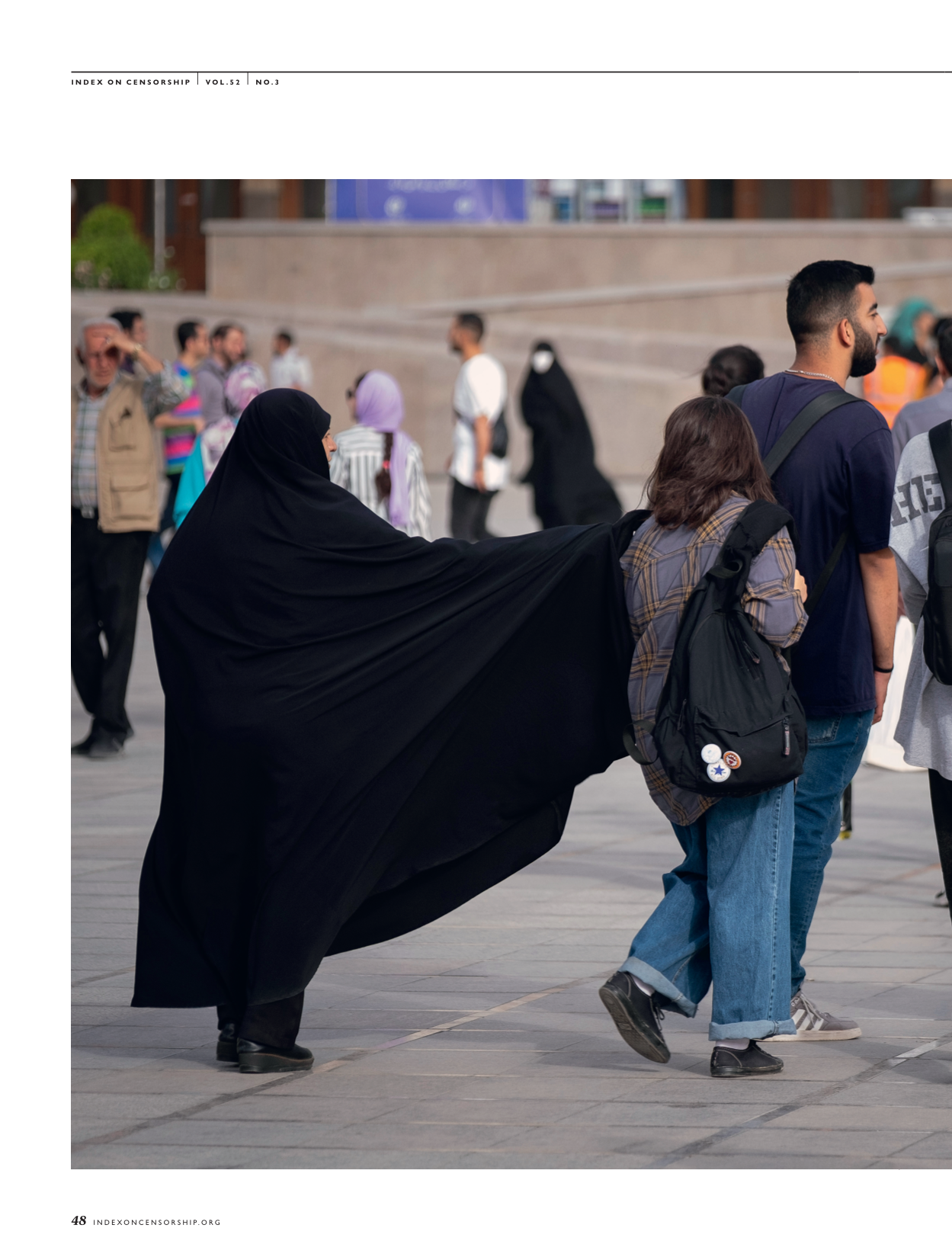
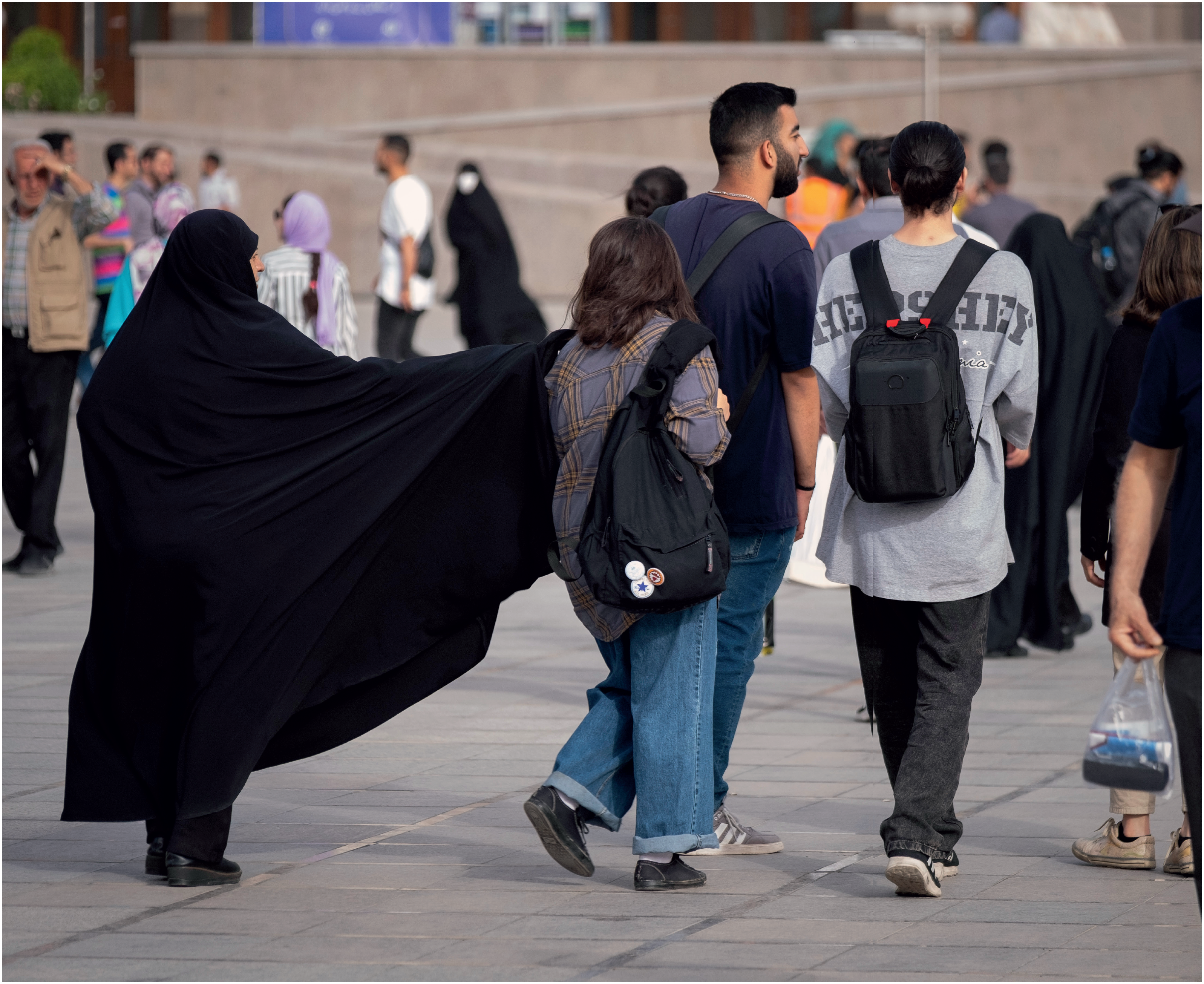
A veiled woman asks another woman without a mandatory headscarf to observe her hijab, at the Imam Khomeini mosque in downtown Tehran during the International Book Fair in May 2023
On 28 April 2020, six weeks after Amina Ahmed had given birth to her son, her husband Mubarak Bala was taken away. It would be nine months before a letter, smuggled out of prison, would let her know that he’d been arrested and accused of blasphemy.
“My life has not been the same. I’ve gone through severe mental and psychological trauma,” she told Index from her home in Nigeria. “This is wickedness of the highest order.”
Two years after being arrested, Bala - an atheist from the predominantly Muslim state of Kano - was sentenced to 24 years in prison.
Around the globe, laws about blasphemy continue to be strictly enforced and strengthened with supporting legislation. The United States Commission on International Religious Freedom (USCIRF) said in a press release in May that it was “alarmed by the continued enforcement of blasphemy provisions”.
“Blasphemy laws are [increasingly] implemented with higher punishments,” Alexis Deswaef, vice president of the International Federation for Human Rights (FIDH), told Index.
Between 2014 and 2018, there were 732 reported blasphemy-related incidents in 41 countries. This is in spite of repeated calls from the UN to repeal blasphemy laws in order to make way for freedom of religion or belief. But that in itself is in conflict with the UN Human Rights Council, who just adopted a resolution that “underscores the need” to hold individuals responsible for blasphemy to account, a move following protests that erupted after the burning of the Koran in Sweden. In July, a cohort of NGOs expressed concern that things could worsen if the UN approved the resolution. In a public letter calling for the draft to be rejected, the non-profits said the resolution “seeks to protect not only individuals but rather religious books and symbols” and that this is “contrary to guarantees of freedom of opinion and expression”.
Since 2015, only nine countries have repealed blasphemy laws. And, as of 2020, 84 countries still had them - with penalties ranging from fines and imprisonment to capital punishment. Some countries have even strengthened their laws over the last year, while Denmark announced this summer plans to reintroduce theirs.
Iran and Pakistan, Muslim-majority countries, have the strictest blasphemy laws, as does Nigeria, which is divided between Muslim and Christian regions.
“Every religion should be strong enough to accept some critics, but what you see in a lot of countries that implement laws is that there are no critics of the main religion,” Deswaef said, adding that blasphemy laws go hand-in-hand with apostasy laws, which prohibit individuals from renouncing their religion.
This is exactly what Bala did. In 2014, Bala told his family he was no longer a believer in Islam. In response, they had him detained in a psychiatric facility. He was released shortly after and became president of the Nigerian Humanist Association, posting online about there being no afterlife.
He pleaded guilty to 18 counts of causing a public disturbance through “blasphemous” Facebook posts in accordance with the Kano State Penal Code. He could have received the death penalty if tried under Sharia law, in place in 12 of the country’s northern states.
Iranian blogger and photojournalist Soheil Arabi did receive a ruling under Sharia law in Iran when he was sentenced to death in 2014 for posting articles on Facebook that criticised the Islamic government.
“In mid-autumn of 2013, 10 Islamic Revolutionary Guard Corps executioners stormed my photography studio [and] arrested me with guns and violence,” he told Index, adding that he was then beaten and blindfolded.
“After 200 days of interrogation and explanation of accusations of blasphemy, proselytising activity against the system and insulting the Prophet of Islam, I was sentenced to the death penalty in the Islamic court.”
His sentence was later changed to eight years in prison, and although he was released in 2021, Arabi has been forced to live in internal exile in a remote location.
In May 2023, two men who weren’t successful in getting their sentences changed - Yusef Mehrdad and Seyyed Sadrullah Fazeli Zare - were executed in Iran for posts in a group chat on the Telegram app which were seen as insulting towards the Prophet Muhammad. In June, a 19-year-old man identifying as Christian was sentenced to death in Pakistan for a similar incident.
And back in Nigeria, Islamic gospel singer Yahaya Sharif-Aminu was sentenced to death in 2020 by a Sharia court for blaspheming in a song. His case is set to be retried following complaints about the handling of the original trial.
Although Bala didn’t receive the death penalty, Ahmed said she knew instinctively there’d be repercussions for him when she saw his online content. “I told him: ‘I have a bad feeling that they are coming to get you’,” she said.
But he refused to believe he could be arrested for posting on Facebook.
Imprisonment for blasphemy is becoming more common around the world. In June, Pong - who uses a pseudonym - was sentenced to 18 years in jail in Thailand, accused of posting insulting content about the monarchy, which is protected under law “in a position of revered worship”. In March, a 19-year-old was sentenced to compulsory labour in Russia for burning a religious icon. And in 2021, a Yemeni man received a 15-year prison sentence in Saudi Arabia for renouncing his beliefs on Twitter. Foreigners there have also been accused of blasphemy, receiving up to 500 lashes and prison time as punishment.
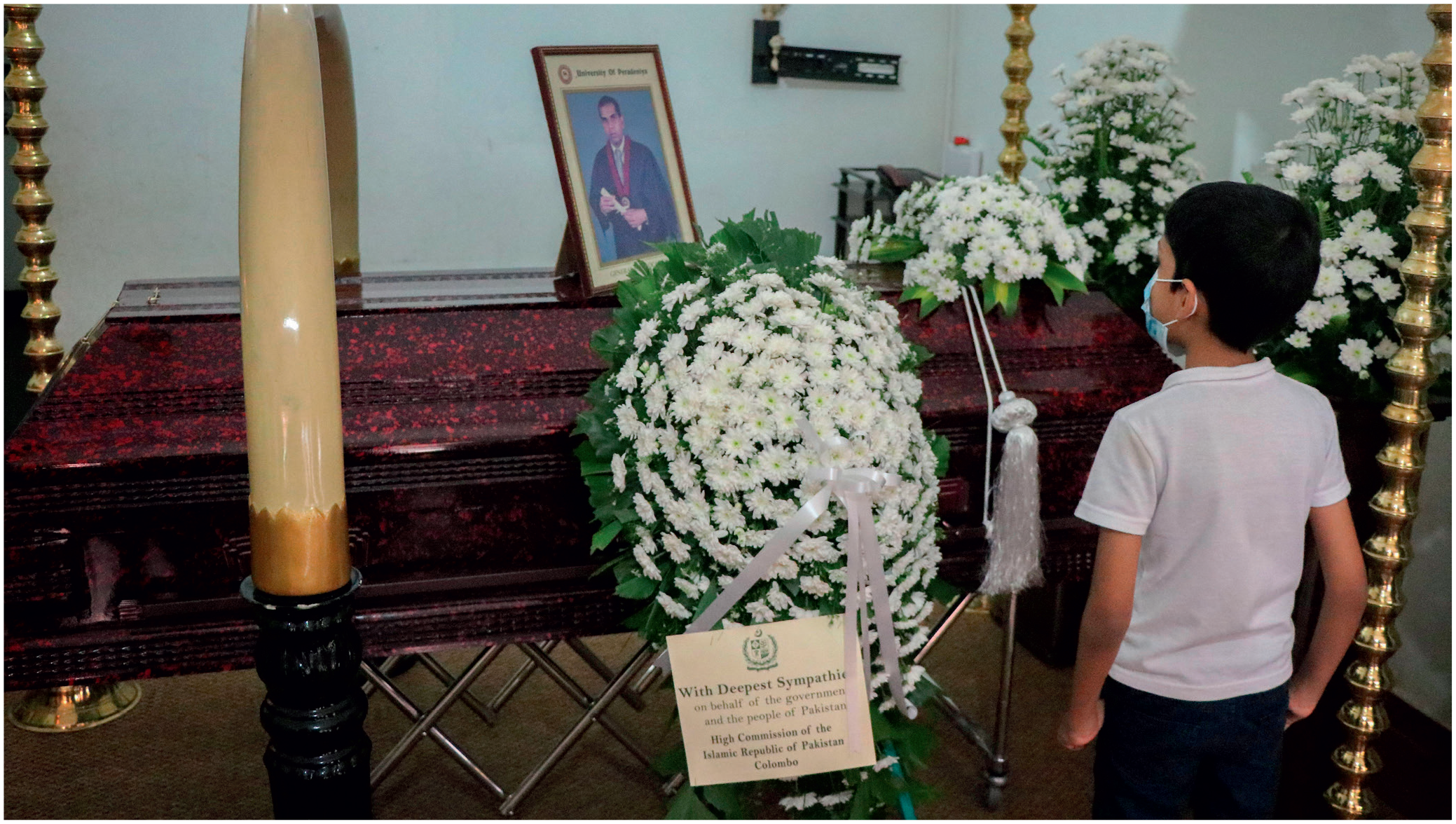
The youngest son of factory manager Priyantha Kumara Diyawadana stands in front of the coffin of his father in Ganemulla, Sri Lanka in December 2021. Diyawadana was earlier beaten to death and set ablaze by a mob in Pakistan who accused him of blasphemy
CREDIT: Pacific Press Media Production Corp/Alamy
Despite global outrage and calls from human rights organisations advocating for the release of these people, some countries have instead reinforced their existing blasphemy laws.
This year both houses of parliament in Pakistan passed legislation making it illegal to insult not only Islam and the Prophet Muhammad but also those connected to the Prophet. In Indonesia, a new criminal code passed in December 2022 has seen the blasphemy law extended to include apostasy for the first time. And in Iran, it was reported earlier this year that the Islamic criminal code was being adapted to criminalise sharing critical opinions on social media.
Misuse of blasphemy laws
Mahmood Amiry-Moghaddam, director of the NGO Iran Human Rights, believes the current Iranian regime is trying “to rebuild a barrier of fear” and is using the death penalty and blasphemy laws to do so. And as Deswaef has highlighted, blasphemy laws and their corresponding punishments are also being used to persecute minority groups.
Civilians pushed back on the authoritarian government with widespread protests last year when a young Kurdish woman, Jina “Mahsa” Amini, was killed in police custody having been arrested for not wearing the hijab in a way considered suitable.
“Blasphemy means that the government has the right to do any injustice to us, and if we protest we will be recognised as infidels and [it] has the right to execute us,” Arabi said, adding that there were also other repercussions.
“These regressive laws affect our whole lives, our studies, our work, our social relationships and even our romantic relationships. My wife divorced me, and I haven’t seen my daughter for six years.”
Isa Sanusi, Amnesty International’s acting Nigeria director, explained how it was not unusual for people to take the law into their own hands. He described how a man with a mental health condition had been murdered.
“Someone dragged him into an argument. He said something and he was accused of blasphemy. People gathered around, set him on fire and killed him,” he said, adding that such incidents were on the rise.
In June, Usman Buda, a butcher, was stoned to death in north-west Nigeria after getting into an altercation with another trader and being accused of blasphemy. And in February, a mob in eastern Pakistan lynched a man who was accused of the same crime.
According to USCIRF, of the 732 blasphemy-related incidents reported between 2014 and 2018 mob activity, violence or threats occurred in 78 cases that coincided with state enforcement and in 58 cases where there was no official enforcement.
Bala, too, was subjected to these activities, receiving threats to “chop off his head”. Yet once he was sentenced, some who had been critical of his actions reached out to share that they thought the sentence was too harsh.
“People take pity on him,” Ahmed said, adding that Bala was doing as well as he could in prison, and calling for others outside Nigeria to urge the government to release her husband.
Setting an example
In April, the European Parliament said blasphemy laws in Nigeria were in violation of its international human rights commitments, the African Charter and the Nigerian constitution, and urged the authorities to release Bala as well as Sharif-Aminu and others. It also called on the country to lead the way in abolishing blasphemy laws.
But Amiry-Moghaddam said such an outcry never came when the two men in Iran were hanged. “We were expecting strong international reactions and those reactions didn’t come,” he said, adding that it sent an “unfortunate signal to all those who are threatening freedom of expression everywhere else”.
“Today it’s Iran, tomorrow it could be somewhere else,” he said. He suggested that other countries impose sanctions on the judges involved in the case. “We need both strong diplomatic reactions and practical steps.”
Arabi echoed this sentiment and stressed that political prisoners need international support. He said: “The Iranian government must be pressured to release the people.”
Researchers have also called on social media companies to protect their users and “uphold global standards of free speech”.
In the meantime, in Nigeria, Ahmed holds onto the hope that her husband will be released and get to witness at least some of his son’s childhood.
“Let him be free and let him reconcile with his family. That is what I’m begging the Nigerian government for,” she said. “It’s insane. It’s not right.”