




Abstract

Aziz Nesin was caught in the middle of Turkey’s anti-Salman Rushdie campaign in 1993. Thirty years on, extremist Muslims are attacking his foundation.
The spectre of this crime against humanity continues to haunt Turkey three decades on. Anyone associated with the legacy of Nesin - who died in 1995 - is viewed with suspicion in Islamist strongman Recep Tayyip Erdogan’s “New Turkey”.
Since 2020, the Nesin Foundation, established in 1973 as a boarding school with a capacity of 40 children in Istanbul’s Catalca neighbourhood, has been a target of Erdogan’s regime. That year, the foundation fell out with Rabita, an Islamist foundation linked to influential Islamic sect the Ismailaga, after Rabita members moved in next door. In 2021, two Rabita members, Sezar Korkmaz and his son Ahmet, attacked the foundation’s director, Suleyman Cihangiroğlu, so violently that he had to go to hospital. Soon afterwards, Erdogan blocked the Nesin Foundation’s accounts.
Members of Rabita were undoubtedly aware of Aziz Nesin’s progressive legacy when they attacked its director. Erdogan was aware of it, too. As Istanbul’s mayor in 1994, a year after the Sivas massacre, he said: “We’ll excise Aziz Nesin’s name from Istanbul’s streets.”
Just two months before the hotel was set alight, Nesin, a legendary humorist, had published portions of Rushdie’s novel in Aydinlik, a leftist newspaper he edited. On 11 May, he penned an op-ed piece titled “The Satanic Verses will be published”, and claimed: “I think that Turks, because they’ve Turkified Islam, won’t murder in the name of religion. I might be wrong… But we can prove by publishing Rushdie’s book that Turkey’s true intellectuals will not stray from rationality, even under death threats.”
Nesin’s optimism didn’t diminish after the government made its position on the Rushdie affair clear by outlawing the importing of The Satanic Verses into Turkey. It also banned any attempt to translate the text into Turkish.
On 28 May, Nesin addressed government ministers in an open letter. “If there are human rights in Turkey, if there is freedom of thought and religious belief in Turkey, how can you issue a decree that stops the novel The Satanic Verses from being imported to Turkey?” he asked.
Nesin’s aim, in his words, was to ensure that “The Satanic Verses can be published in Turkey, as in all other civilised countries”. He also made the issue a litmus test about whether Turkey was genuinely secular. In that test, Turkey failed: The Satanic Verses remains unpublished in Turkish 34 years after its publication, even while the rest of Rushdie’s bibliography is available for readers in a country that has been ostensibly secular since the 1920s.
But Nesin’s test revealed something even more crucial. The hotel massacre, from which he emerged alive, exposed the true agenda of Turkey’s Islamists to the public, raising doubts about their legitimacy.
In 1993, when Erdogan was the mayor, Nesin participated in a live television debate with the future strongman and claimed the Islamist would “erase all the names of people like me, once he achieves true power”.
Cihangiroğlu knows about the violence of politics from his personal experience of 2021. His brother, Halit Güngen, was a journalist for the 2000’e Doğru magazine, in which he published an investigative report into the Islamic organisation Hizbollah’s links with the Turkish government in 1992.
Two days after his piece came out, he was murdered in the magazine’s office in Diyarbakir. A lifetime fan of Nesin’s books, Güngen had penned a letter to his idol two years before his death and asked to be accepted to his foundation as a pupil.
“You have educated yourself; do you have a brother?” Nesin wrote back. So Güngen sent his 13-year-old brother, Suleyman, to Nesin in 1990.
Today, Cihangiroğlu runs the Nesin Foundation. In a recent interview, he said Islamist attacks against the foundation had increased in the 2020s.
On 28 May this year, the day Erdogan won a new term as Turkey’s president, for example, Cihangiroğlu and his staff were shocked by the violent celebrations of their neighbours.
“They use each opportunity to abuse us,” he said. “During the election night, they threw fireworks and used their guns to shoot in the air. Maybe they were not aware, but there are tall pine trees on the border of two buildings, and because they had directed their fireworks and guns at us, those might have caught fire. In that case, they’d have burnt their property and ours. Their abuse has reached a level of stupidity. What century are we living in? They’ve been firing guns in front of children as young as five. I hear, with my ears, the kids asking them whether those are blank cartridges. Their celebrations continued until the early hours of the next day.”
When members of Rabita moved next door to the Nesin Foundation in 2020, shortly after the Covid-19 outbreak began, Cihangiroğlu initially had no idea who they were. “They seemed like nice, elderly, bearded uncles,” he said. “We never complained about their prayers. But one year after they moved, we started seeing busloads of children and adults coming and using a sound system at night for their prayers. Because we’re so close geographically, the sounds they made at 11pm began to annoy us immensely.”
When Cihangiroğlu complained, an administrator of Rabita said they were exercising their freedom of religion. “And I said, ‘Exercise it by all means, but please don’t use the sound system at 11pm. We have small children at our foundation and staff members trying to sleep’.” Elders from Rabita later came to apologise. But in the following weeks, Cihangiroğlu started hearing demonising rhetoric about the Nesin Foundation being disseminated by Rabita members. “We’ve been here for 50 years. I’ve lived here for 30 years, first as a student and now as director. We know so many people in this area, and we heard from them that Rabita members were saying things like, ‘We’re anti-Nesin people; we’re waging war against the Nesin people. Support us in our cause’. Such talk is very dangerous. When we notified the mayor about this, we heard a lecture on democracy and how anyone should be able to pray as they liked.”
Among the rumours Rabita members spread was that the Nesin Foundation wasn’t a single-sex school, which was against Islam. This inflammatory rhetoric brought back memories of the fundamentalists from the early 90s and their call to “burn Nesin the Satanic”.
But Cihangiroğlu doesn’t think Rabita members took orders for their attacks from the top. “Theirs is more of a fool’s courage,” he said. “They keep on coming to us because nobody stops them.”
After the initial conflict, an inspection team from the Directorate General for Relations with Civil Society knocked on Cihangiroğlu’s door in 2022 and notified him that because they hadn’t received permission for their donation campaigns, their accounts would be frozen. They were regular donations, although the authorities treated them as though they were campaign donations. But the reaction to the freezing of the accounts showed that the foundation’s values were shared widely around the country. “People from nationalist, leftist and other political camps contacted us in solidarity and called this a big injustice,” said Cihangiroğlu.
The raid was shocking for pupils of the foundation. “Inspectors entered female students’ rooms and even tried to look inside their drawers. As the foundation’s director, I don’t have the right to enter a child’s room. When I go, I knock on the door and would never enter a room if I didn’t hear a sound back. But these inspectors came and just rushed into the rooms.”
The assaults of Erdogan’s regime on Nesin’s legacy reminded many Turks of another strongman, Kenan Evren, who ruled Turkey with an iron fist between 1980 and 1989 and similarly despised Nesin. “After Kenan Evren instigated his coup in 1980, everyone suffered - from left to right - but Nesin was alone in his public rebellion,” said
Cihangiroğlu. “He published a Petition of Intellectuals against the dictator when everyone was terrified about whether Evren’s junta may detain them. Nesin’s was an unforgettable gesture. As with all good and beautiful things, that gesture remains relevant today.”
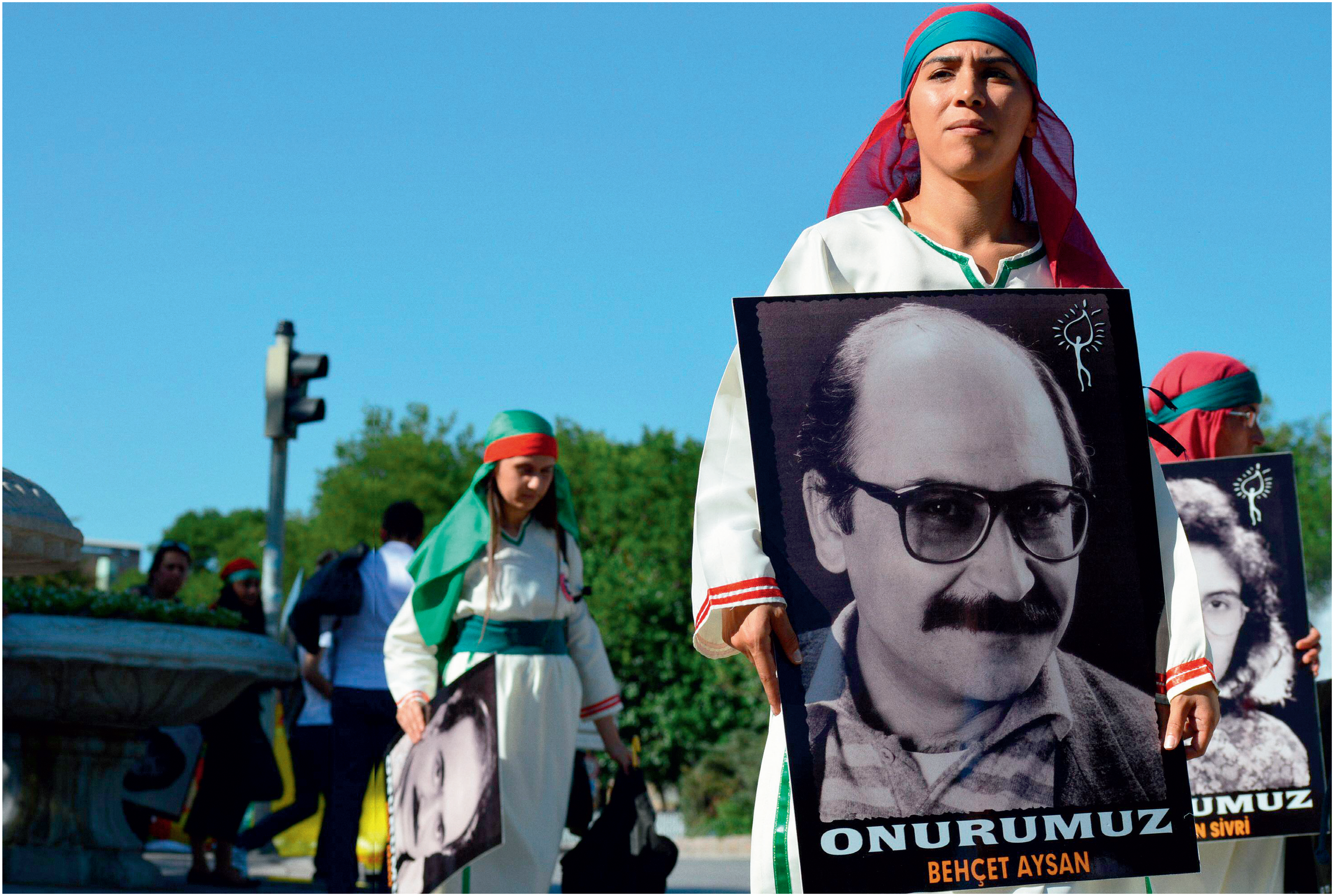
A woman holds a portrait during a march in Ankara on the 24th anniversary of the Sivas massacre on 2 July 2017. 37 people were killed after a mob arson attacked the Otel Madimak in the Turkish city
CREDIT: NurPhoto SRL / Alamy
Among Turkey’s writers who grew up admiring Nesin’s stubborn defence of freedom of expression is the novelist Burhan Sönmez. “Throughout his life, Aziz Nesin struggled to bring out the meaning of freedom and tell that to people,” Sönmez said in an interview with Index. “Maybe he wasn’t able to change Turkey. But he changed me and many others like me. He raised us, and he made us believe in freedom. I think this was his victory. Even if we can’t change the system, transforming one person and believing in the future is a victory. When he was drafting the Petition of Intellectuals and publishing The Satanic Verses, despite all the threats, Nesin’s aim was not to beat the system. He knew he’d fail in that. He wanted to keep the passion for freedom fresh in people.”
As director of PEN International since 2021, Sönmez has been reminding people of Nesin’s role in Turkey’s history in the wake of Rushdie’s stabbing at the Chautauqua Institution, New York, in August 2022. In a recent speech, Freedom of Expression and its Champions, Sönmez drew parallels between enemies of free thought through the ages: “Rushdie and his book The Satanic Verses are not the first to be targeted. In the Middle Ages, Christian clergy like Calvin burned the clergy they had argued with, and Islamic rulers destroyed the books of Muslim thinkers like Avicenna,” Sönmez said before speaking about the 1993 massacre.
“This act evokes the flames that ignited in the Middle Ages and was somehow forgotten by international platforms. Freedom of expression is not about banal platitudes but a concrete need that arises in the specifics of each work. This need is embodied today in Rushdie’s name.”
Today, one third of the Nesin Foundation’s income comes from property Nesin had invested in while alive. Another third comes from donations. The final third comes from the royalties of Nesin’s books, which sell around 250,000 and 280,000 copies annually. “Nesin is still among the most-read authors in Turkey,” said Cihangiroğlu. “We sell more copies of his books than when he was alive.”
Aziz Nesin and his generation shaped my life. In high school, I read most of his books. In our small town, we’d read books with my circle of friends and exchange volumes, as it wasn’t easy to find books. I think his books were among those we read the most. Aziz Nesin was famed for his short stories and humorous tales, but I was most impressed by his book Surname. It’s among his few novels, and its story is far from humorous. From that book, I learned that bad people, even those who commit crimes, could be good.
To find something good even in the most evil people, and to struggle to achieve good for humanity, must not have been easy for him. Aziz Nesin paid a heavy price for this through prison sentences, exile and censorship. In the last years of his life, he led the struggle for democracy against the 12 September 1980, military coup, and he defended freedom of expression against the ascendant fundamentalist movements.
When he and his followers published the Petition of Intellectuals, I was a university student studying law. A few months later, I had my own first experience of detention and torture. This wasn’t an extraordinary occurrence at the time. Almost every family had a member who went through something similar. Those were times when the official cruelty of the Turkish state spread on all streets. During another detention, a decade later, I was taken to the Gayrettepe Police Headquarters in Istanbul for a torture session.
I was, by then, a young lawyer who followed human rights court cases. I was surprised to see how plainclothes police officers talked about Aziz Nesin instead of asking me questions. This was a few weeks before the Sivas Massacre. Their attitude showed that the Turkish state had amassed enough fury against Nesin. It was clear that the government had a spiritual affinity with Islamic groups: they were preparing something against Aziz Nesin. These were plainclothes police officers, and they have not tied my eyes in this instance, I think because I was a lawyer.
When I looked them in the eye and said that Aziz Nesin was an excellent writer and a good human being and that Turkey could become a much better place only if people listened to people like him, they were infuriated. Ignorance of freedom caused their violent attitude. They were trying to scare off people struggling for democracy and freedom.
I believe that from Aziz Nesin to Salman Rushdie, from Osman Kavala to Dawit Isaak, whoever struggles for this same aim today contributes to the shared culture of humanity. These artists and intellectuals base their work on principles and a commitment to values. They pursue the struggle for freedom, even when left in the minority.
I saw Aziz Nesin only once in my life. I was a student. I was in Cagaloglu, preparing to buy a book from a distributor. The old elevator of the building must have been out of order. There was someone stuck in it. A doorman came and opened the door. And he said to the man trapped inside, “Okay, uncle, you can step out now.”
The man who stepped out was Aziz Nesin. With the joy of seeing him, I stood in the corridor and watched him for a while. This was one of the happiest days of my life. I know that Turkey is like an elevator out of order. It’s stuck. To rescue people trapped inside, we must open its faulty door.
Asked whether the ultimate aim of Rabita was to drive him and the Nesin Foundation out of their home, Cihangiroğlu laughed. “If they want to wait for that, they’ll wait a long time. Aziz Nesin is here, for one thing. His body is buried here. Even if we left, his body would haunt them forever.”