




Abstract

These well-meaning folk have a point, of course. In fact, I’ve always loved going to cities such as Istanbul for exactly the same reason. One sees the possibility of what Tehran could be, a city where the religious and the secular manage to live side-by-side. Even a friend of mine who never takes off her hijab in Tehran acknowledged the irony of feeling far more comfortable in Istanbul as a hijab-wearing woman than she does in Tehran. “For one thing, no one ever gives me evil looks in Istanbul for preferring my hijab,” she said.
Once the flames of the protests began to calm in last winter, it was still a novelty to see women in public without some sort of head covering. Folk would either applaud the few courageous trailblazers or curse at them. Half a year later, being without a hijab is nothing if not ordinary, a part of the landscape of our cities. Still, the “men of the regime” (and I use the Persian term dowlat-mard quite deliberately) are hellbent on reimposing their will any way they can. Not a day passes without rumours and speeches about exorbitant fines to be imposed on women, or those not wearing hijabs being barred from jobs or denied social welfare or, even worse, being handed jail terms. This is all scary. And, yes, we women are scared. Who wouldn’t be?
In parliament, swathes of hours each week are spent giving speeches not on the country’s dire economic situation or Iran’s diplomatic relations with other countries but on the hijab issue. Even though the morality police have been taken off the streets, recent reports suggest they will return under a different name. This pattern of simply changing a dreaded official entity’s designation in the Islamic Republic is hardly new; it’s been done before. There is talk about the authorities hiring “hijab patrols”. So far, there’s no sign of them, but the penalties and summonses are real. Actresses who have publicly taken off their hijabs are being called in for questioning and banned from work, and photos of cars with hijab-less women in them bring stiff fines to the vehicle owners’ doors. In the meantime, any number of businesses and sports clubs are being shut down until further notice because women have been spotted there without head coverings.
The narrative on the hijab - its various iterations and its trajectory ever since the revolution - has been one of the more interesting aspects of the Islamic Republic. In the early days, if instead of a traditional chador (a full-body and hair cloak) you wore the equivalent of a long robe or overcoat (a manteau), the regime simply would not give you the time of day - not for government jobs nor for admission to higher education. Nevertheless, in time the manteau itself became shorter and shorter while women wore more and more makeup and flaunted it. When a manteau went from being ankle-length to being knee-length for the first time, those of us who made the leap were ecstatic. Today, the knee-length manteau is so mainstream that even anchors on official state television wear them in front of the camera. Furthermore, no one considers the knee-length manteau “short” anymore. The truth is that the hijab, by default, became something of a fashion statement. Those women who did not like it or want it learned to own it anyway, until this past year when those same women chose to throw away their hijabs altogether.
There is a catch, though: unlike family and friends visiting from abroad, I’m not jumping for joy over any of this. To see women without hijabs or women freely riding bicycles and even motorcycles leaves me mostly cold and sad. Because my reality is not the reality of our guests from abroad or our Western sympathisers and counterparts. Our reality is the poverty we see on the streets every day, the international economic sanctions that strangle us and the everyday fear from the regime concocting new laws. Besides, how are we to live with the memory of all those we lost this past year, through pitched street battles, incarcerations and executions? Where is the joy to follow from that? The only thing we can do is to pretend life goes on and everything is normal. Pretend that there is hope still, and that somehow there will be light at the end of this decades-long struggle.
Women in Tehran defy headscarf laws, March 2023
CREDIT: Arne Bänsch/dpa/Archivbild / Alamy
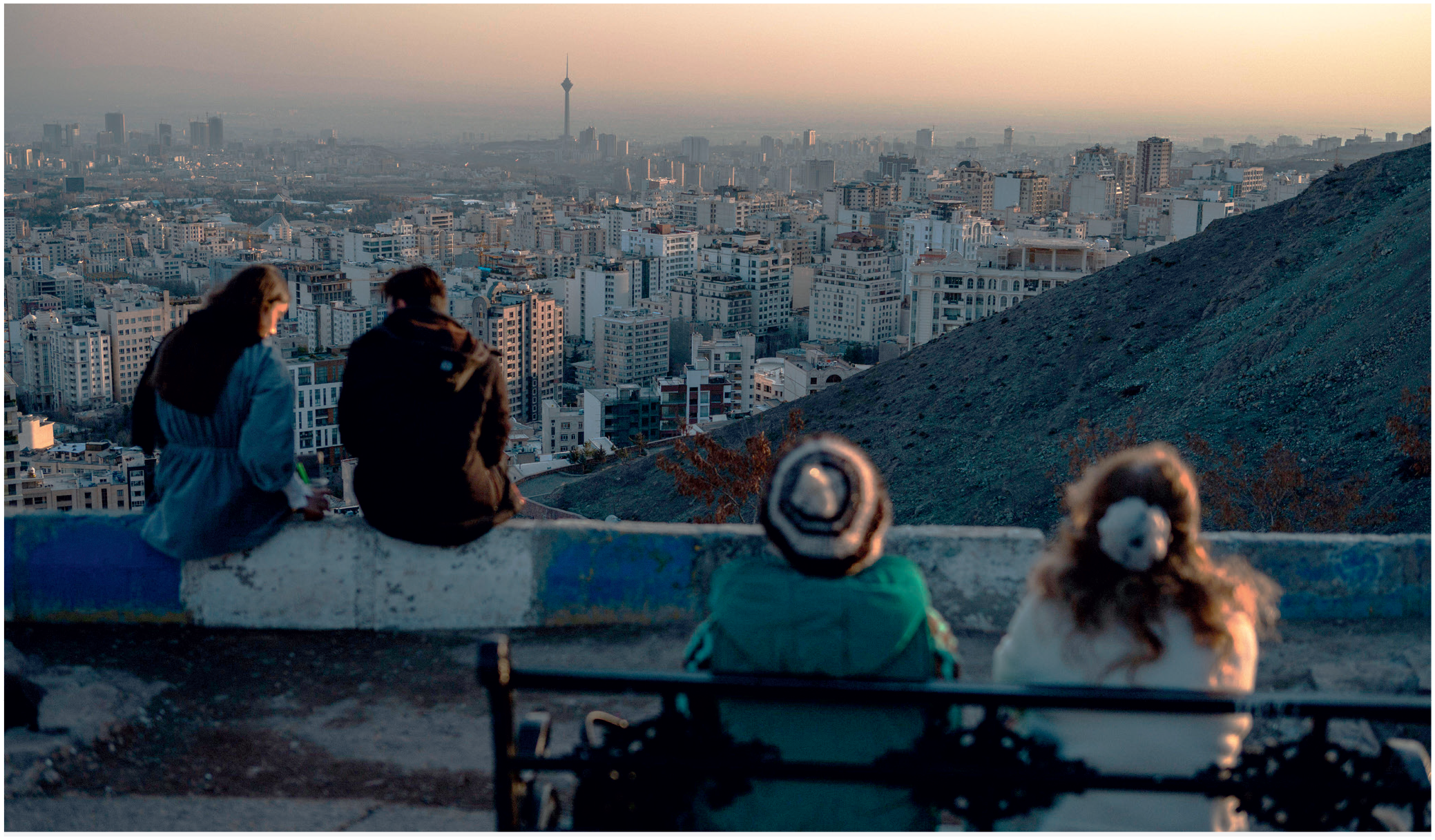
I hadn’t expected this. Nor did I expect it yesterday at the photocopy shop when the man stood up, bowed in my direction, and said, ‘Long live our courageous women!’ Nowadays, instead of being pestered on the streets by young men, women are met with the refrain of the movement: Woman, Life, Freedom. This too is as unexpected as it is beautiful.
I get off the bus at Maidan Valiasr, in the heart of the city. I have to pass through the eastern end of the circle, which is where the undercovers and Basij militia are assembled. So far, the entire city has paid my curls nothing but respect. But not these guys. As I pass by them, one of them says to the man next to him, ‘I bet if I hit her over the head she’d pass out.’ He laughs as he says this, loud enough that I can hear it. My heart is in my mouth. I expect a baton to collide with my head at any moment. As I continue walking, looking directly ahead, someone hits me in the ribs - maybe with the butt of a gun - and shouts at me to cover my head. I don’t have anything to cover my head with, and I wouldn’t do it even if I did. My hands stay by my side and I press on ahead. Another one of them shouts, ‘Dirty Bahai, cover that head.’ The next man adds, ‘Bahai slut’. I hadn’t realised until now that, to these men, calling someone a ‘Bahai’ - a member of a much-abused religious minority that got its start in Iran in the nineteenth century - is the ultimate insult. In the meantime, I’m still waiting for that baton to hit my head as I finally march past the end of the line-up of street thugs.
The maidan at Valiasr has for many years had a gigantic billboard space on its northwest quadrant. I still don’t dare look up, expecting that at any moment something, anything, is going to knock me flat to the ground. When I finally muster enough courage to look, I notice that, on the several-stories-high billboard, there’s nothing but a vast blank space and below it the words: ‘The Women of My Land.’ The absurdity of seeing these words in reference to nothing and no one is as strange as hearing paid street thugs call you a Bahai slut. The billboard looks orphaned with just those words serving as signifiers to something nonexistent. When it was first put up, the faces of real Iranian women, heads of course properly covered, had been up there - supposedly the regime’s way of fighting back against the Woman, Life, Freedom refrain of the street demonstrations. But there was such an outcry by the people featured and their relatives that the regime was forced to remove their photos, leaving only a string of forlorn words on a massive vacant poster.
I keep on walking. Walking without that dreaded piece of cloth they’ve forced on us since the first year in school. The piece of cloth that clawed at my throat throughout my younger years would often slip off without me realising it. That piece of cloth is gone. Gone from my head and from those of many others. For us it’s as if the Berlin Wall has finally come down.
I’ve run a gauntlet and a fire of insults and I’m still in one piece. The fear is still with me, but it’s only lurking in the background. Our world here has shifted. Those militia goons can say what they want; the truth is that not wearing a hijab no longer means being a loose woman or a ‘slut’ in this country. It no longer creates a feeling of us-versus-them. We Iranians are all in this together. And no one is going to hang us from our hair in hell anymore. In primary school, the religious studies teacher insisted this is what would befall us if we were seen outside in public without our hijabs. The image of being strung up by my hair in hell was so traumatic that I begged my parents to take me to the barber and cut off all my hair like a boy’s. I figured no one would be able to hang me from my hair if I didn’t have any in the first place.
Nowadays, loose hair - without a forced casing of fabric around it - is simply hair. Nothing more, nothing less. This hair is not going to lead any young man astray with desire. At the very least, the people on the streets of my city have realised this. Maybe one day the country’s religious studies teachers will get it too.
Translated from Persian by
Published from the upcoming book Woman Life Freedom: Voices and Art from the Women’s Protests in Iran, edited by Malu Halasa and published by Saqi Books in September 2023
Footnotes
Translated from Persian by