




Abstract

The UAE talks about how it values tolerance while actively discriminating against the country’s LGBTQ+ community.
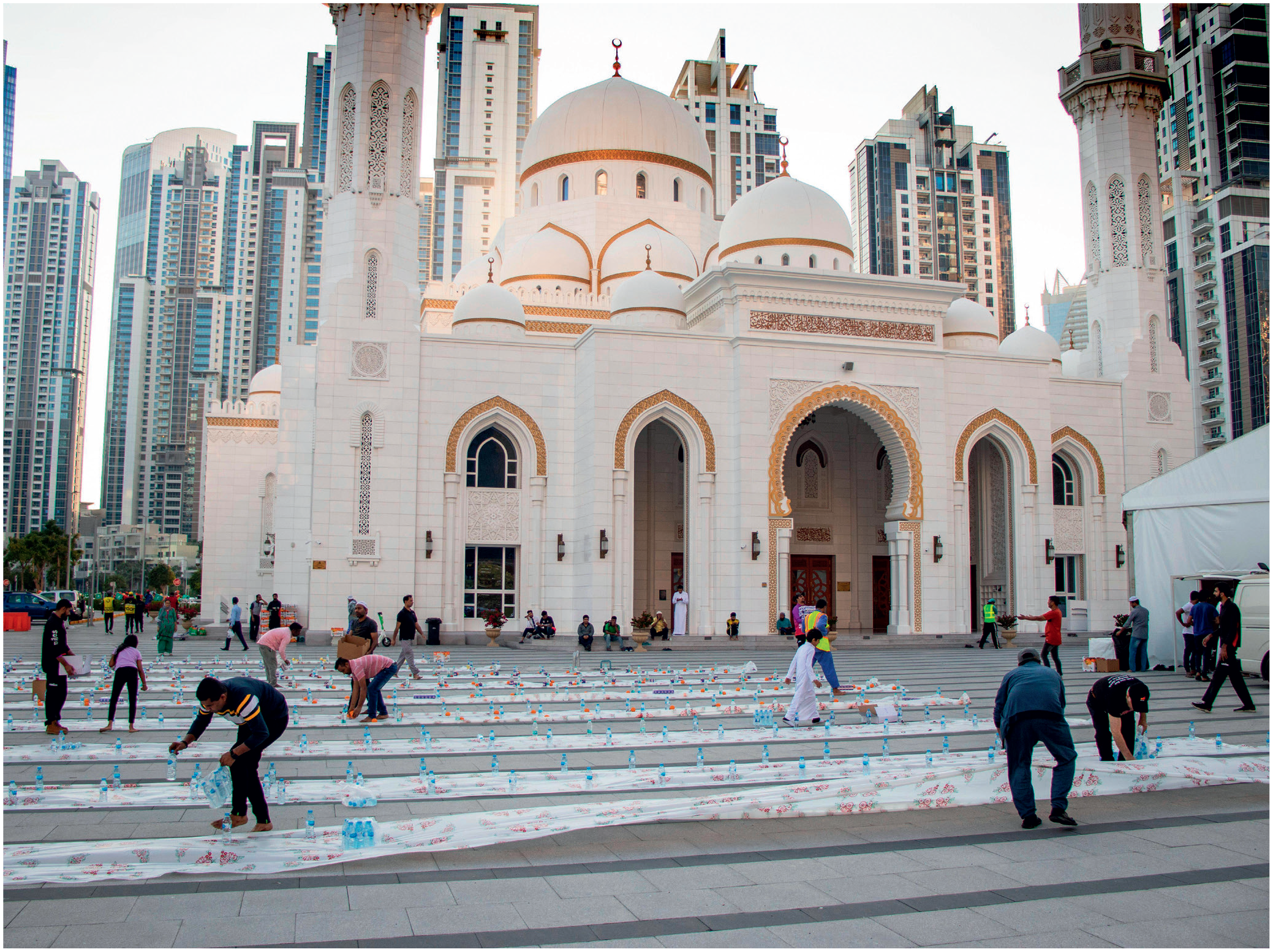
People preparing for iftar in front of a mosque in the modern Business Bay district of Dubai, April 2023
CREDIT: Viktor Pazemin/Alamy
Same-sex relationships and transgender individuals are criminalised in the country, and the new code of conduct is the latest in a history of legislation that uses the values trope as a mode of subjugation. “Censorship is part of everyday life in the UAE,” said Radha Stirling, CEO of Detained in Dubai, the organisation that ensures the security of foreign nationals in the Gulf. “Given the country’s Muslim roots, it’s unsurprising that authorities have explicitly prohibited classroom education in relation to gender and homosexuality.”
Chapter 2, verse 256 of the Koran is often cited as a call for tolerance - its maxim “there should be no compulsion in religion” - suggests no one should force opinions on others. The customs and values central to Emirati social legislation - tolerance included - are largely legitimated by Islam doctrine and, in 2016, the UAE government founded its own Ministry of Tolerance and Coexistence to “promote an environment of human fraternity and peaceful coexistence”. One of the Ministry’s first moves was to partner with the Hay Festival for the first UAE iteration in Abu Dhabi. Yet, despite the Ministry’s aim of using the partnership to illustrate their commitment to tolerance and understanding, one of the British festival organisers accused the UAE’s Tolerance Minister, Sheikh Nahyan bin Mubarak Al Nahyan, of sexual assault during a meeting about the event in his private villa in 2020. Al Nahyan refuted the accusation.
Last year the UAE welcomed the Pope to the country, the regime using the exercise as another illustration of its move towards a more tolerant society. However, in the same year, the UAE government requested Netflix remove “offensive content” in an apparent targeting of programmes featuring LGBTQ+ characters that “contradict Islamic and societal values and principles”. Amazon removed access to LGBTQ+ products - books, Pride flags - from their regional site at the request of the Emirati authorities. Transgender model Rachaya Noppakaroon told her Facebook followers how she’d been denied entry into the UAE as her passport showed her gender as male. In their 2022 report, Out Leadership, the organisation that supports LGBTQ+ business leaders worldwide, warned that “the UAE is one of a few countries in the world that prohibit transgender women’s very existence, punishing ‘any male dressed in female apparel’ with a prison term”.
While Koranic teachings can be seen to preach tolerance, they are also used to justify the positions of those expressing anti-LGBTQ+ sentiments in the UAE. Last September, US-based international law firm Baker McKenzie severed ties with their senior partner in the Emirates, Habib Al Mulla, after he posted tweets to his 61,000 followers using religious standpoints to denounce homosexuality as “evil” and a “perversion”. Al Mulla also used Twitter to comment on a social media video celebrating Emirati Women’s Day. The film showed one Emirati woman saying, “No matter what you look like or feel inside you are not alone”. Al Mulla saw this as a thinly disguised promotion of homosexuality, tweeting that “there is a children’s story for gay marketing entitled ‘How You Feel Inside’“ and “as for the phrase ‘You are not alone’, it is used frequently in gay publications”, before going on to equate homosexuality with “paedophilia and atheism”. After the news of the split broke, Twitter users defended Al Mulla’s stance. One account posted Koranic text referencing the city of Sodom that was punished by Allah for celebrating same-sex relationships before going on to declare, “homosexuality is a setback for human instinct, and a dangerous deviation from the laws of God almighty”.
“In the West, pioneering liberal views are a challenge for Western societies. For the UAE, they are totally foreign concepts,” British academic Matthew Hedges told Index. Hedges was carrying out research in the UAE in May 2018 when he was arrested on spying charges and sentenced to life in prison in the country. He was pardoned later the same year. For Hedges, the UAE’s recent ramping up of anti-LGBTQ+ censorship is linked to a domestic conflict of interests. While the UAE longs to be seen as modern and progressive, its heteronormative communal values remain pegged to religious ideology.
“The idea of discussing gender norms and homosexuality is a highly contentious issue for the native national community,” he said.
“Should this community become altered by foreign gender norm re-evaluations or a liberal view of homosexuality, it will fragment their traditional view of the family. Think of it as Republican US, but with a related national community.” Hedges also sees a link between social conservatism and religious extremism in the UAE. “Social conservatism has risen as a reaction to modernisation, globalisation and hyper development,” he said. “The state is trying to balance this.”
Born in Abu Dhabi and now living in the USA, a person who wanted to be referred to simply as Noon is a transfeminine Emirati. Speaking of their time in the UAE, they said, “as I grew older I recognised more aspects of censorship by things deemed inappropriate in Islam. As an openly queer 15-year old Emirati, it was easy to censor me by making me not exist. I was told ‘Arabs can’t be queer’ and ‘you’re just mentally ill’.”
Unmoved by the UAE’s new legislation, Noon manages to find a glimpse of positivity in its theme. “It means that more young people are talking about their queerness, which I didn’t have any access to as a youth,” they said. “The fact is, these laws won’t stop us from being queer. They give me hope that some man with power is scared of us because we’re not so silent and hidden anymore.”