




Abstract

With elections around the corner in Poland, a row over the reputation of a former Pope is being used for political gain - but that’s not the only worrying way religion is exploited in the country, writes
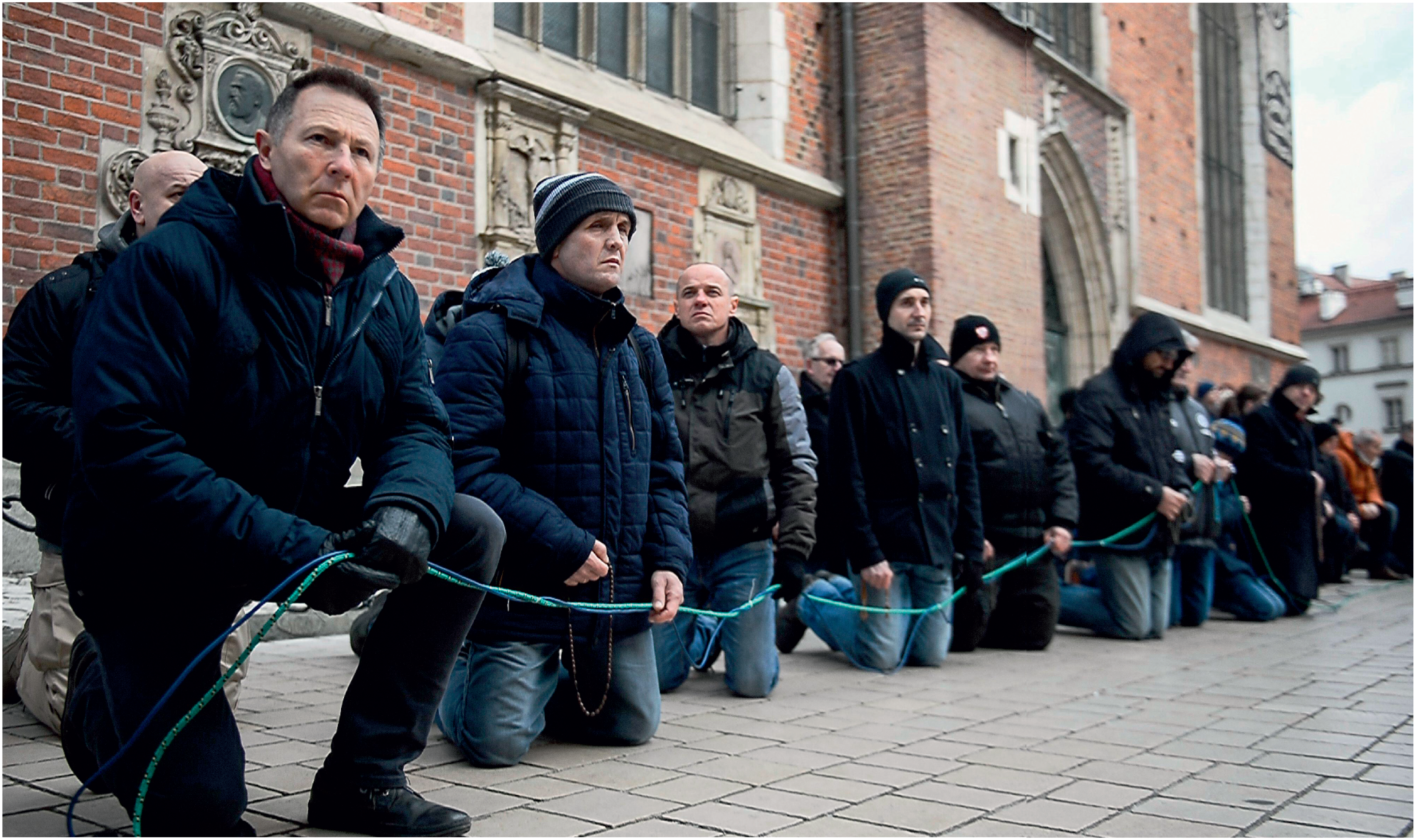
Polish men, who gather every first Saturday of the month to pray and beg forgiveness for blasphemy during the monthly Men’s Rosary at the Main Square, in Krakow on 4 January 2020
CREDIT: SOPA Images Limited / Alamy
In the midst of extensive protests in Poland against the introduction of anti-abortion laws in 2020, Nierodzińska hurled three eggs at the Church of the Elevation of the Holy Cross in Poznań.
As a result, she faced legal charges for disrespecting a public space designated for religious ceremonies.
“I don’t consider my act as something emotional. It was the least I could do while watching the Catholic Church take Polish women’s rights away,” she said. “Its work causes deaths. It was just my reaction to the crimes that are happening in Poland.”
Nierodzińska no longer lives in Poland. She says that her decision to move away was influenced by, among other things, this “fascism and feudalism that thrives in Poland, and the threats I was receiving” - including, she said, being spied on by police.
The Polish constitution states a division between the Catholic Church and the state, but the reality is very different. Under the current ruling right-wing Law and Justice party (PiS), religious groups have further infiltrated politics.
Dominika Bychawska-Siniarska, a human rights expert, told Index: “The authorities favour the Church. And they exploit the power. Polish authorities flirt with the Church. Many politicians share these values, therefore allowing it to have a stronger voice. The Church gains additional privileges.”
The Catholic Church has always played a central role in Poland - and at times for the better. During the communist era, for example, it emerged as a prominent symbol of resistance. Despite the prohibition on religion in most Warsaw Pact nations, including Poland, the Catholic Church garnered substantial backing and influence. The assassination of Solidarity-supporting priest Jerzy Popieluszko in 1984 further intensified the strained relationship between the Church and the communist regime. Attending church services symbolised an act of defiance.
However, underlying tensions persisted, and beneath the surface the conservative nationalism held by numerous priests clashed strongly with the secular liberalism embraced by many prominent dissidents. Although the Church was anti-communism, it was not necessarily supportive of free speech, individualism and liberalisation. After 1989, when the Church was legalised for the first time under communist rule, it resumed its central role in the public sphere. It regained land and property it had lost after World War II, and clergymen attended secular celebrations, including the opening of McDonald’s restaurants. Few parties ever openly opposed or contradicted it. Even Aleksander Kwasniewski, the former president of Poland who was on the far left, met the Pope on several occasions.
But it is in the PiS that the Catholic Church has really been centred. Under the PiS - members of which are open about their faith - the Church has received a record amount of money from the public budget and their views have become more influential.
The Archbishop of Krakow called the LGBTQ+ community a “rainbow plague” and, rather than such sentiment being dismissed or ignored, it’s became a template for others. From 2019, hundreds of regions across Poland — about a third of the country, with more than 10 million citizens — transformed themselves into “LGBT-free zones” in an effort to fit more in with “family” and “historic Christian” values. And the Church’s hardline conservative stance on women’s rights influenced the near-total ban on abortions imposed by the Constitutional Tribunal of Poland.
Perhaps no one symbolises how the Church still dominates, and how religion is exploited, in Poland today better than Pope John Paul II, who was sovereign of the Vatican City State from 1978 until his death in 2005. Born Karol Wojtyla in Poland, he is credited with helping end communism in the country and is widely revered. But this year his reputation was dealt a blow when a documentary aired on US-owned broadcaster TVN alleged that when he was a cardinal in Krakow, his home city, he protected priests accused of sexually molesting children.
In response to the claims - which some have said are based on unreliable sources - PiS struck back. US ambassador Mark Brzezinski was summoned (later toned down to “invited”) to the foreign ministry. PiS then pushed through a parliamentary resolution “in defence of the good name of Pope John Paul II” which read: “The [parliament] strongly condemns the shameful campaign conducted by the media… against the Great Pope St John Paul II, the greatest Pole in history.” The government and its affiliated media launched a campaign in his name. Public broadcaster TVP aired a daily papal sermon, while a large picture of the Pope was projected on the facade of the presidential palace in Warsaw.
As religion and politics intertwine and people’s bodies become a battleground, speech is also being regulated and blasphemy charges have increased. Data shows a correlation between the occurrences of “offences against religious rights” cases and the ruling party in Poland. The lowest count was observed in 2011 when the pro-EU party Platforma Obywatelska (Civic Platform) was in office. In 2020, this number surged to 97 cases under the conservative PiS administration. In March this year, a court found two women guilty of offending religious feelings simply for displaying an image of the Virgin Mary and Jesus with rainbow haloes during an LGBTQ+ march. One was ordered to do five months of community service while the other was fined 2,000 zloty (about $500).
Originally, Article 196 of the Polish Criminal Code was designed to protect religious minorities (including Jews who were, for centuries, the victims of pogroms in Poland and then the Holocaust).
Now it’s the opposite. It takes just one accusation - even an anonymous one - saying “my religious feelings are offended” to start prosecution. Last year, a junior partner in the ruling coalition proposed toughening the blasphemy law to allow anyone who “publicly insults the Church” or interrupts mass to be jailed for up to three years. The ruling party did not support that bill, but later justice minister Zbigniew Ziobro submitted a proposal to parliament, signed by more than 400,000 people, calling for the law to be broadened by abolishing the requirement of proof that somebody has been offended, among other things.
The most common punishments are fines and community service. Although the maximum punishment can be up to two years in prison, this is very rare and usually reserved for repeat offenders or if paired with another offence.
Even though it is an EU member state, there is not much the EU can do about the rule of law in Poland. As in Hungary, which is also led by a right-wing party with links to the Church, the EU has proven largely ineffective at intervening.
“Considering our government’s existing stance on adhering to the directives of the European Court of Human Rights, which they are obligated to enact and follow through on, it seems that they are indifferent,” said Bychawska-Siniarska. “Taking a rational approach, it would be wise to consider abolishing the imprisonment penalty for actions that are seen as disrespectful to religious sentiments.”
That said, in a rare victory, the ECtHR recently ruled that a charge of blasphemy in Poland from 10 years ago against the singer Dorota Rabczewska (known as Doda) violated her human rights. Polish authorities have been ordered to pay €10,000 in damages.
Perhaps surprisingly, Poland has one of the highest secularisation rates in the world, Konrad Talmont-Kaminski, a professor at the University of Bialystok, told Index. When church attendance, personal prayer, declared religiosity, religious affiliation and supernatural beliefs are considered, there is a huge generational divide in the country. He said: “A very typical thing in Poland is to see a person who claims to be a Catholic. But when you ask them, ‘When did you last go to church?’ the answer could be, ‘A long while ago, when my nephew had his first communion a year ago.’ Religion plays no role in this person’s life.”
But religion is important for the PiS. The Church continues to have disproportionate influence among the elderly and those living in smaller towns and villages, all of which are PiS’s electoral strongholds. Defending its honour is a way to shore up support and attack any opposition. This is crucial ahead of the upcoming general elections, set to take place on 15 October.
Young voters are expected to turn out in large numbers, amid calls by the far-right for an even harder line on women’s and LGBTQ+ rights. Will the PiS lose power, and in so doing allow Poles some distance from the Church and to regain some liberties lost?
Bychawska-Siniarska believes that the status quo in Poland is hard to change.
“The interaction between the Polish state and the Church relies heavily on a significant level of agreement,” she said. “Therefore, even if a leader with more progressive viewpoints assumes power, altering this process will remain highly challenging.”
If Poland’s history tells us anything, Bychawska-Siniarska is right - which is a disaster for anyone who wishes to live their life free from religious interference.