




Abstract

The insistence by Maui officials that journalists channelled questions about the recent fires through the "Aloha spirit" has led some to question whether they had something to hide, reports
The aftermath of the Maui fires in Lahaina Town, August 2023
CREDIT: Wildfire Image/Alamy
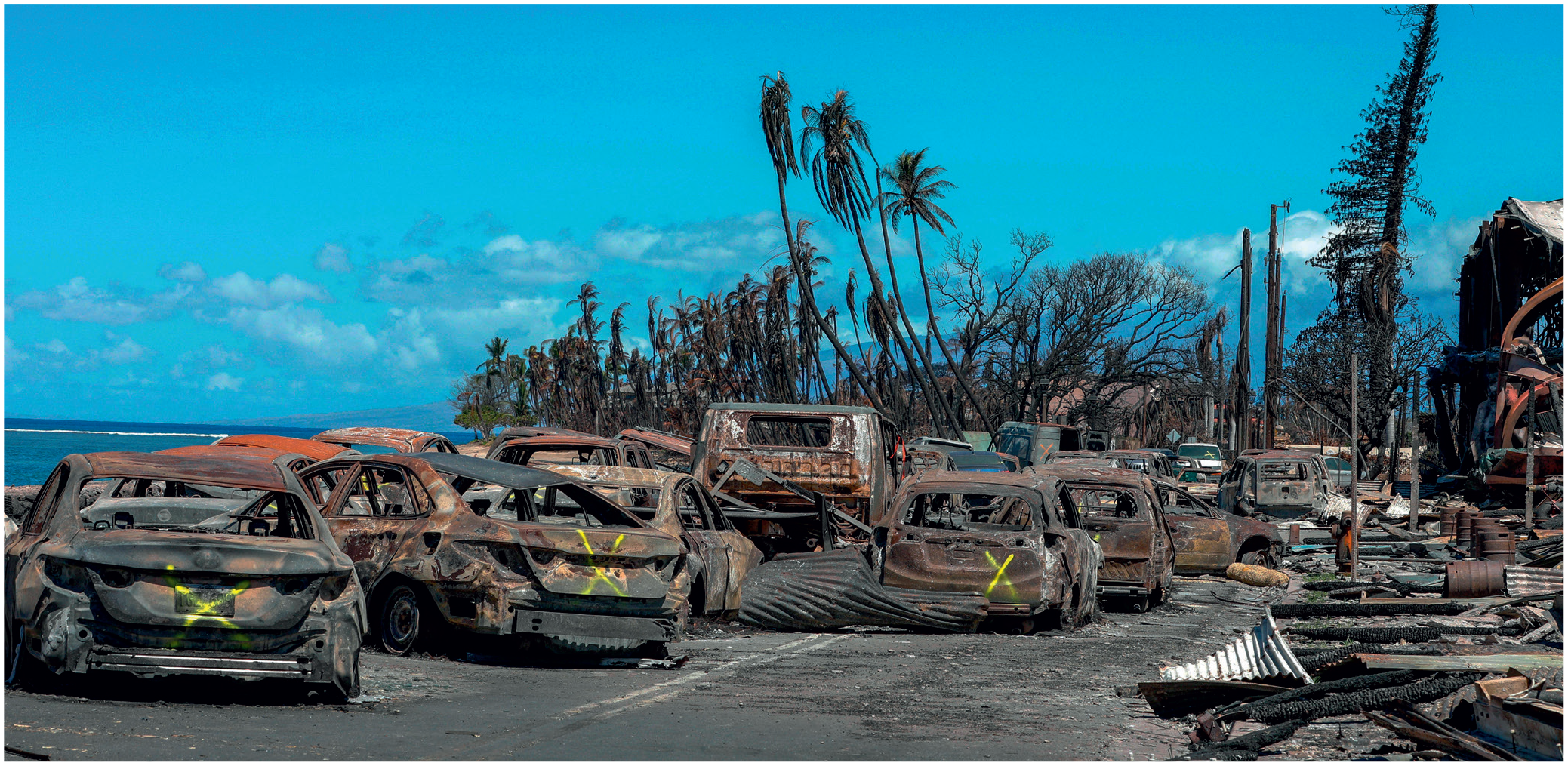
On 8 August four major blazes burned more than 16,000 acres and left more than $5 billion in damage on the northwestern side of Maui (centred in the town of Lahaina). Two months after the blaze, the number of victims remains undetermined, with official numbers climbing to 98 dead as of mid October (according to County of Maui reports).
In the days immediately following the disaster, a collection of mainland USA correspondents descended on the island, mixing with local media while covering the aftermath. Public conflicts between the off-island reporters and Hawaiian officials flared within days of the tragedy as every press conference kicked off with an official request that media attendees present all questions "with Aloha and kindness". That request left many reporters wondering how one could ask factual questions about a deadly wildfire while emoting "good feelings to others".
Steve Gregory, Los Angeles-based national correspondent for iHeartMedia, attended a press conference on 14 August, a day after arriving on Maui. Like many of the arriving reporters, he wondered when he would get an opportunity to survey a fire zone kept off-limits by local law enforcement.
"The press conference included the governor, the mayor and other officials," Gregory told Index. "Before it began, a spokesperson for the governor’s office came in and - I’m paraphrasing - she said, ‘To those of you who are new here, we count on the Aloha spirit. We don’t mind hard questions, and you can ask them. But, you may not like the answer to your question, and then it’s time to move on."
Gregory said two previous correspondents asked questions using words such as "mistrust" and "distrust" - referring to citizens’ frustrations over the lack of clear answers coming out of government as to the fire and its victims.
"I spoke to nine people the day before that press conference, and the common theme with all of them was that they weren’t getting any information," Gregory added. He said he also heard of colleagues being threatened with arrest after accessing Lahaina by boat despite police closing the roads.
When his turn came up at the presser, Gregory asked when national media would get access to inspect the fire zone: "Media are not allowed into those areas, and there’s no independent or objective reporting allowed…We’re getting a sanitised version - a one-dimensional version - of events. At what point is the media going to be allowed to start reporting what’s really going on?"
Hawaii governor Josh Green moved to the microphone, insisting "a media gaggle" was escorted into the fire zone previously. However, his remarks quickly became heated: "To suggest that we’re not providing access is simply inaccurate. I’m glad you’re being turned away in this case because otherwise you’d be tromping on our dead neighbours…You’ve done enough…If you want to see the dust of those who have been lost, that’s what you’d see if you went down there…Feeding your desire to tell a story is not my goal. My goal is to make sure my people are protected from additional trauma."
Gregory says there was talk after the confrontation that all mainland reporters would have to undergo education on the spirit of Aloha before attending press conferences on the fires. However, he cannot confirm any such classes occurred.
"I believe (state and local officials) knew there was some incompetence in play, and they were trying to avoid anything that looked negative," he added. "I also learned that there is a cultural consideration in the fire zone that some found highly sensitive. But, I think (government representatives) were in over their heads and the spirit of Aloha allowed them to avoid anything critical."
Professor Gerald Kato is a native Hawaiian, a journalism instructor at the University of Hawaii and a former print and television reporter. He sees the clash between off-island media and regional government less as a conspiracy of silence using the spirit of Aloha and more a case of officials overwhelmed by an unprecedented tragedy.
"I’m not here to defend government, but I did grow up here, and I’m familiar with local culture," Kato said. "Those early news conferences that first week were total disasters because it was clear officials were not prepared - not for the fire or the aftermath."
Kato believes the statements regarding the spirit of Aloha governing press access and media questions came out of shock and confusion.
"I’m hearing now that it’s no longer just mainland press that’s not getting responses, but local media is also not having its questions answered," Kato added. "It seems to me that they realise litigation regarding the fire response will be involved, and (officials) are really not saying anything they don’t have to - really going into their bunkers."
John Hill is the investigations editor for the Honolulu Civil Beat. He wrote a column at the end of September exploring the state government’s response to public records requests following the Maui fire, entitled "Hawaii Agencies Flout the Law by Ignoring Maui Fire Records Requests."
He acknowledges officials remain less than forthcoming, even at the risk of violating the Uniform Information Practices Act. Still, he believes some mainland media members could have asked their questions in a manner that didn’t presume deliberate censorship.
"What I saw happening during those press conferences was the national press having a style of journalism that didn’t sit well with Maui officials," Hill said. "Those reporters had a very aggressive way of questioning in press conferences that the officials in Maui hadn’t experienced before because it’s not in keeping with how they do things."
Hill insists there’s a way to ask difficult questions that doesn’t insinuate officials made a deadly mistake or were covering up wrongdoing. He suggests such pressure could lead to already overwhelmed government representatives shutting down further.
"It could be a case of those officials thinking: ‘we’re so busy we don’t have time to deal with the press,’ following the fires," Hill said. "But the public perception of how transparent they’re being is an element in how their response is judged. It does matter. The public starts filling in the blanks with rumours that can be worse than the reality. Now, we’re seeing a million weird conspiracy theories growing - some outlandish and some inaccurate, but still believable. They all grow out of that vacuum."
Footnotes
Those officials who were successfully contacted but declined to comment for this story include Erika Engle (press secretary for the Hawaii governor’s office) and Makana McClellan (office of the governor director of communications).
Entities who did not reply to contact requests include governor Green; Maui chief of police John Pelletier; Mia Noguchi (office of the governor deputy director of communications); Mahina Martin (county of Maui chief of communications and public affairs); Tasha Karma (county of Maui council presiding officer pro tempore); Yuki Lei Sugimura (vice-chair of the Maui county council); and Nohe U’u-Hodgins (county of Maui council member).