




Abstract

Stationed in Ukraine, British journalist
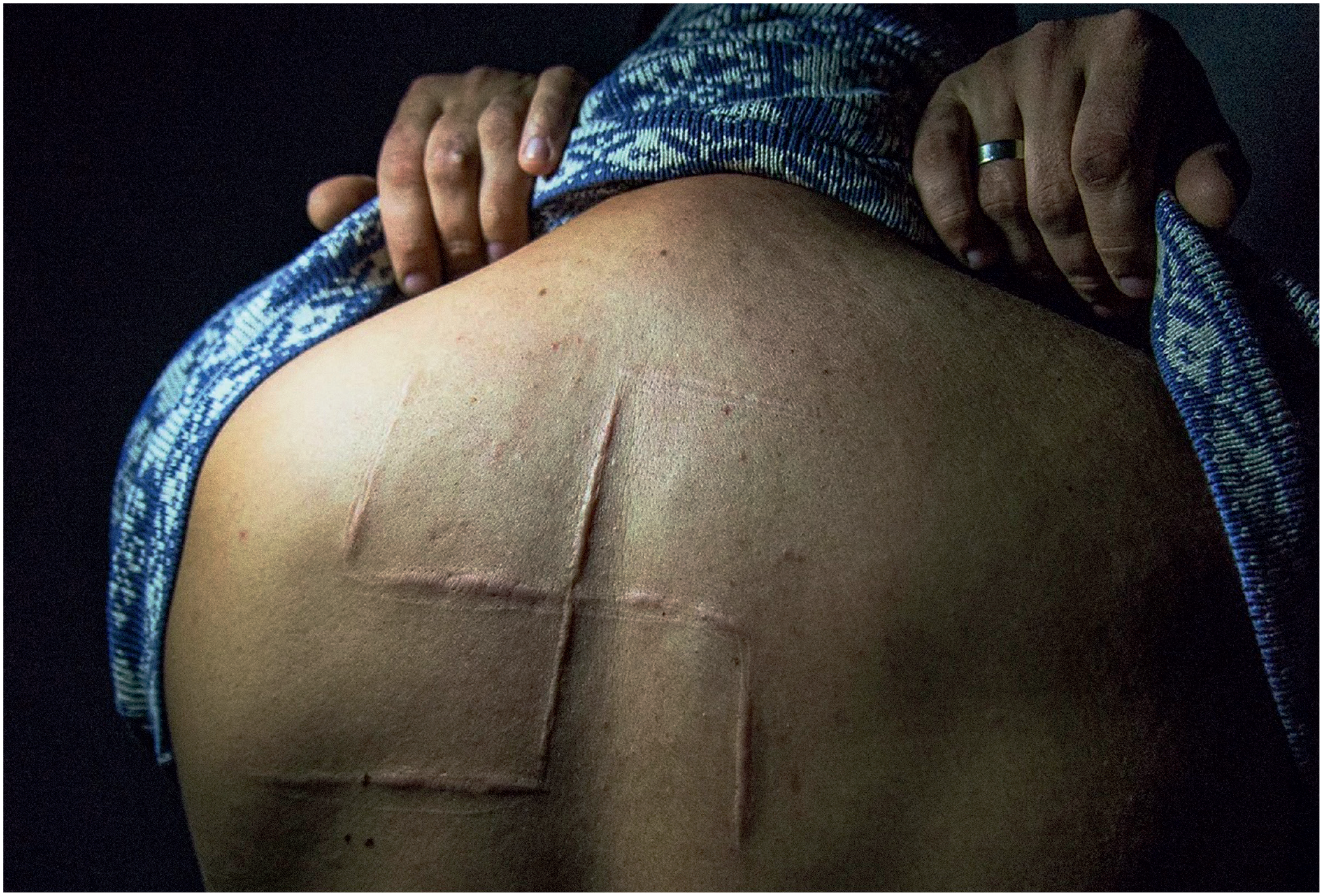
The back of an ordinary Ukrainian from Donetsk who opposed the first Russian invasion in 2014 and had his back marked with a swastika as a result, part of a photo display at the festival
CREDIT: (left) Zoya Shu ; (right) Chris Occhicone
It started last year in the early days of the Battle of Kyiv, when the Russian killing machine was 12 miles from the centre of the Ukrainian capital and I was doing daily war diaries for the thing that used to be known as Twitter.
Sick to the stomach from listening to "Putin’s Lullaby" - the howl of the air raid sirens, signalling yet another rocket attack - I hit on an idea. I filmed myself as I opened the skylight of my Airbnb off Khreshchatyk, Kyiv’s Piccadilly, let the snow fall on my face, listened to the siren and then said: "I have a simple message for Vladimir Putin. Vladimir Putin: do fuck off!" I said it with the same vehemence that Father Jack in sitcom Father Ted says "Drink!" - and then some.
My video got one million views, and became a catchphrase and a hashtag - #VPDFO!
I did another video, walking back from the Buena Vista - the Cuban bar that stayed open when all the other bars in Ukraine were closed because of martial law - breaking curfew, as usual.
As Putin’s lullaby screamed, I explained the plot of Tom Stoppard’s great play about journalism, Night And Day - how a young journalist is murdered by an African dictator and his grieving lover, played by Diana Rigg, says none of it is worth it: "Not the heartbreak beauty queen, not the crossword and definitely not the leader." And then the old photographer, played by John Thaw, nods and says: "Yes, yes, but also the other thing… People do awful things to each other. But it’s worse in places where everybody is kept in the dark. Information is light. Information, in itself, about anything, is light."
This is the greatest single expression of why people commit to journalism ever written. I quoted that and added VPDFO. That, too, got a million views, and a sweet thank-you note from Stoppard himself.
Then Penguin commissioned me to write a book, Killer In The Kremlin, which became a bestseller. My late mother used to say: "A fool and his money are soon parted." An Irish friend told me that his mother used to say: "There are no pockets in a shroud."
I sided with my Irish pal and blew a good chunk of my royalties on staging the first VPDFO! festival in Kyiv, starting on 7 October, which just so happens to be Putin’s birthday. It was a chaotic mess. It was also a thing of beauty and the funniest gag of all was that Putin, in a kind of way, paid for his own "Do Fuck Off!" festival.
One of the highlights was the Ukrainian comedian Anton Tymoshenko cracking brilliant gag after brilliant gag. Humour is always hard to convey on the page but here’s one joke: "The Germans keep on saying that they can’t arm Ukraine as much as Ukraine would like because they don’t have enough weapons. Well, my grandma, she remembers a different Germany. Back in her day they had a lot of weapons…"
A second highlight was chatting to Yaroslav Lodygin, a Ukrainian filmmaker. I asked him about the possibility of getting nuked. He replied: "Shortly after I was born there was a great panic about nuclear war starting by mistake. Then there was Chernobyl. Then the country I was born in ceased to exist. Then there was economic chaos. Then an Orange Revolution. Then the Maidan Revolution. Then my country was invaded. Then Covid. Then my country was invaded again. So a nuclear war would be just collecting the set."
A third highlight was Vlad Demchenko, a Ukrainian soldier, telling the audience what it was like to arrest me for being a Russian spy on Day Two of the Big War: "Sweeney was so arrogant. He told me: ‘You’re not a policeman.’" Vlad had a machine-gun; I did not. Vlad won that argument. Since then we have become great friends. This summer I introduced him to James, a British friend my age who drives ambulances to Ukraine. Before they met I told Vlad not to say to James "God Save The King!" The moment Vlad met him he said exactly that, to which James responded: "Really? Must you?"
James had been an officer in the British army and the young and old soldiers hit it off. (By the way, his full name is Major James Hewitt.)
The day after the festival, the Russians fired a ton of cruise missiles at Kyiv. Four got through, killing 18 people. One landed in a children’s playground in Taras Shevchenko Park.
A Ukrainian bringing her rescue dogs out of harm’s way in Irpin 2022
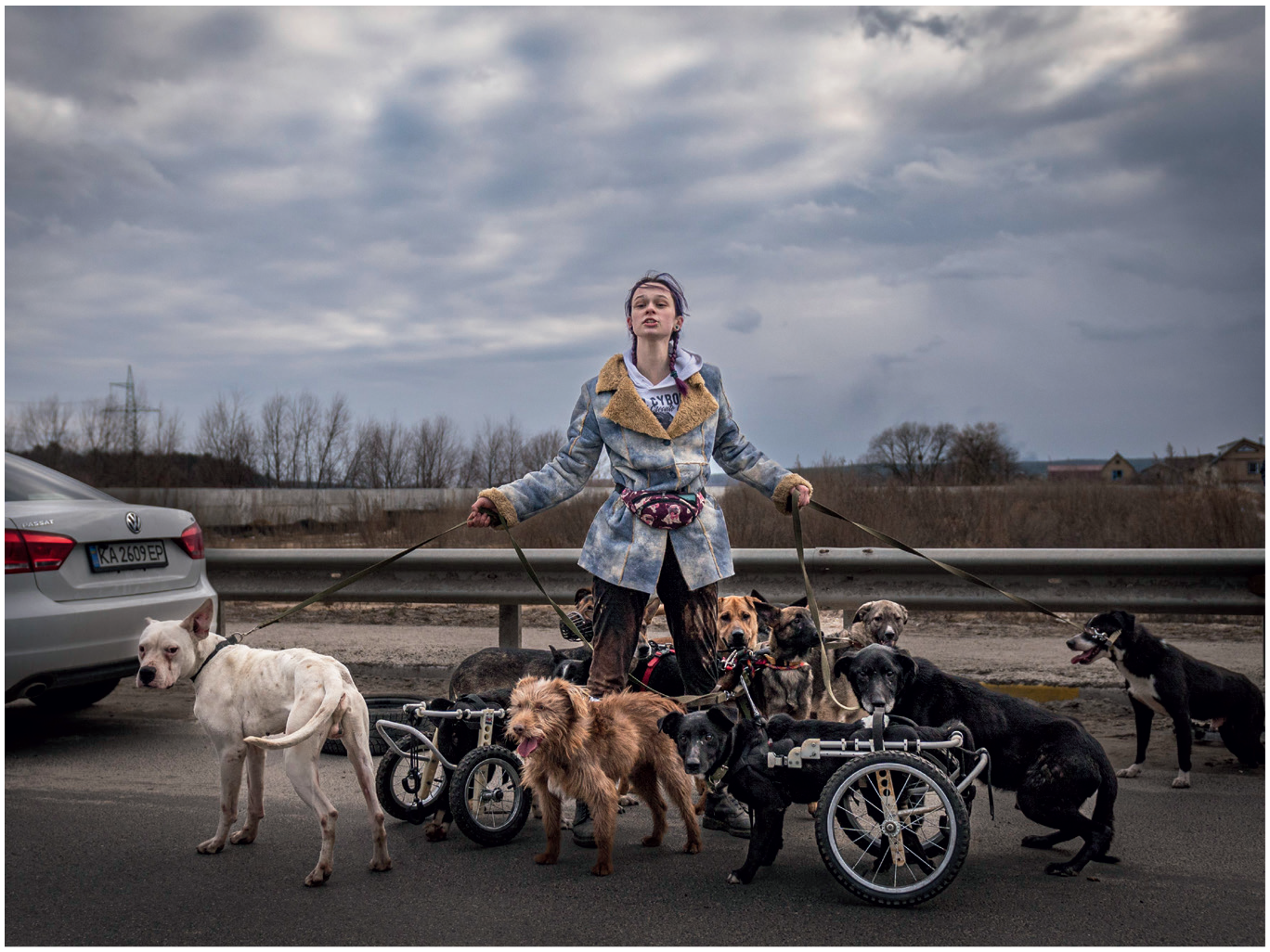
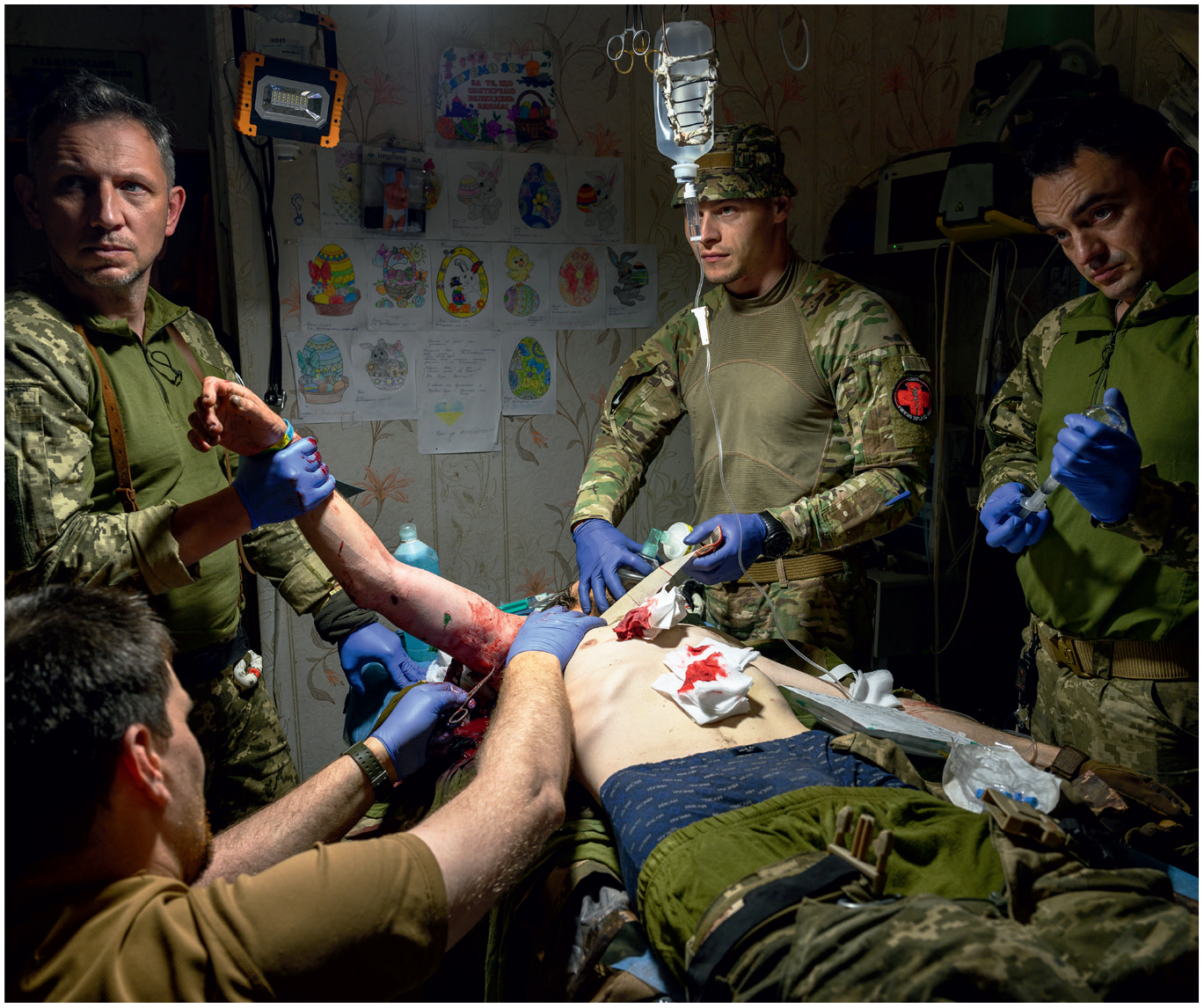
This year, Putin still being alive, we did it all over again. We booked bands, comedians, a fashion show and talks, and had a photography exhibition. This was quite a thing. Ukrainian photographer Zoya Shu gave us her print of a photo of an ordinary Ukrainian chap in Donetsk who opposed the first Russian invasion in 2014. The Russian proxies scarred his back with a swastika. Chris Occhicone, an American who has lived in Ukraine for the past nine years, gave us a whole series of prints. Two photos stand out: one of a Ukrainian bringing her rescue dogs out of harm’s way at Irpin last year and a second of three surgeons operating in a field hospital not far from Bakhmut on a difficult patient and looking up to see fresh horrors coming at them. This photo looks like a Caravaggio.
Surgeons operate in a field hospital not far from Bakhmut as bombs rain down
CREDIT: Chris Occhicone
On the first day, it rained and rained. Hardly anyone came and it was a disaster. Our melancholy was made all the more intense because Hamas chose Putin’s birthday to massacre Israel’s innocents. That was in itself a thing of evil and also, if you support Ukraine, an evil distraction.
On the second day, the sun came out, the bands were brilliant, many more people turned up and we had a series of fascinating talks. Conversation in a city that could get rocketed at any moment is naturally heightened. Laughter is not a luxury. It is a necessity.
Some of our conversation was bleak. My normal fixer, Dima Kovalchuk, had been driving author Victoria Amelina around the Donbas with some journalists from Latin America. After a long day on the road, they were sitting at the same table in the Ria pizza restaurant when the Russians fired a cruise missile at it. Dima lived. Victoria died. He explained what that was like and then motioned to a Ukrainian soldier in the audience to speak. He’s a sniper, used to killing and the risk of being killed. The soldier said: "Listen, I know war. I am used to it. But suddenly I was having to do combat medicine on young women, on children… I will never forget this awful thing."
Chris talked about life and death in the field or the stabilisation hospital in Chasiv Yar, close to Bakhmut, and how dark humour rules the day. How, if you lose a leg or an arm, you’re fine.
Zoya Shu spoke about taking photographs of Ukrainian prisoners-of-war who had been tortured most cruelly by the Russians and their proxies. As did Shaun Pinner, the author of Live. Fight. Survive. It’s an extraordinary book.
Shaun is a London lad, a supporter of West Ham United FC, but his story is a grim one. He told us about soldiering in the Ukrainian marines, his capture by the Russians and subsequent torture, kangaroo court trial and sentencing to death. Shaun told the story of how he and a Moroccan guy, Brahim, who had also been fighting with the Ukrainian marines, were offered a shower by their prison guards. They were beaten on the way to the shower; the shower dribbled; they were beaten on the way back. When they got back to their cell, Brahim joked: "Next time I’m going to skip the shower." Laughing in the cell was verboten, on pain of fresh torture. Shaun recalled the showerees shaking with silent glee.
Too much horror. I tried to bring in a lighter note when I asked everyone how they would like Putin to die. Dima won the moral high ground by saying that he would like him to die, like Milosevic, at The Hague. But Yaroslav Lodygin, the film director, won the most laughs by saying that he would like to see Putin locked up in a glass cage above Khreshchatyk so he could see what ordinary Ukrainians really think about him. He has now written a libretto based on a dictator in a cage above the people he once most cruelly treated. It’s very good.
As last year, the festival made some money for Ukraine charities. I hope and pray that Putin dies so I don’t have to organise another bloody VPDFO festival. But pessimism has its attractions. In which case, does anyone out there want to sponsor next year’s festival? If you do, the Kremlin won’t like it.