




Abstract

Leading comedians from outside Afghanistan talk to
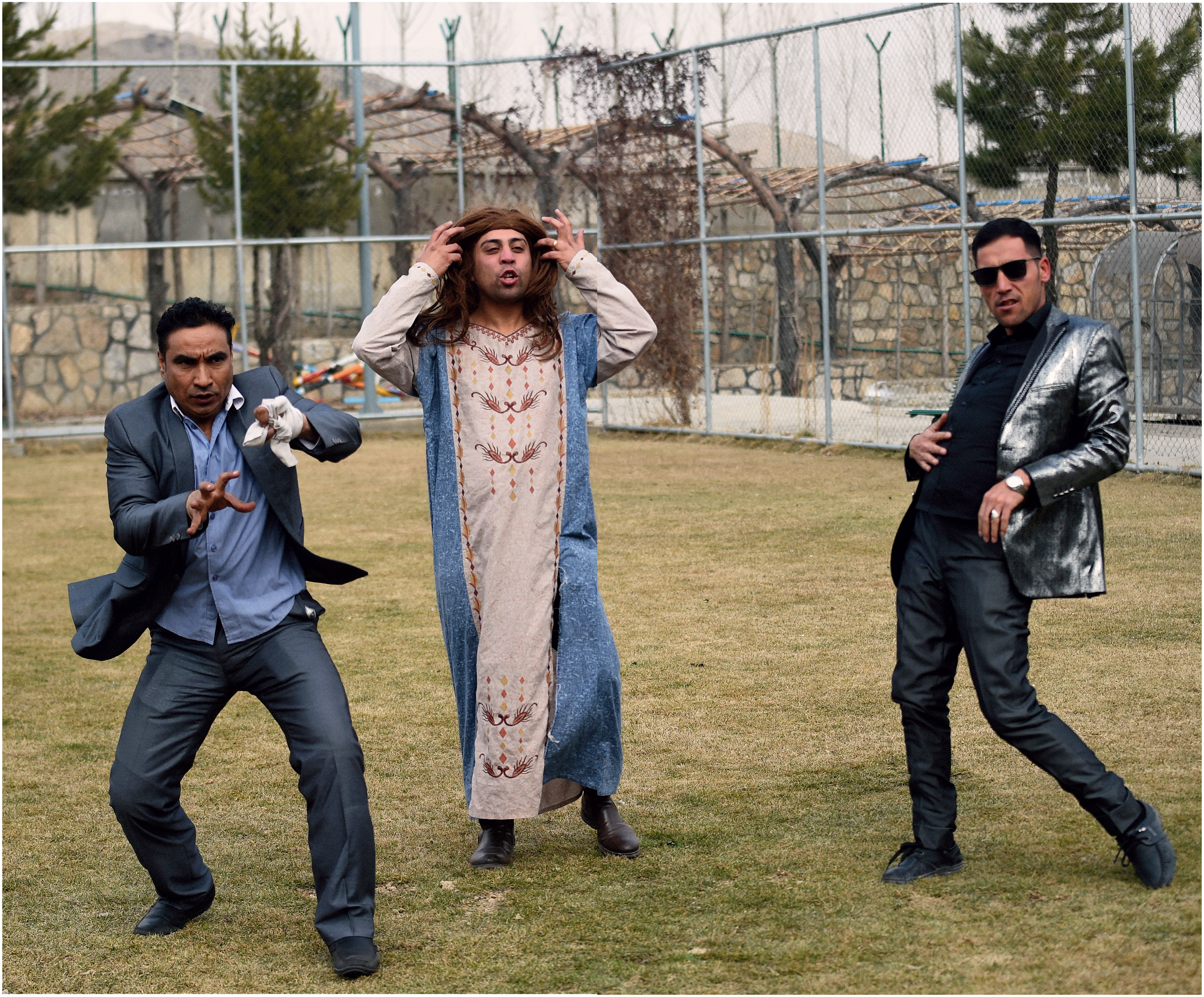
Afghan comedians Ibrahim Abed (left), Ghulam Nabi Roashan (right) and Ahmad Siar Matin filming for comedy television show Shabak-e-Khanda on the outskirts of Kabul in 2017. The trio were a thorn in the side of warlords, policemen and politicians, skewering them on television - with laughter
CREDIT: Wakil Kohsar/Stringer/Getty
"Do you know what I am going to say?" The audience said "no", so he said he had no desire to speak to people who didn’t know what he was going to talk about and left. The people called him back again the next day. This time, when he asked the same question, the people replied "yes", to which Nasreddin said:
"Since you already know what I am going to say, I won’t waste any more of your time!" Again he left.
The people were really confused. They decided to invite him to speak one final time. When he asked the same question, half of the people answered "yes" while the other half replied "no". So Nasreddin said:
"Let the half who know what I am going to say tell it to the half who don’t," and he left!
The stories of Nassreddin have always served to both entertain and impart moral lessons, blending humour with wisdom. They’re part of the broader rich fabric of comedy within Afghan culture. Our country’s comedic tradition can be traced back to ancient times, when oral-storytelling would often feature humour. But under the Taliban comedy has lost its humour. The few who continue making jokes often do so for the Taliban, not against, and even then when we tried to reach out to them we received a cagey response, to say the least.
It’s all the more tragic when you consider how much comedy was flourishing just before the Taliban takeover. In recent times, comedy has served as a coping mechanism for Afghans, offering an escape from the harsh realities of life in a war-torn nation. And it also has a role in challenging authority. Comedians provide a voice for the people, using laughter as a means to question power and address sensitive topics.
"Comedy is a tool to say difficult and uneasy things in an easy way without inviting hostility," said Khyber Farazi, a famous comedian based in Kabul. He added:
"We express things that others can’t, so we become voice of the people. Comedy is a way to show a mirror to authority."
Of course comedians always faced threats in Afghanistan for their daring acts. While talking to us Ghulam Nabi Roshan, a famous Afghan comedian (referred to as Afghanistan’s Jon Stewart) who is currently seeking asylum in the USA after fleeing Afghanistan, likened performing comedy in Afghanistan to eating beef in India. It entails threats and risks "because every time someone gets offended". He recalls how he and two other colleagues got into trouble after one of their shows.
"We had to travel in an armoured vehicle for 40 days with strict protocols from our security department after receiving threats from a powerful parliamentarian," said Nabi.
Farazi recalls a similar experience.
"Our entire show crew and organisation was in trouble due to threats from an influential government official during the previous government."
Similarly, the renowned media outlet Tolo News reported that they had faced backlash from a government advisor who was unable to walk, over a character in one of their comedy shows, Zang-e-Khatar, who was also disabled. He thought the skit was about him and urged the government to take action of some sort (no details were given as to what exactly he wanted). The editor-in-chief had to clarify and assure him that they had not humiliated anyone and to promise that they wouldn’t do it again.
While comedians in Afghanistan walked a fine line, there was still somewhat of a golden age of comedy in Afghanistan over the last 20 years. During this period many comedians became famous, many comedy shows were aired on television and radio, and even public performances were common. With the advent of social media in Afghanistan many individual Afghans also started making funny and humorous content, especially overseas Afghans. Two television shows, Shabak-e-Khanda (Laughter Network) and Zang-e-Khatar (Alarm Bell), were particularly popular. These were weekly programmes broadcast on Tolo TV. These shows were entertaining and they also held government to account. They used comedy to shed light on serious political and social issues such as corruption, incompetence, inflation and poor governance.
However, all that evaporated with the return of the Taliban.
"There was more freedom for comedians during the previous government because we could make jokes about the then Afghan president but it is not the case now," said Farazi. "There were big comedy shows on media, the comedians could do comedy on diverse topics but things are not the same."
Just two weeks before the complete takeover of Kabul, the Taliban killed a popular local comedian, Nazar Muhammad Khan, known by the stage name Khasha Zwan. A video appeared in the media where he was beaten and humiliated by the Taliban before being murdered.
"This incident was a harbinger for what was to come," said Nabi.
Unsurprisingly, many comedians fled the country soon after the Taliban’s takeover. Those who remained lost their jobs or left them out of fear.
Nabi told Index:
"I was working as content manager in One-TV, but within just two months of the Taliban’s government we [the show] were terminated and told that the organisation is no longer continuing the programme given the new situation in the country."
In a curious twist, there are still some comedians working in Afghanistan and some comedy programmes remain on air, such as Tolo TV’s Shabak-e-Khanda and Khand-o-Qand. "These shows are different to ours. We had more freedom but they can’t talk about many things. There is a very thin spectrum for them to talk within. The shows are controlled and censored," said Nabi.
In terms of specifics, today comedians cannot talk about the Taliban leaders or criticise the government. They can’t reference anything intimate related to men and women or joke about women’s progress or lack thereof. They have to stay within tight parameters, typically talking about small social issues, like a fight between two brothers, an amusing interaction between a student and a teacher - that sort of thing.
Farazi thinks comedy has lost its lustre in Afghanistan and he feels broken. "Many comedians and sponsors fled the country and those who are left behind are afraid to do such shows because of the risk associated with it," he said.
We tried to talk to many Afghan comedians in and outside of Afghanistan but most of them were too scared to talk to us. We even tried to interview one of the last remaining female comedians inside Afghanistan but due to questions related to comedy under the Taliban’s rule, she ended the interview calling it part of a foreign agenda and threatened us if her answers were to be published.
The result is that television viewership has dropped drastically. Before the Taliban takeover millions would watch the main shows, whereas now it is just in the thousands. And while the mullah jokes still circulate, Afghanistan’s richer comedy landscape is no longer. This at a time when people need humour and its ability to speak the truth more than ever.