




Abstract

Comedy in Lebanon mirrors the political landscape and provides a much-needed escape from reality,
Stand-up comedians including Mario Moubarak, Mohamad Baalbaki and Nicolas Tawk exchange ideas backstage ahead of their show, awk.word, in Beirut, December 2020.
CREDIT: JOSEPH EID/AFP via Getty
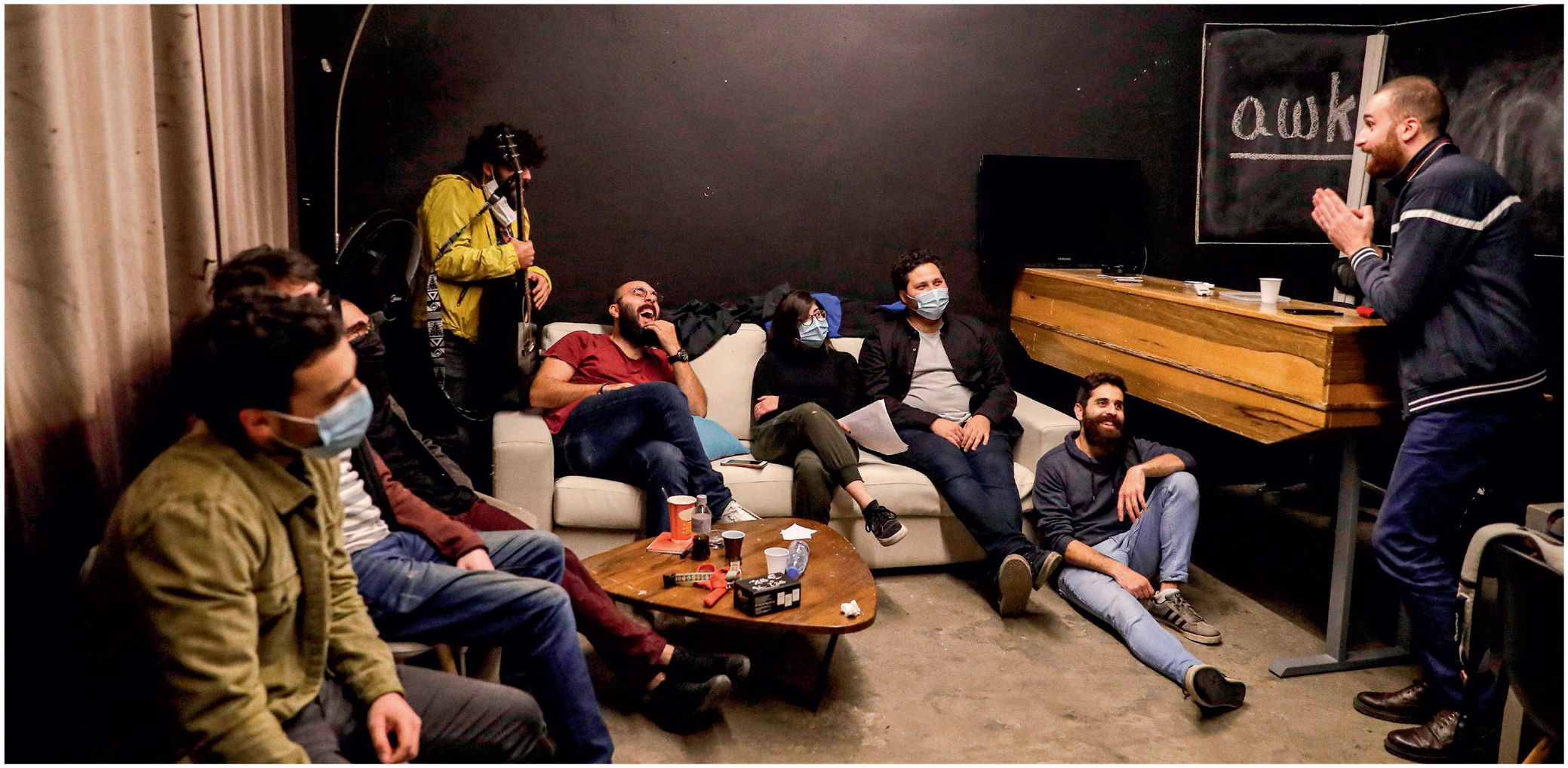
"On stage, we’re not that careful," Mario Moubarak, a stand-up comedian and comedy writer, told Index. "[But] the army is the red line. Don’t talk about the army unless you have a brother in jail that you want to visit."
Lebanese comedians masterfully turn sorrow into satire, mirroring the country’s complex socio-political issues in shows such as Bas Mat Watan (a double entendre for Smiles of a Nation and When a Nation Dies) and reruns of As’al Shi (The Most Annoying Thing) and La Youmal (Cannot be Bored With). While older comedians often resorted to impersonations and innuendos to critique politicians, the newer generation adopts a more direct approach, boldly pushing boundaries.
Lebanon’s stand-up comedy scene has flourished in the past few years thanks to awk.word, the country’s first comedy platform, which was founded in 2018. The platform fosters a space in which comics freely tackle taboo topics including religion and some government institutions.
Mohamad Baalbaki, a 34-year-old comedian, compares his comedy to a "layered cake", whereby a joke may mean different things to different people.
"I know how to be safe," he explained. "I see this as being smart and not getting myself into unnecessary situations." This nuanced approach is shared by many Lebanese comedians who balance self-expression and sensitivity in their work.
In Lebanon, there’s no shortage of material to work with. The country’s often absurd political developments
- such as when a squabble among members of the political elite led to the tiny country adopting two timezones
- provide ample material for gags that require little-to-no embellishment.
But the deeply creative nature of Lebanese humour is self-evident
- even as the economy flounders, comedians blend comfort with disquiet, playfully challenging social norms and existing prejudices.
"I’ve just dated outside of my religion for the first time," Nicolas Tawk, another stand-up comedian, said in one skit where the subtext was the country’s still-rampant sectarianism. "I’m Christian, she’s Roman Catholic."
The jokes also reflect on Lebanon’s deteriorating societal conditions, such as frequent power cuts and piles of uncollected rubbish. In that context, the work is far more than humour - it’s a commentary on a society in deep distress.
Tawk acknowledges the challenges and rewards of his profession, noting audiences’ gratitude for a respite from their harsh daily realities.
"Comedy is just a way of escaping the ugly reality we live in," he said. "We tell people, ‘OK, we are all in this shit together. Just forget your phones for one hour and we’ll get back to it once we’re done’."
This ethos reflects a common sentiment among the Lebanese: humour as a coping mechanism in difficult times.
By "shit", Tawk is referring to Lebanon’s myriad challenges: political instability with no sitting president, one of the world’s worst economic crises since the mid-1800s, a devalued currency and hyperinflation.
Tawk’s humour draws from these economic hardships. He quips that, in Lebanon, Secret Santa remains a secret because "no one can actually afford to buy Christmas gifts".
The hardships are further intensified by regional security issues, such as the exchange of fire between Israel and Hezbollah along the border, illustrating the complex backdrop against which Lebanese humour thrives.
Clampdown on comedy
"Everybody wants to laugh, especially in these times," Moubarak said. "But the thing is, what to laugh about? You cannot laugh over the misery of people, but you can laugh in a special way to send a certain message."
Depending on the nature of these messages, Lebanon’s comedians face significant risks for their creative expression, as evidenced by the military interrogation of Nour Hajjar and Shaden Fakih. Their treatment represents a wider clampdown on free speech in the country, drawing concern and condemnation from both local and international bodies, including the Coalition to Defend Freedom of Expression in Lebanon.
"Lebanese authorities have militarised their response to criticism by comedians," said Ramzi Kaiss, a Lebanon researcher at Human Rights Watch. "As the country has been plunged further into crisis in the last few months, Lebanese authorities have sought to crack down on the rights of lawyers, teachers and artists to freedom of expression, and comedians have not been spared."
Hajjar’s legal troubles began with a joke about members of the Lebanese army moonlighting as delivery drivers to supplement their income (about 80% of Lebanon’s population lives below the poverty line). They escalated when a five-year-old quip resurfaced and led to accusations of Hajjar committing "an insult against Islam" and fostering discord. Many speculate that this was a pretext for his interrogation, reflecting the tense atmosphere surrounding free speech in Lebanon.
What happened to Hajjar, according to fellow comedians, wasn’t a result of the joke itself but because it went viral online. "It’s the same as when I was at school and made a joke. If everyone laughed, it caused problems with the teacher," Moubarak said. "But if only two people laughed, it didn’t really matter."
Moubarak noted that while individual soldiers may enjoy the humour and relate to it behind closed doors, mocking the institution of the army is off-limits. And Tawk suggested that the government’s questioning of Hajjar highlighted an even deeper issue: in a chaotic environment with the government exerting limited power, controlling humour can become a potent means of exercising authority.
Fakih, meanwhile, explores the intersections of religion, sexuality, gender and cultural conventions in her comedy. As such, she not only confronts Lebanon’s intricate sectarian-based politics in her material but also speaks openly about her queer identity and the struggles women face.
"In stand-up comedy I am myself, though with a performance for sure. I’m living my absolute truth within my convictions. Be it my view of religion, my view of existence, my view of society, my view of sex, my experience in sex or my experience as a lesbian woman, I don’t want to hide myself," Fakih told France24 last year.
This openness has not come without repercussions. In 2021, the Office of Cybercrime had questioned Fakih following a complaint by the Internal Security Forces which stemmed from a humorous phone call the comedian had made to the ISF’s hotline during the Covid 19 lockdown, in which she jokingly requested sanitary pads. In 2022, she was found guilty of "damaging the reputation of the ISF" and "insulting its members". Consequently, she was ordered to pay a fine.
Nour Hajjar performs at the Al Madina theatre in Beirut, Lebanon, in June 2023
CREDIT: Abaca Press/Alamy
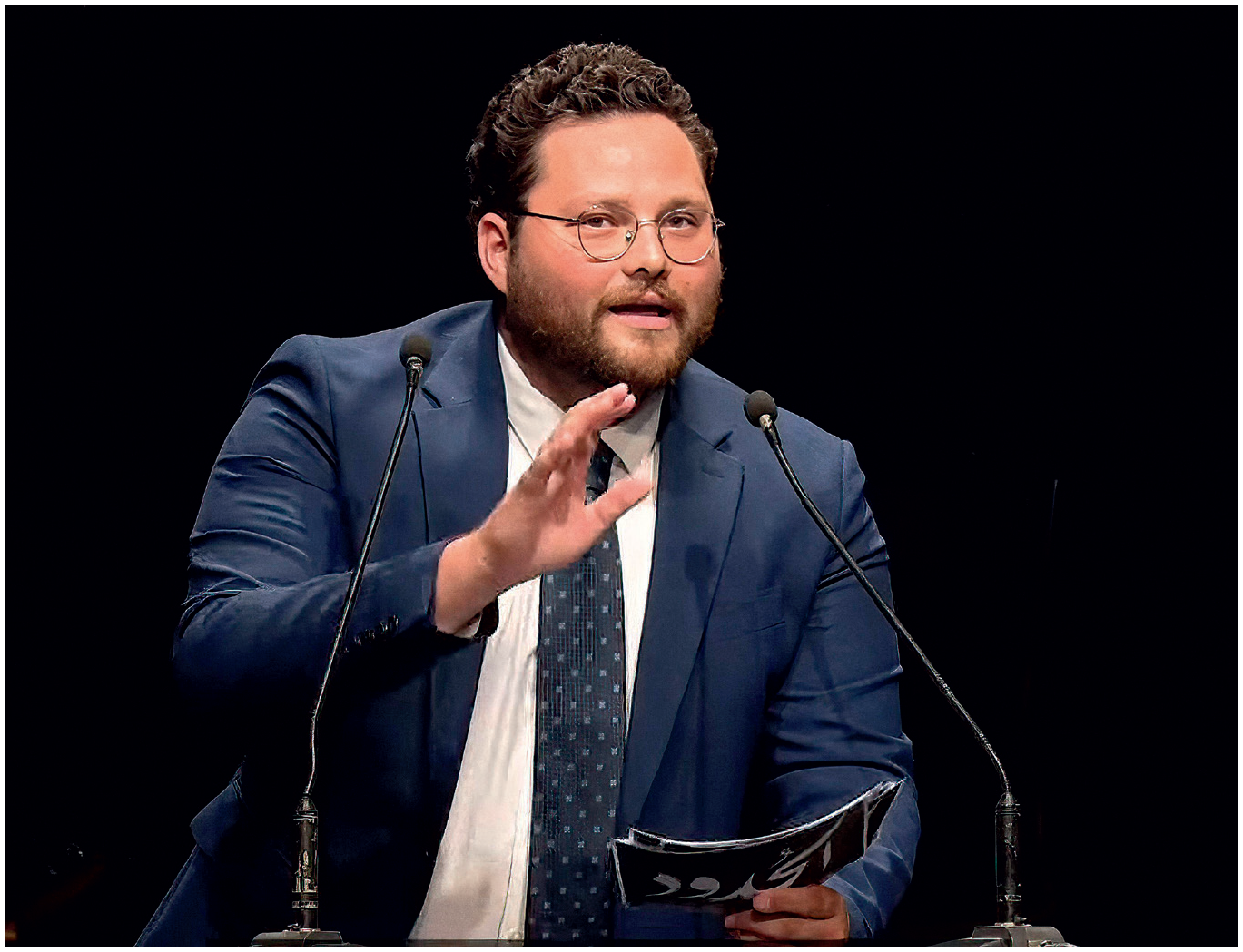
Comedians Hussein Kaouk and Mohammad Dayekh have also faced a significant backlash - in their case for a TV skit deemed offensive by some members of the Shia community. The pair were accused of infringing upon religious sanctities. Such incidents are part of a larger trend whereby comedy, instead of stimulating critical thought, can become a contentious flashpoint, sometimes even curtailing the very dialogue it seeks to encourage.
Mental health and staying funny
Lebanese comedy doesn’t exist in isolation from the ongoing traumas experienced by the wider population. These traumas have left an indelible mark on the collective psyche, impacting people’s mental health in profound ways. While making others laugh, comedians themselves are not immune to the emotional impacts of the tumultuous environment within which they live.
Baalbaki feels his comedy career has helped him navigate his own mental health struggles. Having escaped an abusive home in Tripoli at 17, he sought solace in humour.
"I’ve been the funny guy all my life," he recalled. After being encouraged by his friends to take to the stage, he joined awk. word in 2019. There, he found his calling.
"I felt it was my duty to entertain people," he said. However, the dissipation of the 2019 revolution, the ensuing economic collapse and the 2020 chemical warehouse explosion in Beirut presented new challenges.
"Now I had this [feeling of] depression and oppression," Baalbaki said. He sustained an injury to his leg during protests after the blast, he couldn’t secure job interviews, his girlfriend left him and he was broke. His reluctance to seek therapy, stemming from the tough exterior he’d developed, compounded those struggles.
"It was difficult to make people laugh all the time because I was suffering from emotional damage," he admitted. But Baalbaki eventually found his resolve, driven once more by his goal to make others laugh.
While the revolution and the Beirut blast brought forth myriad emotional challenges for comedians, they also signified a shift in the discourse, whereby previously untouchable figures were now considered fair game. Jokes about certain politicians "are now normalised", Moubarak observed - with the revolution being the turning point.
Tawk agrees. He said that "during the revolution, a lot of those superhero images of these political parties and political figures" were destroyed, with people now openly posting comments on social media where they make fun of those figures. But he avoids politics in his comedy.
The growth of stand-up comedy and the increasing visibility of dark humour on social media in Lebanon are testament to an unyielding, perhaps even resilient, spirit. As comedians innovate and agitate, they do more than simply entertain: their quips are part of a larger narrative resisting the systemic censorship and sectarian divides that have long dictated the boundaries of acceptable speech and art in the country.
Despite the ordeals that comedians share, they remain optimistic about the future. They recognise that they enjoy more freedom than their counterparts in other Arab countries; they are bolder in their work, and they reach bigger audiences via social media. They also say that the older guard is now less likely to sexualise women. And the new crop of comedians seems to be attracting audiences of different generations at their stand-up gigs: those who were born after the civil war ended in 1990 and those who bore witness to it, all of them experiencing the tragedy of Lebanon today while finding it within them to laugh at the same jokes.
"That’s the power of comedy," Moubarak said. "Once you laugh at something tragic, you kind of overcome it."