




Abstract

Official documents relating to the Duke of York are to be kept secret until 2065.
The Duke of York, Prince Andrew, at the Botanical Gardens in St Louis in 2003, as part of his then role as special representative for International Trade and Investment. The role was tax-funded but many files related to his activities as part of it remain closed
CREDIT: Bill Greenblatt/UPI/Alamy
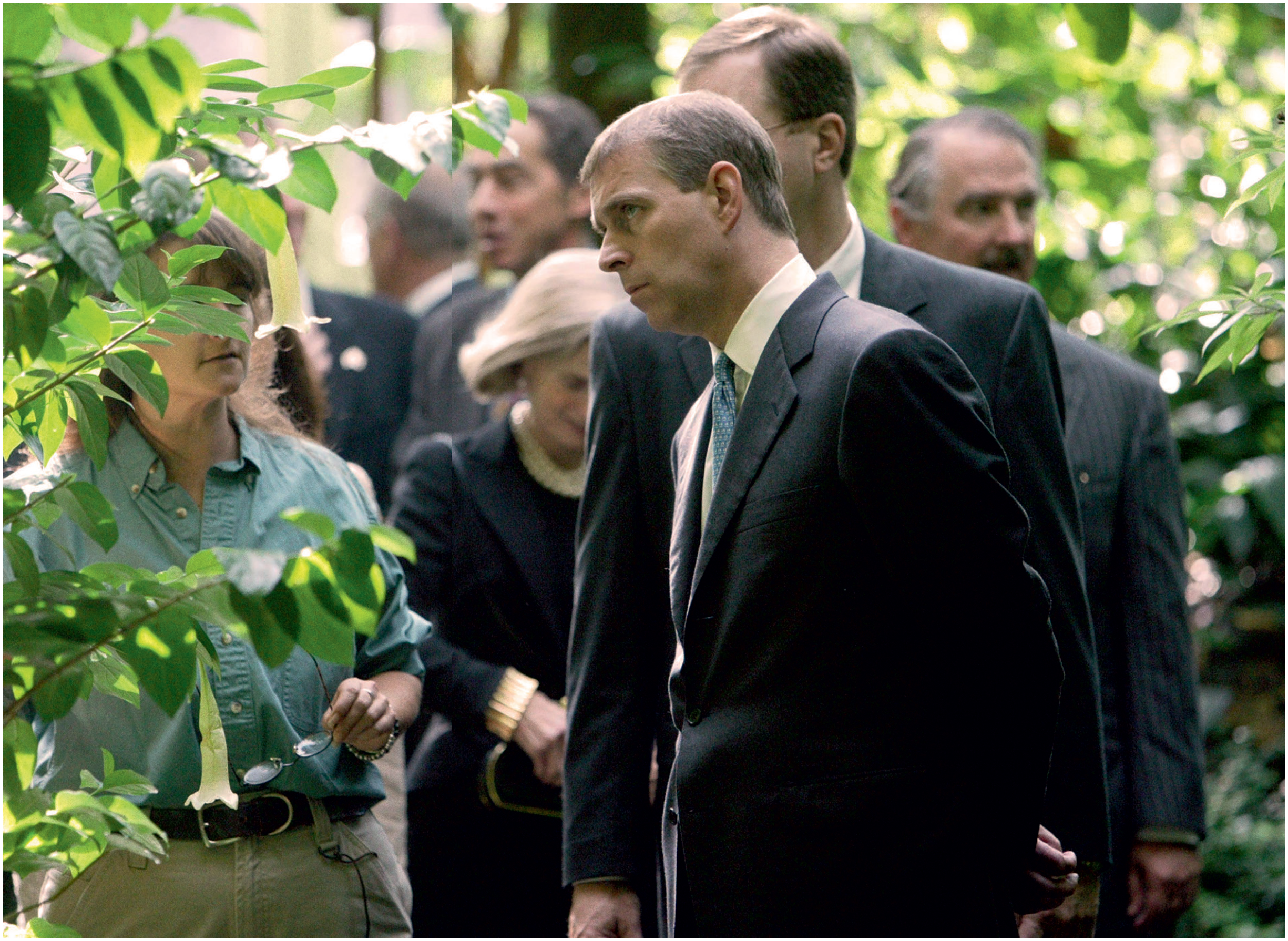
In response to FOI requests I’ve made related to Andrew, the Trade Department and the Foreign Office have given inconsistent replies. They both cannot identify "the information you requested as stated in your FOI request" and they have refused to answer my FOI requests on a costs basis by aggregating the requests, though the trips highlighted were to different countries at separate times. "We estimate that the cost of complying in full with the requests received between 26 April 2023 -28 June 2023 related to visits by Prince Andrew, would exceed the FOI cost limit. For example, information that could possibly be relevant to FOI2023/12802 and FOI2023/12803 is held in several hard copy files and thousands of electronic documents which would have to be searched to identify if the information you have requested is held," to quote them.
After appealing an FOI decision the FCDO provided me with one telegram relating to the Duke’s visit to Kazakhstan in September 2003, which simply detailed the logistics of his trip. The Department of Trade confirmed they had some files which still had to "go through an appraisal and selection review by the Records Management Team" and "if selected as records of historical importance the files will be transferred to the National Archives. If not selected, they will be destroyed in line with the department’s policy." A friend at the Department of Trade says that all references to the Duke on the central computer have gone. The Metropolitan Police have refused to say whether they ever investigated the allegations made against him nor have they confirmed whether he still receives protection and, if so, who pays for it. An FOI request for the names of those on the Royal Visits Committee for 2002 has several names redacted.
This is worrying because there is a justifiable public interest in who accompanied him on his trade trips and for what purpose, who is paying for his security now that he is no longer a working royal and whether the allegations, by Virginia Giuffre and others, have not been investigated simply because he is a member of the Royal Family.
It wasn’t always this hard. To be sure researching books has never been easy but there were always tools for the experienced writer - testimony, whether it be from interviews, diaries, letters or official documents. For those of us writing for the period to date, there are written documents on which we can draw, supposedly made easier by Public Records Acts and the Freedom of Information Act.
But I worry for the historians of the future. Will obtaining information be harder than it is even now? I have my concerns, and it is ironically as a result of the 2000 Freedom of Information Act. Tony Blair, who introduced the legislation, later regretted it and argued it hampered decision-making, and David Cameron described the Act as "furring up the arteries" of government.
We historians have hitherto worried whether records might be destroyed and when they would be released, but the worry now must be whether any record was ever kept in the first place. I suspect there is now more "sofa government" as ministers conduct business alone and without officials, and sensitive information is not recorded or is entrusted to encrypted and non-permanent systems, such as post-it notes or private emails which are never collated. I am told that words are deliberately misspelled to make them more difficult to retrieve in FOI searches.
Future historians will face other challenges making their work harder. It is not just that there may not be new records, but the available public records may be withdrawn on the say-so of a junior member of staff at The National Archives. I discovered this after requesting a 1932 protection file on the future King Edward VIII, which was refused on the grounds it would jeopardise the current safety of the Royal Family. When I explained there were dozens of similar files at the TNA, which had been open for 20 years, and was instructed by a tribunal judge to produce them, I discovered that they were no longer available and designated as "Access under Review". Eighteen months on they remain closed.
It all started encouragingly with the Waldegrave Initiative, a policy introduced in 1992 by Lord Waldegrave, whereby all government departments were encouraged to re-examine what had been previously regarded as particularly sensitive records, with the objective of declassifying a greater quantity of information. It was a precursor to the UK’s Freedom of Information Act 2000, and it set a precedent of declassification across Western democracies. But our ‘glasnost’ did not last long.
Public authorities did not like this declassification and, having failed to amend the Act, have become more adept at ensuring records are not made available under FOI with a series of techniques. These include: kicking the can down the road as long as possible by asking for repeated extensions; changing the exemptions deployed as each is addressed and shown not to apply; playing with semantics in carefully phrased replies which are economical with the truth; aggregating separate requests and then refusing on grounds of costs of compliance, claiming one is being vexatious; deploying FOI exemptions without a public interest test and which cannot therefore be challenged.
The percentage of FOI requests granted in full has declined from 62% in 2010 to 44% in 2019 and the percentage of requests withheld in full increased from 21% to 35% over the same period.
A favourite trick is simply not to respond to requests which puts requesters in legal limbo because without a substantive refusal they cannot fully enter the appeals process. Decision Notices issued by the Information Commissioner about this practice, called ‘stonewalling’, have increased by 70% in the last five years.
The growing number of Decision Notices is unfortunately more a reflection of poor behaviour by public authorities rather than a more zealous regulator. The Information Commissioners Office’s capacity to investigate complaints and enforce the Act is diminishing. The regulator has seen its budget cut by 41% over the last decade, while its complaint caseload has increased by 46% in the same period. Its ability to enforce the Act is hampered by its governance structure as it reports to the Cabinet Office - who have the worst FOI record of any major government department - who also set its ring-fenced budget. The Office of the Scottish Information Commissioner is funded by and reports to the Scottish parliament. Though parliamentary committees in 2006 and 2014 suggested a similar system in England, that reform has never taken place.
The situation with royal records is equally depressing. The 1993 Open Government White Paper promised that "records relating to the royal family will be treated in the same way as other records". The result was that they were only closed for more than 30 years if they contained information which might harm national interests, was supplied in confidence or might distress individuals or their descendants. The result was the release of a wealth of material on the role of the monarchy in British politics during the 1960s and 1970s.
It was superseded by the 2005 FOI Act which introduced an exemption for the royal family but with a public interest test. That year the Guardian journalist Rob Evans, after a long court battle right up to the Supreme Court, secured the release of the then Prince Charles’ correspondence with various government departments. As a result of that, in 2009 it was announced that the FOI exemption for the royal household would be made absolute for the sovereign and heir to the throne until 20 years after the correspondence was written or five years after their death, whichever was later. This was confirmed in the Constitutional Reform and Governance Act of 2010. And now the news that files on Andrew won’t be open until 2065 when he will be 105.
A new reign should have been an opportunity for a reboot of monarchy but it looks like there will be even less transparency in the future. Prince Philip used his final years to ‘organise’ his papers ready for an official life and the late Queen’s papers will be vetted not by a trained historian but a trusted valet.
A new government, whatever form it takes, offers no more encouragement to historians, writers or journalists. There is no enthusiasm throughout Whitehall and government for greater freedom of information, which only invites scrutiny and justification.
I am finding it hard enough to write about our institutions now but I suspect you will find it even harder in the future.