




Abstract

Belarusian author
CREDIT: Iruchka Karzanova
"History cannot be banned. You can cut off the hands of the clock, you can make them go backwards, you can invent your own time and declare it the only correct time, punishing those who dare to doubt it. History will still one day invade the place where it was condemned to non-existence in absentia. Retribution for arrogance and megalomania will be severe. Those who imagined themselves to be gods, lords of time, will fly into the abyss. Dragging us along."
These are the haunting words that open the preface to a new short story collection, Shakedown in the Museum (Pieratrus u muzei), by Belarusian writer and novelist Alhierd Bacharevič.
Bacharevič was born in 1975 in Minsk, then part of the Soviet Union. After graduating from the Philological Faculty of the Belarusian Pedagogical University in Minsk, Bacharevič became a teacher of Belarusian before becoming a journalist. He was one of the founders of the literary and artistic avantgarde group Bum-Bam-Lit, which was behind the publication of the cult poetry anthology Tazik bielaruski (The Belarusian Basin).
In 2002, he published his first short story collection, A Practical Guide to Ruining Cities: Stories, 1997-2001) and had produced many collections and other novels since, including Alindarka’s Children, winner of the English PEN award, and The Magpie on the Gallows, shortlisted for the Central European Angelus Prize.
Bacharevič’s magnum opus, the 900-page Sabaki Europy (Dogs of Europe) was published in 2017. The novel takes place over a wide range of different times, from the present day to a future in which Belarus doesn’t exist and has been colonised by the Russian Reich and the utopian pseudo-state of New Belarus has been built on an island.
Bacharevič tells Index Dogs of Europe is "a book about human and national solitude, about the power of language, about the human obsession, about the mystery of creativity, about Belarus as European island and about Europe as a Belarusian dream, about sex, literature, future…"
It won book of the year in Belarus and was shortlisted in 2019 for Russia’s biggest literary prize, the Big Book.
How things have changed.
After the disputed re-election of Alyaksandr Lukashenka for a sixth term in August 2020, Bacharevič took part in mass protests in Belarus.
The Belarus Free Theatre staged Dogs of Europe in Minsk that same year but the novel was then banned by the Belarusian authorities for extremism - "what the authorities in Belarus call any free expression and any dissent". It was the first literary work to be labelled extremist by the authorities.
Soon after the beginning of Russia’s invasion of Ukraine, Bacharevič wrote an open "Letter to Ukraine", which was published in one of the biggest news magazines in the country. In it, he outlines the similarities and differences between the two former Soviet republics.
"The Ukrainians and Belarusians have a common enemy, Russian Putin’s imperialism," said Bacharevič. "Putin and Lukashenka would be very happy, if we, Belarusians and Ukrainians, became enemies for each others.
"Ukrainians had many illusions about Belarus," he wrote in the letter. "They didn’t realise that Lukashenka’s state was not a peaceful brother-country in the north of Ukraine, but an authoritarian regime dependent on Putin, that hated Ukrainian freedom and was afraid, that it would come to Belarus. They didn’t want to know about Russification and political repressions. Lukashenka had been a relatively popular politician in Ukraine before the war began. On the other side, many Belarusians had an idealised picture of Ukrainian democracy and national identity. For millions of Ukrainians, as far as I see, these values have become important only after the bombardments and mass murders. We knew not so much about each other, though we thought we knew everything.
"Belarusian soldiers are fighting for Ukraine right now. But this is not the war of two armies, this is the war of two world-views, of values. On the Ukrainian side there is freedom and democracy, Ukraine stands for the better European future and for whole free world now. The resistance of Ukraine is a chance for Belarus to leave this dead end of its history."
Back in 2019, Bacharevič had participated in the intellectual club of Sviatlana Aleksievich and said that there is no single nation called "Belarusians".
That all changed after the protests.
"The real nation started taking shape in 2020, united by anger and desire to overthrow the dictatorship," said Bacharevič. "And there are Soviet people on the other side, the same ‘red men’ that our Nobel laureate wrote about. Red men think of themselves as being outside of Europe, outside of the world, outside of the time and history. They do not know themselves who they are. They live in the crevices of the pedestals of the dumped monuments to the leaders. Their homeland is still the Soviet Union.
"And these two groups of people live in Belarus, and they will never understand each other. Former Soviet people actually take their ancient dark horror dreams about the great Soviet Union for reality. Unfortunately, we have been paying a lot for this movie, and our descendants will pay very soon.
The worst thing is that the red men have weapons. And we have only our language, our words, our values, our moral resistance.
"Many in the West cannot understand this," he said. "This misunderstanding often leads to discrimination against Belarusians abroad. Everyone who has Belarusian citizenship is suspected of complicity in Putin’s aggression. People who suffered from the regime, who managed to escape, who all their lives through tried to warn about the dangers of Russian imperialism, have become the second-class people just because of their Belarusian passport. Their bank accounts are blocked, talks and conferences are canceled, Western companies and even cultural organisations proudly declare: we do not cooperate with the citizens of Belarus. It’s bullshit. Belarusians today are people with passports, but without a state. Our own state has declared war on us."
Bacharevič writes in Belarusian, which he says is his "most powerful weapon against assimilation".
He says, "The independent Belarusian culture speaks Belarusian and by this already opposes the empire. Without the Belarusian language, Belarus will disappear from the world map and then my gloomy prediction from the novel Dogs of Europe will come true. The Belarusian language today is part of the resistance to Putin’s fascism, Russian imperialism. This is true for many who have understood the danger of the Russian Reich in recent years. But for me the Belarusian language is something more. I speak, write, dream in Belarusian, and have been doing this for more than 30 years. The Belarusian language is my homeland, which is always with me. Because the homeland of the writer is his language."
Until 2020, it was possible for writers in Belarusian to write freely.
"We had had our own platforms for discussions and readings, our own literary festivals and independent publishers. Our literary and cultural life went on, so to speak, along with the state cultural life. The state pretended that we were not existent, but we worked, we wrote and established contacts with the international literary world. The state just didn’t perceive the free Belarusian literature as a threat for its power. Only writers who were engaged in political activity directly were repressed by the dictatorship. But after 9 August 2020, everything changed. A lot of people suddenly realised that this system was built on lies and violence. Even the people who recently were not interested in literature and language, who considered Belarus a normal state. And in 2020, these people started reading Belarusian literature, and today they need answers for their painful questions: who we are, why this disaster has become possible, what our past is and where we are going now."
Bacharevič’s new collection of short stories, Shakedown in the Museum, is dedicated "to all those who assert the value of communal freedom at the cost of personal freedom. To prisoners of Belarusian prisons."
Bacharevič says there are many reasons for writing the book but one of the most important is this, he says: "Because I want the world to know, even after our death, what happened in Minsk in 2020 and 2021. How we lived there, how we felt, how we hurt, how we doubted and believed, how our strange days passed - the days of people in whose house history once came."
Below we publish the short story Karniki (Punitive Squad) from the new collection, translated into English for the first time here. The title draws a parallel between the murderous activities of the SS Special Regiment under the command of Oskar Dirlewanger during the Nazi occupation of Belarus in World War II and the modern-day OMON (special purpose police squads). The members of the SS regiment became known as ‘karateli’ (punishers) in Russian and ‘karniki’ in Belarusian.
Punitive Squad
They left in three minibuses. The plan was to get it over and done with before the heat became intolerable, but on their way out of the city they had to stop and wait for a reporter—the order had come in suddenly. While they waited, the sun found them beneath the maple trees that grew along the highway, glanced in through the tinted windows and from then on stayed with them. The reporter hopped into the first minibus and said that they had to wait for a cameraman. They said nothing, after all an order is an order. Somewhere in the village a man woke up and looked out of the window. He put his phone on charge and went out into the yard to relieve himself. He opened the door to the outhouse, went in and took up position over the hole to the sound of flies buzzing and the regular mechanical banging that was coming from over the neighbour’s fence, took a look through a crack in the wall and zipped up…
The cameraman knocked on the door, and off they went.
They rode in silence. The sun kept up with them; it ran along the left-hand side of the highway, at times showering the occasional roadside patches of forest with its rays and then jumping beneath the minibus wheels. It was a bit stuffy inside the bus but nobody attempted to open the windows. The TV reporter had by now become the object of Safronaŭ’s intense scrutiny—blatant, goggle-eyed, frowning and utterly indifferent. He did this to everyone who had the temerity to enter his field of vision. At such moments people usually turn away and begin to fidget uneasily, trying to find some sort of activity for their hands and so pretend they have nothing to do with Safronaŭ. However, he would keep on staring and normally they would quickly give in by moving to another seat or getting off, but here in the minibus the journalist had nowhere to hide. That’s why he took his phone out, back bent under the weight of Safronaŭ’s direct gaze boring right through him like an empty pipe, and pretended to read some important message. He showed his concern by tapping the screen several times. Everyone knew, of course, that what was most important still lay ahead of them, in some fifteen minutes’ time.
"Lads," the TV cameraman said suddenly, turning to them as if they were mates of his, or he was one of the squad. "Who’re we going after today, eh? What beast are we hunting?"
Nobody said a word in reply. The cameraman buttoned his lip.
Uduhaŭ looked calmly out of the window through his sunglasses. He liked the comparison with an animal—he too was expecting there to be a hunt, one that had to be successful. When they were told they would be accompanied by someone from the TV with a camera, he immediately pictured to himself the kind of woman who natters endlessly on the telly, and this infuriated him. You mustn’t take women with you when you go hunting—otherwise the hunt is bound to end in failure. Now, however, there were once again only men in the team, so it was perfectly reasonable to expect that they would succeed in cornering the beast. Uduhaŭ looked at the tinted glass and saw a boar’s head in front of him. A head with teeth bared and eyes blood-filled and bulging.
Whenever his ancestors used to go hunting and killed a beast like that, they would share out the meat and skin among everyone. Then they would offer thanks to the gods for the kill, and to the beast for providing humans with its carcass. If hunters met someone on the road while they were carrying a boar they had killed back to camp, it was customary for them to present the traveller with three ribs from the right side of the animal. Uduhaŭ did not know the language of his ancestors, but then his people had forgotten it long ago. However, there was a website which offered information about his ancestors’ traditions, and Uduhaŭ visited it from time to time. In the life of each person there comes a moment when they begin to think seriously about who they are and where they’re from. Uduhaŭ’s land was here, and here he was spending his life—among these gentle hills and suspiciously peaceful lakes, wondrous, deep, hidden in forests as thick as the fur on the back of a folktale hero. Among these people who accepted him as one of their own and didn’t ask unnecessary questions. Somewhere far off distant relatives of his led a hard, monotonous life. He talked to them on Viber sometimes and once flew down to see them, but got no joy out of it. He was an outsider there, even though they greeted him as one of their own and gave him presents when he was leaving: smoked meat of a saigak wrapped in newspaper, cognac, a knife in a sheath bearing some clever-looking but cheap ornament. Uduhaŭ felt relieved to be back in foggy, thawing Miensk. Once again among his own kind. But were they his own kind? ‘This own kind’ of his had never seen a boar’s head before them in the full light of day, whereas he had.
Not far from the forest they took a wrong turning and ended up in a dried-out bog; on the other shore there was a group of young birch trees suffering in the heatwave. They had to make a u-turn and reconstruct the route. The TV journalist had been sipping water from a plastic bottle for the whole journey—it looked like he had had too much to drink the night before; now there was no water left. He gazed with blood-shot eyes at the squad cautiously and in hope, but did not dare ask. The minibuses eventually regained the highway and then turned off again on to some forest road. All of a sudden the road threw a cyclist under their wheels; he was desperately pedalling with his short legs in wellies. He tried to swerve to one side, literally flew into the ditch, disappeared and drowned on the other side of the tinted windows as though he had never been.
"Don’t stop," was the short, sharp message from Commander Bitok on the front seat.
It looked as though they were on the right road now. Some old peasant woman, her head wrapped in a colourful head scarf, was riding a bike along the roadside towards them. The whole frame was wobbling.
"Wait," growled Bitok and rolled down the window. He asked her for directions in a voice of authority; the woman nodded her head vigorously as if a bumblebee was biting her beneath the head scarf, and waved her hand behind her back.
"Drive on."
At last a signpost appeared from behind the bushes. They stopped and, stretching, jumped out of the buses. Bitok ordered the men to encircle the village around the perimeter—there were enough of them for this and the village was small. The squad ran off in two directions. Somewhere over the village the roar of an invisible plane could be heard—just beyond the nearby low hills was the international airport, a grey spot on a green map.
"Safronaŭ, Uduhaŭ, Skuratovič—you’re with me. We’ll take him."
The street could already be seen beyond the bushes: old pear trees sticking out their elbows, uneven fences leaning in all directions, and behind them—a newly-built brick house and sacks of cement.
"Right then," said Bitok softly, "the TV people will be at the back. Don’t come up close. It’s not some drunk we’re dealing with here, but… In short, we don’t want anything else happening… Got it?"
The journalist and the cameraman stopped and looked at the sun with hatred. The cameraman took out a baseball cap.
"Let’s get on with it." The coordinates they had were precise; it would have been difficult to mistake the Conjuror’s house for anything else. It was a quite small property of light-coloured brick with a glassed-in wooden veranda that served as a kitchen in summer. One of the kitchen walls gave the owner’s occupation away: it had tigers jumping through a fiery hoop depicted on it. It looked like an old circus poster that had seen service over God knows how many years. Bitok shifted his eyes towards Skuratovič, who immediately broke down the low gate. Bitok hurled himself towards the front door and stood stock still. Skuratovič jumped over to the window. Safronaŭ ran round to the back of the house and took up position behind the apple tree, while Uduhaŭ took a run-up to the door and smashed it open with his shoulder; holding his AK at the ready, he shouted something out, but the journalist and the cameraman couldn’t make out what exactly.
Then silence fell, broken only by a radio that started talking and interrupting itself somewhere over the next-door neighbour’s fence, and by bluebottles banging on the windows.
They all entered the house at once from all sides.
There was no one inside.
Even so the house breathed the air of a recent awakening. A still hot mug of coffee stood on the table of the summer kitchen, and next to it fried eggs on a cracked plate posed with a crust of bread; emboldened, one of the flies settled on the bread and wiped its feet. Safronaŭ looked at it spellbound. The thought suddenly occurred to him that the fly might well be the Conjuror himself—it just sat there brazenly, drawing attention to itself, getting ready to have its breakfast as if nothing was happening, in spite of the uninvited guests. That was how it mocked them, all dressed in black, sweaty and tense. It was posing quite shamelessly for the disenchanted eye of the camera.
They searched the house: three cramped rooms where the air was stale after the night. For some reason it also smelled of dog. They looked in the larder and the fridge, broke open the doors of the wardrobe, looked behind the stove where there were empty bottles standing, and met up together again in the largest of the rooms. They bent over the cover of the cellar. It had obviously not been lifted for ages.
"Right," said Bitok. "Uduhaŭ, check the cellar. Safronaŭ, you go and have a good look round outside. I wouldn’t put it past that bastard to make himself a hidey-hole somewhere. But he’s not going to get away. Skuratovič, you come with me, we’ll suss out from the neighbours where he is."
Without a word Safronaŭ moved out to the yard.
"What about us?"
Uduhaŭ half-lifted the cover of the cellar and shone his torch down. There were jars glinting, and his nose was struck by the cool smell of rot and potatoes—both pleasant and alien at the same time. Bitok and Skuratovič left the room.
"What about us?" This was the TV journalist timidly asking Uduhaŭ again. "Follow the commander." With an air of authority, Uduhaŭ gave a nod in the direction of the door, and the two of them hastily ran out on to the street.
* * *
Uduhaŭ climbed down the wooden ladder. The light from his torch poked all the pot-bellied jars. It was as if dozens of partially blind eyes were staring at Uduhaŭ from out of the darkness; there was no joy, no greeting in them, only impatient waiting for him finally to stand on his own two feet on the earth floor and become one of them.
The cellar was quite deep. Uduhaŭ finally reached the bottom and shone his torch on each jar, each shelf. There were springy, disgusting old potatoes rolling around underfoot. The square of light above his head suddenly went pale—it was as though someone had part-closed the cellar cover. Uduhaŭ blinked—and it was light once again. The sun must have gone behind a cloud.
The torchlight slithered along the wall and landed on a low door. Uduhaŭ walked over and opened it with the toe of his boot. He shone his torch into this unexpected passageway between sagging shelves and walls covered with a layer of cement. The passage was narrow, only one person could get through. Uduhaŭ slowly moved forwards, holding his AK at the ready and lighting the way ahead. There was water dripping somewhere close by in the darkness, filling the passage with a trembling echo. And then he heard breathing; It was there where the light couldn’t reach.
Uduhaŭ stopped and listened intently. By the light of the torch he could just make out the head of a boar; it flashed for an instant before him in the depths of the passage and then melted away, merging with the bricks. He automatically raised his AK, then lowered it and began listening again. He could still hear the breathing, it was close, it was hiding at the point where the passage became narrower. Uduhaŭ aimed the torch straight at the spot where the animal had just been and stepped into the darkness. For a second he saw a man appear in the passage, shielding himself from the bright light with his hand.
"Freeze," said Uduhaŭ loudly.
The breathing ceased. That left just the water dripping somewhere behind the narrow walls of the passage.
"Freeze, Conjuror. Yes, I’m talking to you," repeated Uduhaŭ. "Let’s have you, come here."
He pointed the torch straight at the face of the man who emerged from the passage.
It was one of the squad. In uniform, but unarmed. Uduhaŭ forgot what his name was. Screwing his face up as though he had toothache, the guy looked right past Uduhaŭ into the darkness behind his back.
"Don’t shoot, Uduhaŭ," said his squad mate. "Didn’t you recognise me, or what? You unrussian soul!"
Uduhaŭ lowered his AK.
"What are you doing here?"
"I don’t know myself. Bitok sent me down to check," said his squad mate. "And suddenly you’re here too."
"And I’m here too," said Uduhaŭ. "Where’s your gun, mate?"
"I left it up top," he muttered. "Back there."
There was something wrong about his voice. The lads in our outfit don’t talk like that, thought Uduhaŭ. They simply don’t get accepted, not types with that kind of voice. It’s like it’s artificial, sort of stuck on.
"Uduhaŭ, you go on ahead and check what’s down there, OK?", said this misfit. "And I’ll go… I’ll fetch my AK. And you go and have a look… The passage goes on further."
"What about the torch?", said Uduhaŭ, feeling the hand in which he was holding his gun go numb. "What did you come down here for without a torch?"
"Off you go, Uduhaŭ. don’t be afraid." His mate casually waved a hand in his face and disappeared into the darkness from which he had come. Uduhaŭ tried to follow him, but his torch lit nothing but bare earth walls, the concrete had come to an end. Water was still dripping. He lent forward slightly, took a couple of steps and suddenly found himself in a spacious cave—maybe cave wasn’t the right word, it was like some kind of hall, dissected by a murkily sparkling stream. Uduhaŭ went as far as the water’s edge and stopped. Somehow he knew that he shouldn’t go any further.
He shone his torch on the opposite wall; it looked as though it was really close, but the stream stopped him getting any closer. The breathing could now be heard coming from there. Uduhaŭ aimed his torch on the water; tiny, dark drops were falling into it, breaking against it with a loud plop-plop-plop. He got out his radio, although he knew that there wouldn’t be a signal here underground. However, the radio came to life.
"What have you got, Uduhaŭ?" Bitok’s voice sounded impatient.
He briefly described the situation.
"So get on with it. Do something!" crackled the radio. "Seize him, Uduhaŭ. Seize the Conjuror, my son. You’ll be a hero."
At moments like this Bitok would usually give vent to a torrent of swearing and cussing such as only people who live in this country know how. Even in his most terrible dreams Uduhaŭ could never have imagined Bitok calling him ‘son’.
"We’ve got to pay here." Uduhaŭ forced the words out of himself and almost stepped into the stream. He had no idea why he said it, or what made him say it in exactly that way—but somehow it was clear to him that it would be better to pay, that he shouldn’t simply go over to the other side of the stream.
"So pay and go," the radio shouted angrily. "Come on, Uduhaŭ, I’ve got enough to do without bothering with you! Over and out."
Uduhaŭ dug around in his pocket and fished out some coins. He didn’t know where they came from, perhaps they were the change left over from the ice cream he bought yesterday. He placed the coins right beside the water and hesitantly crossed the stream.
* * *
…Bitok was really irritated as he watched the couple get dressed in front of him. They had turned to face the wall as they hastily put their clothes on, trying to please Bitok by doing what he had ordered them to do, but even so they were doing it so slowly that he felt like firing off a volley above their heads to make them fall to the ground and squeal in terror. Bitok and Skuratovič had caught the pair in the doggie position right in the middle of the kitchen, and they were quite unable to separate themselves, just as if they were a couple of street mongrels.
"How’s Uduhaŭ getting on down there?" asked Bitok, watching the short man get all muddled up with his trousers.
"There’s no reception," answered Skuratovič, hanging the radio on his belt without taking his eyes off of the woman’s backside.
The window shook as an aircraft roared just above the house. It must have been flying very low.
"Try him again, tell him to come here," muttered Bitok through clenched teeth and sat on the edge of the bench. "Right then, citizens. What are we going to do? Do you know the Conjuror?"
"Do you mean that neighbour of ours, the bloke from the circus?" Shorty was ready with a quick response. He finally managed to zip up his flies. "We all live so close to each other here. How could we not know him?"
"Where’s he hiding?"
"Well, he was at home. But we’re not what you’d call friends with him. OK, yeah, we say ‘hello’ to each other but that’s about it."
"What if we check?" Bitok stood up and went over to the window. "And what if I find him, eh?"
He looked at his fist and, with a smile on his face, smashed one of the panes of glass. The woman let out a squeal behind his back.
"Where’s the fucking Conjuror?"
"We don’t know, honest," wailed the woman.
Unwillingly, Bitok went right up to her.
"Where’s the Conjuror? Where did you hide him? Eh, bitch?"
"We don’t know." She was beginning to sob. "We don’t know him."
"What about your neighbours?"
"Yeah, the neighbours might know," mumbled Shorty.
"Stay indoors, don’t go anywhere," ordered Bitok. "Keep up the practice."
Skuratovič opened the door for him and they set off straight across the kitchen garden for the next house. The pair from the TV trotted after them. Images in the camera lens: a little cherry tree that showed up and then disappeared from view, a rusty Rabitz chain-link fence pushed to one side, and finally some real material to catch on film: a couple of human figures under a canopy, a grill, smoke, a window with a yellow curtain, tomatoes scattered on a table top. And in the midst of them like a tower—a white jar of sour cream.
* * *
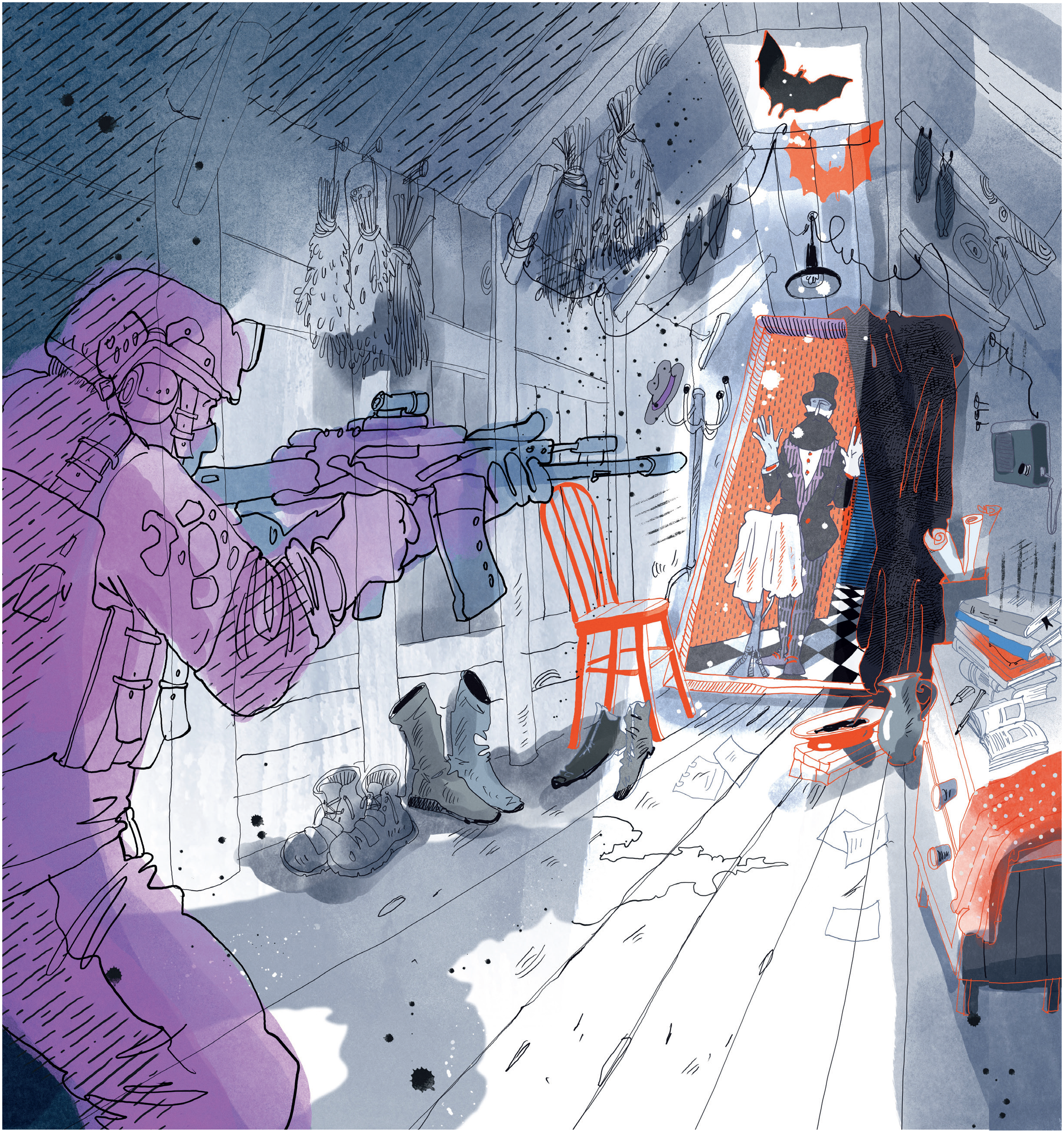
…Safronaŭ looked sullenly at the sky, where a furrow of snow and foam was growing—the plane itself wasn’t visible, there was only this trail heading off in the direction of the sun. He opened the shed and went in, holding his AK muzzle forwards. The Conjuror was looking at him. A portrait of him was leaning against the wall—black top hat, cloak, white gloves, an absolutely, unbearably fancy beard, eyes beneath thick pomaded brows, the squinting, repulsive, mocking eyes of a swindler.
There was a large spider sitting on the Conjuror’s nose. It was perfectly still, as if waiting for Safronaŭ, as if it was afraid of frightening the prey that was coming willingly into its clutches.
Safronaŭ looked around. Beneath the mirror in the corner there was a bowl with soapy water and drops of blood around the edges. On a little board next to it was a can of Nivea shaving gel, a blade and an unwashed shaving brush. The morning light was worming its way in through the gaps in the wall. It was perfectly still inside the shed, even the flies weren’t moving—but Safronaŭ could sense that there was someone here. He glanced at the mirror—the strips of light on his face looked like camouflage. He checked the floor and walls metre by metre, then looked up—and recoiled. Hanging on a string from the ceiling was a little wooden figure, a silly, eyeless marionette. Safronaŭ swore softly and tugged the marionette by a leg. At that very same moment there was a flapping noise above him—was it birds or books?—Safronaŭ couldn’t make out exactly what, but it seemed like they were going to hurl themselves onto him—and then everything went quiet. They had flown off through a gap in the high roof—all except for one whatever it was sitting on a beam, its wings folded and looking melancholically down at Safronaŭ from above. A bat. They were bats. Safronaŭ had never seen live bats before. He took aim but then lowered his AK. Someone squealed softly right behind his back. Safronaŭ caught a whiff of something in the air and shifted the portrait away from the wall. In a box lined with straw sat a white rabbit, and right by him was that black top hat.
"Abracadabra," a voice suddenly intoned somewhere close by in the shed, and Safronaŭ turned sharply—but everything was still the same: the portrait, the marionette hanging from the ceiling, and even the bat was sitting in the same place, and still looking just as gloomily at Safronaŭ.
The radio burst into speech. "Safronaŭ, anything new to report?"
"Nothing."
The radio cursed.
"I remind you: he’s to be taken alive. I know you, Safronaŭ."
"Understood."
* * *
…The kebabs were burning. The woman was crying. The husband was glumly watching the meat being turned to charcoal on the shiny new, recently-bought skewers. The children were standing in a huddle a bit further away, unremittingly staring at the AK in Skuratovič’s hands. The boy was shielding his sister with his back, and she was looking with hatred at the TV cameraman. He lowered his camera in embarrassment.
"Keep filming", Bitok ordered immediately. "Are you on a job here, or what? Feeling sorry for them, are you? They’re all lying bastards here, do you think I don’t see that? So, come on then, citizens. Where have you hidden the Conjuror?"
"I’m telling you, it’s our son’s birthday," sniffled the woman. "What Conjuror?"
"Shut up," her husband gestured with his hand to get her to be quiet. "Stop clucking like a chicken. I’ll explain it all."
"What is there to explain to them?" said the boy, trying to hide his sister behind his back, but she wasn’t having it—she wanted to be in the frame. "You can see what’s going on. We all can."
"And precisely what is it you can see?" asked Bitok with a smirk on his face. "What can you see? Come on, tell me."
The boy bit his lip.
Bitok walked up to the grill, pulled off a black piece of meat from one of the skewers and blew on it.
"You’re all in it together, aren’t you?" he said, put the meat in his mouth and spat it out. "I reckon you were all so proud that the Conjuror had bought himself a summer place here in your village. A celebrity, right? He must have amused your kids. But here’s the problem. I can see it in your eyes: you’ve hidden him all right. You’ve hidden him and you’re keeping your traps shut. That makes you all his accomplices. You’ve gone and built hidey-holes for him like there’s a war on all over the fucking place. And meanwhile you can’t even buy proper rabitz fencing for yourselves.
He went over to the fence and kicked it with his foot.
The fence sank slowly down into the grass. The boy followed it with his eyes.
"Lift it up," said Bitok. "You, yes, you."
Skuratovič came up close to the boy and shoved him in the back with the barrel of his AK to get him to hurry up.
The boy moved slowly in the direction of the fence and lifted it up.
"And don’t let it go until I say so," said Bitok, and yawned.
"He’s not guilty of anything," shouted the woman.
"Who said he was?" Bitok sounded surprised. "What’s wrong? The whole country respects a decent bit of rabitz fencing. You’ve got it here in this village—each house has some. We could see it everywhere when we were on the way here. Absolutely everywhere. For people in this country Rabitz is like their very own mother. It’s like a second skin. I’ve got some at my own summer place. You there, keep on filming. You’re on a job. You’ve got to be tough on these people. I can see right through them, they were all there, all of them. They were all waving those rags of theirs. What was it you called us? The pathetic poofters? What’s fucking stopping you from shouting it out now? Crapped yourselves, have you? Come on, get it on film, who do you think I’m talking to? What do they call you, yes, you with the camera? Journalists… As if I don’t have enough to deal with without them as well. Skuratovič, follow me."
* * *
…The first thing Uduhaŭ sensed was the smell—resin and warm haze, charcoal and leather. A camp fire. It was there in the darkness, in the wide passage beyond the underground stream. Sparks flew along the ground. He made a turn, holding on to the walls with his hands. Warmth caressed his face—he could feel his father’s hairy arm.
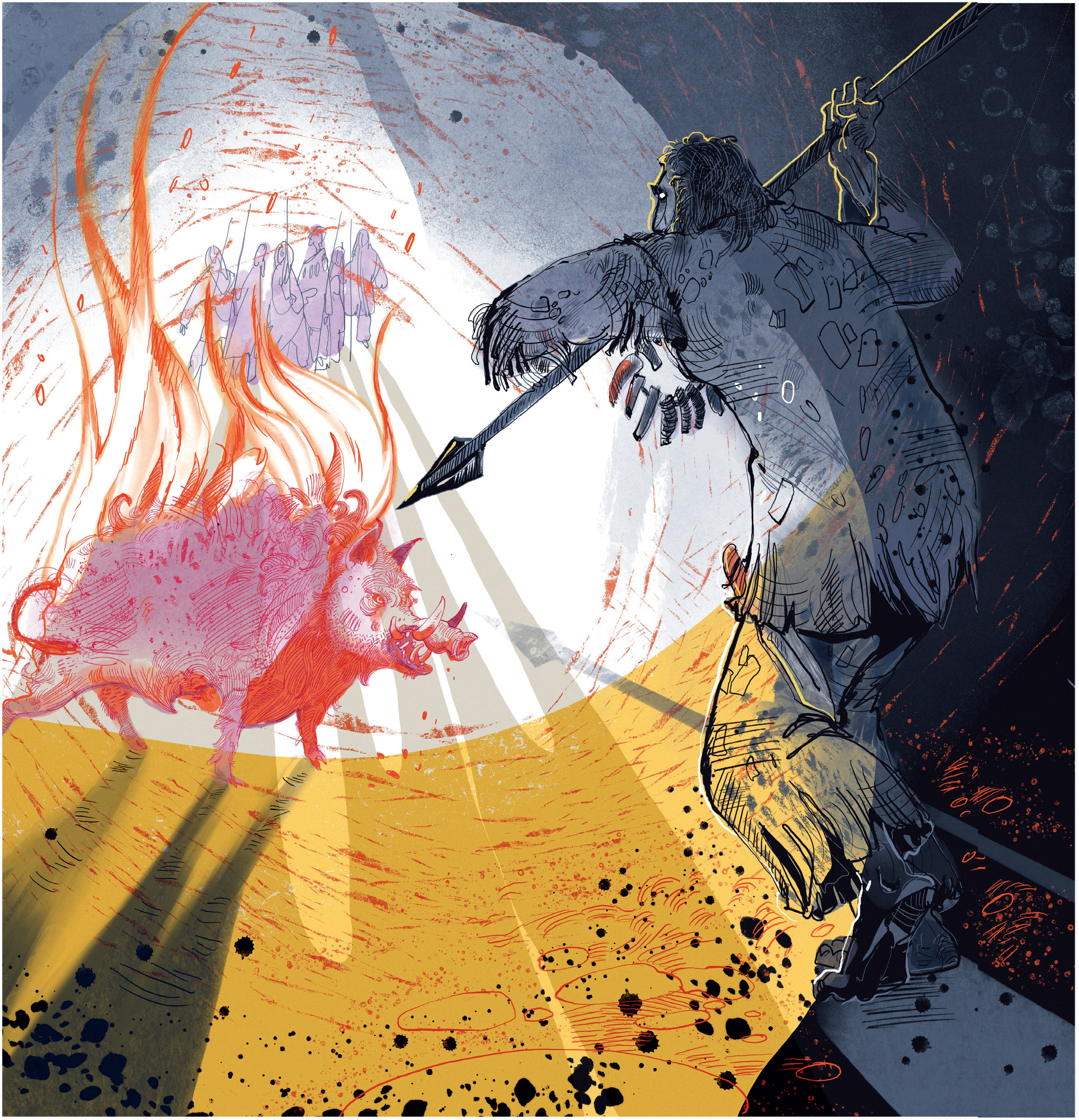
The fire had been set right in the middle of the cave. There were people sitting around it—all men, all with beards, all holding spears on their laps. All he had to do was approach them, and they began to speak—in an agitated but friendly way.
However, he couldn’t understand a single word.
They noticed this and fell silent. One of the men stood up and walked over to him. He grabbed the AK with his hands. Uduhaŭ didn’t want to let go of the stock, but without knowing quite why he submitted—the man took the weapon and stood it against the wall. Another man handed Uduhaŭ a spear—one like all the others had.
And then they burst into song: all together, singing in low voices, solemn, looking at the fire. Uduhaŭ alone was silent, holding tightly on to his spear. There were moments when he thought he knew the song. He couldn’t join in, although he opened his mouth along with the rest of them. Even before they had finished their song, they stood up and moved off further into the darkness.
He went with them. It was difficult for him even to imagine that he could not have done so. He had to.
He walked on, seeing ahead of him only the fuzzy outline of the fur hunched cloak of the man who bore the torch. That hunched back—and the snout of a boar with eyes like hooves.
The flames of the torch crackled—or maybe the crackling was coming from the radio that was attached to Uduhaŭ’s belt. He couldn’t pick it up—he held the spear in one hand, and with the other he covered his testicles. He had no idea why, but it was clear to him that he had to guard against a blow in exactly that spot.
Suddenly they halted. The column of men parted. Uduhaŭ also wanted to press himself against the wall—but they parted in front of him, they gave him space, they showed their respect for him, they expected something from him.
He stood in this corridor and looked straight ahead into the depths of the passageway. And in the depths stood a boar.
He raised his spear and hurled it.
Dozens of eyes turned towards the beast as if by command.
It snorted, leapt towards Uduhaŭ and fell snout first to the ground.
And then there was singing on both sides of Uduhaŭ.
Sitting in his rightful place by the campfire, he could feel how they in turn reached over to him to pat him on the shoulder. Uduhaŭ could no longer remember where his AK was; the cave seemed to have become wider and more spacious, and in the centre they were sitting around the campfire that had flared up with renewed strength. Two men brought the boar and heaved the carcass over the fire, while the others began to sing in low, hoarse voices. Uduhaŭ felt joy—however hard he tried to drive the feeling away, it all the same flew right into his face in the form of hot sparks.
One of the men drew a long knife. The singing grew in intensity—and as soon as the metal sliced open the boar’s skin, the chorus exploded into such a beautiful melody that Uduhaŭ joined in. He could not have done otherwise. He knew the words now.
The boar’s head was jutting out of the fire right in front of him.
"What are you doing, Uduhaŭ?" whispered the head, looking with hatred straight into Uduhaŭ’s eyes. "You unrussian soul. Who do you think you’re scorching, Uduhaŭ, eh?"
"Safronaŭ?"
"I hate you, Uduhaŭ," said Safronaŭ. Black scorch marks were beginning to cover him. The radio on his belt shouted something, but the shout was drowned by the squealing of the flames.
…The sky above him was in uproar; for quite some time the aircraft drowned out the sound of his own voice. Safronaŭ often used to talk to himself, especially when there was nobody else around. Although that’s only how you say it: talking to himself. In actual fact Safronaŭ was talking to an old acquaintance, a lad. A lad whose name he didn’t know.
It was autumn, a year ago. Safronaŭ remembered the day, remembered every moment—but he had learned to delve into his memory like looking through a spyglass, a black spyglass. All you need do is take a casual glance, and the memories come back. But if you don’t look, it’s like nothing ever happened.
However, he looked.
…The lad had suddenly appeared from round the corner, without realising that the street where he was now standing was a dead end. And Safronaŭ had already stationed himself in it, quite alone. The lad was certain that he had got away. He didn’t notice Safronaŭ at first; he leaned against a wall and wiped away the sweat. He tried to calm his breathing down, but without success. Safronaŭ could see his heart pounding beneath his T-shirt. In fact it was as if he could see right through the lad’s skin at that moment, could see his heart working inside him: straining, breathing, pleased at his escape. The transparent lad stood in front of him, without noticing anything.
And he, Safronaŭ, stood in front of the lad. In some ways they were alike: both soaking wet to the bone from sweat. Back then, just as now, it was blisteringly hot and stuffy in the city. Especially in the sun.
Then the lad raised his eyes. At first Safronaŭ was satisfied to see horror in them—the horror of a rabbit, desperate, hopeless. Then came pleading, and this Safronaŭ did not like.
"Let me go," said the lad, and smiled. Safronaŭ killed him quickly, with a single blow. Bats for use as weapons had been distributed before their shift—they had had to sign for them. Safronaŭ had never used anything like them before, and he was dreaming of trying one out. The bat seemed somehow to fly up into the air of its own accord—so comfortable, so impetuous, so heavy, so merry. He checked—yeah, the lad’s dead. Safronaŭ wiped the bat with the lad’s T-shirt, the covering of a heart that was already at peace, and went off to rejoin his colleagues.
…"So, you’ve gone off to meet your people, and I’m off to mine." This was Safronaŭ continuing his conversation and looking round suspiciously at an old pear tree. "You didn’t suffer, did you? And I didn’t either. You asked for it. Didn’t you? That’s how it was, wasn’t it? Anyway, you’re better off where you are. We’re frying in the heat here; it’s like hell. And it’s this fucking way day after day."
Safronaŭ walked over to the wooden outhouse and sharply tugged the loose-hanging door open. He stood over the hole and spat. A scene suddenly entered his mind that he was quite unable to rid himself of: the Conjuror swimming in a pile of excrement. Well then, thought Safronaŭ, that’s not a bad place to hide yourself. Whoever would have thought of checking the crapper? But that’s exactly what he was thinking of.
The Conjuror could well have concealed his head beneath the liquid sludge. But he wouldn’t have been able to hold his breath for long down there. Without batting an eyelid, Safronaŭ looked closely into the hole, but no head floated to the surface. He straightened up and unzipped his trousers.
"Abracadabra" was the message written at eye level on the wall of the outhouse.
Through gaps between the letters Safronaŭ could see a field and the forest beyond it. There was someone out there making his way right through the rye.
With a look of grim determination on his face, Safronaŭ pressed his lips together and leapt out of the outhouse. The man was clearly aiming to reach the forest in a hurry. He was trying not to wave his arms around, but all the same it was as though he was swimming freestyle through the field—but swimming on the spot, without getting any closer to his goal. Safronaŭ raced to where the grass was, then ran into the rye and took aim.
He had to do something. True, there must have been lads from his squad in position around the perimeter, but they had apparently missed him. Safronaŭ shouted, but more to himself than to the man making for the forest. Then he fired, aiming for the legs.
It took him a long time to reach the body—it was difficult, like walking through water.
Lying in front of him with his face to the sky lay Uduhaŭ. And in the sky above them a beautiful flag was being drawn—criss-cross white on blue—and quickly dispersing; the work of an invisible aircraft utterly indifferent to mere earthly matters.
* * *
…When they reached the last house in the village, Bitok allowed Skuratovič to drink as much water as he wanted. While Skuratovič was taking a long drink, Bitok looked at the woman kneeling in front of him; she’s also acting, he thought, lying, pretending, exaggerating. They’re all like that when they’re being filmed. They all want to look their best.
"What’s that Conjuror bloke done to you, then?", asked the pensioner they had dragged out of his greenhouse. In spite of the heat, he was wearing a jacket and woollen socks.
The camera turned in his direction.
"Not to us," said Bitok unwillingly, "but to you. It’s his fault you all have to suffer. He’s a terrorist, but justice will be served, old man. He’s had a bit of luck for now. He’s still on the run. But you’re the ones who have the problems."
"What sort of problems do we have?" muttered the pensioner, and lowered his eyes.
"Come on, old man, don’t try and tell me you’ve not seen or heard anything." Bitok spat it out. "What’s going on in the country, you don’t know that either? You’ve got the internet at your summer place, I bet. You sit there surfing the web night and day, looking at forbidden channels. I can see right through you. All I’ve got to do is poke any of you here, and God knows how much crap is going to come oozing out. Skuratovič, fetch us the loudhailer."
Bitok sat by the greenhouses, fighting the desire to have a smoke, and Skuratovič popped down to the minibuses. He returned with the loudhailer. The two of them, together with the camera team, set off down the street, with Skuratovič shouting merrily into the megaphone:
"Citizens! We’re ordering you to gather by the empty barn. In five minutes you’re all to go and stand by the empty barn! Citizens!"
Bitok tore the loudhailer out of Skuratovič’s hands and yelled: "All of you, be by the bleedin’ barn, screw the lot of you."
They obeyed. Bitok didn’t bother to count to see if they had all come, but it did look like all of them, they’d even brought their kids. That gormless little twat had even turned up with his bit of rabitz. They stood in a huddle, the kids in panama hats, the others in whatever had come to hand: some in caps, others with handkerchiefs on their heads. The smell of burnt meat hung heavy over the street.
"This is how it’s going to be, citizens," shouted Bitok. "I’m giving you five minutes. Five minutes to tell me where you’ve hidden the Conjuror. I’m not joking with you. If you don’t tell me, things are going to get ‘ve-ry in-te-res-ting’.
They stood huddled together, their backs bent, blinking their eyes.
"We just don’t know," a woman wailed. Bitok simply turned away.
"He got away, didn’t he?" The pensioner took a step towards Bitok, but Skuratovič chased him back to stand with the others.
"What are you doing, you bastards!"
Bitok laughed.
"Saving you from a terrorist. Three minutes."
"Um, er, might it not be possible to let you have someone instead of the Conjuror?" stammered someone carefully. "There’s this neighbour of mine…"
Bitok looked with contempt in the direction of the little heap of humanity.
"Two minutes."
He called Skuratovič over.
"What’s Uduhaŭ up to? And what about Safronaŭ? Where are the useless gits? Fuck ‘em both."
Skuratovič burbled something into his radio.
"One minute," announced Bitok. "Listen, why are you being like little kids? You’re supposed to be adults. One of you’ve hidden him. I know you inside out, all of you! Oy, you with the camera! What are you just standing there for, like you’ve shat your pants?"
"I’ve got to change the battery," and the cameraman squatted down.
"Go on and bloody change it, then," snarled Bitok. "And do it quick. Because the most interesting part is about to begin. Right, so you’re not going to say anything then. You’re concealing a criminal, you cunts. So, all of you, into the barn! What are you gawping at? Into the barn! I’m going to burn the lot of you buggers. Changed the battery? Get on and film. I’m going to make some real kebabs for them!"
He walked over to the huddle of villagers, squatted on his haunches in front of some kid, took him by the cheek and stroked him with his thumb.
"Do you like playing hide-and-seek?"
"Yes."
"Good boy. Take a lesson from this little kid, you sods. What about the Conjuror, do you know him?"
The boy said nothing.
"You know, that funny man who lives in that house over there?" Bitok smiled. "Has he never shown you any tricks? He works in the circus. Worked, I should say. Do you know the Conjuror?"
"Yes."
"Did you see where he’s hidden himself? He’s playing hide-and-seek with us. He’s a grown-up, but really funny. He thinks that nobody can see him, but you and I will find him together, won’t we?"
"No."
"What do you mean, no?" Bitok’s face was like thunder.
"Well, he’s a conjuror, isn’t he?" said a girl with a peeling nose. "He knows lots of tricks and we don’t."
"Have you seen him? Where does he like to hide? Did he ever show you?"
"He’s not here," said the girl with the peeling nose. "He can turn himself into whatever he wants."
"What’s that supposed to mean?"
"Well, if he wants, he can turn himself into a rabbit," said the girl. "Or into a pig."
"Into a pig." The children giggled timidly.
"And, if he wants, into another person," said the girl and sniffed seriously. "Into you, for example."
"Right, that’s it." Bitok stood up. "Into the barn. Get the lot of them into the barn, sharpish. Together with these little pieces of dog shit. Skuratovič, fetch the petrol. I’ll give them a circus act they won’t forget in a hurry. And if they don’t go, shoot them in the leg."
He aimed his AK at the heap of humanity.
"Get in the barn, you bleeders!"
"Can’t you simply just shoot us?" The pensioner’s voice.
"I wouldn’t waste the bullets on you," said Bitok through clenched teeth. "This is war, old man. What did you expect? Although where are you going to know about the war from, it was already over when you were born. And here you are, making yourself out to be some sort of veteran. Get in the barn. And you, keep filming, cameraman, or whatever it is you call yourself."
Bitok reached for his lighter, and clicked it—once, twice, three times.
"Good God, what stupid morons… They’ve bought a whole shit-load of rabitz, but they’ve got absolutely no brains… OK, shut it up, Skuratovič. Maybe they’ll change their minds."
"Is it possible they really don’t know?" This was a voice behind Bitok’s back. He glanced round—the cameraman was staring straight at him.
"Oh, they know alright." Bitok sounded tired. "We’ve got some really good lads in the ring I put round the village, a mosquito won’t be able to get through, let alone a terrorist. You’d be better off doing less talking and more filming. It’ll make a good news item, I can promise you that. Nothing’s going to happen to them. They’ll come to their senses as soon as they smell the smoke. Do you think I don’t know what kind of people we’re dealing with? We’ll let this plane pass over and then we can make a start."
* * *
…The Conjuror took out a mirror and frowned: next to one eye there was still a bit of dark make-up left. He wiped it away with a damp tissue and took a look through the porthole. The sky was so joyfully blue. It was as though the summer had only just started, and with it the holiday season; his summer house was waiting for him, where he was going to spend three months practising a really difficult trick. However, the summer was coming to an end, and he had made no progress with the trick. He yawned and smiled. He had been woken up this morning by a text from a well-wisher, and then spent a few minutes lying in bed, trying to decide whether he should trust what the text said or not. A Spectator—that’s how the well-wisher signed himself. God only knows, there’s a lot of spectators. The Conjuror tossed a coin. Don’t trust it, the coin said. While he was having his breakfast, he suddenly stood up and fetched his laptop. He bought a ticket, and then went to the shed where his props were. He shaved in haste, cut himself, gave the rabbit some hay and put on the top hat one last time.
Should he take it or not?
The text that this unknown well-wisher had sent was short. However, there was something about it that he trusted. Perhaps it was letters that had been omitted or, on the contrary, letters that didn’t need to be there.
"Should I trust it or not?" he asked a fly when he went back into the house to fetch his passport. The fly, however, was already eating his breakfast. It was as though the house no longer belonged to him.
When he reached some high ground, he turned. The house stood and looked at him as if it was alive. As if it was under a spell.
He abandoned the bicycle right by the airport, in a clump of trees not far from the spot where the wooden bison stood. He hung the woman’s headscarf on the bicycle frame and pulled the dress off over his head. Standing underneath a pine tree he wiped off the make-up. He felt in his pocket for his passport. Should he trust, or not?
He had never been to Istanbul. He pictured himself on the streets of the city, demonstrating his prowess to the people there. They don’t understand, but they’re laughing.
The Conjuror smiled too, and for the last time looked at the flat ground beneath him. Grey and green, yellow and areas blackened by fire. All strictly divided into small squares, and from this height somehow resembling a Rabitz Chain-Link Fence.
CREDIT: Iruchka Karzanova
Footnotes
Translated from Belarusian by
He is the author of Dogs of Europe