




Abstract

A new short story, published here for the first time from China-born Canadian writer
CREDIT: Alex Green
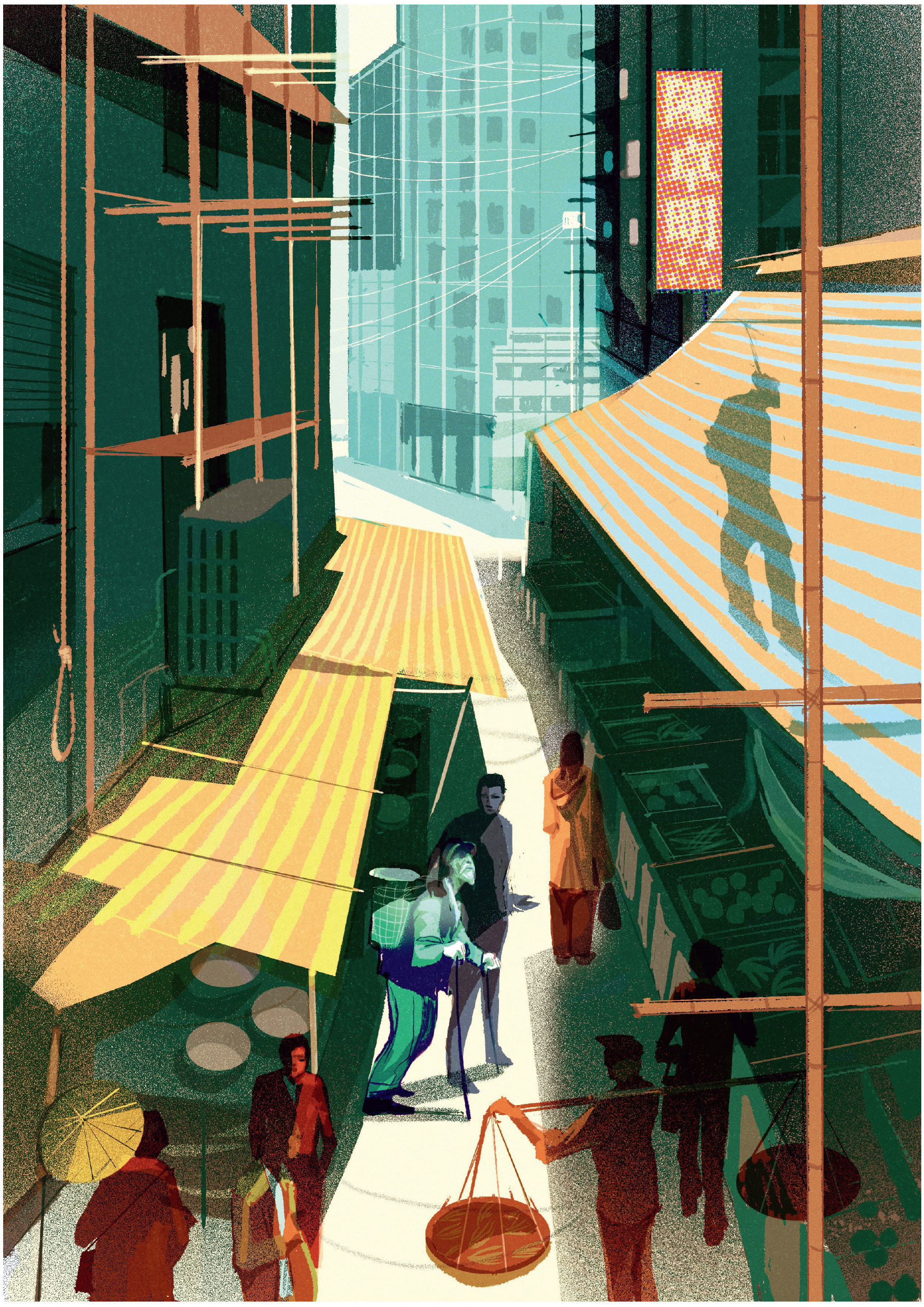
Soon after, he was borne along by the crowds and found himself squeezing through the narrow exit of the train station. Once outside, he came face to face with hordes of flashily dressed young women, waving rough cardboard signs with vulgar hotel names scrawled on them. To their inviting calls and grabbing hands, X kept shaking his head while trying his hardest to get through the seemingly endless entanglements. Still, he was pursued for a while by a heavily made-up young woman. By the time he got away from her, he had no idea where he was.
Standing at the southeast corner of the square, X realised he was lost. He walked toward a hunchbacked old man squatting by a utility pole. He asked him how to get out of this labyrinth of a market square.
Instead of pointing him in the direction of the exit, the old man’s words plunged X into a darker labyrinth. "This square served as the execution ground not so long ago," the old man said with a strange intensity. "Who knows how it became this gigantic marketplace, the biggest one in the city." Derisively, he added: "You can purchase just about anything here. And people come either to buy or to sell."
"What are you selling?" X asked him.
"Nothing," said the old man.
"Then what are you here to buy?"
"Nothing," the old man said. "I’m an exception."
"An exception?"
"Yes, not a seller or a buyer," said the old man. "I’m here because this used to be the execution ground."
In the half hour that X wandered aimlessly around looking for the exit, the hunchbacked old man kept at his heels. "You’re an exception as well, I can tell," the old man said. "You’ve got nothing to buy or sell."
X didn’t feel like chatting. He just wanted to get out of this labyrinth.
"And you’re not from around here," the old man went on. "With a glance, I could see that too."
X stopped but did not utter a word. "I know this city very well," added the old man, smugly. "I can tell you’ve got no connection with the place."
The concert and the farewell afterwards had etched this city into his personal history, X mused. So many times in past years, they had passed through this city that happens to lie midway between their respective cities, but neither of them had ever gotten off the train here before. Stopping in this city was a first for both, and the last together.
With bold curiosity, the old man asked: "What are you here for?"
"For a goodbye," X said matter-of-factly. "I just saw off someone who’s also an out-of-towner."
"A girlfriend?!" said the old man.
"How did you know?" X asked.
"I could sense that too," the old man continued.
Glancing at the old man, X felt a bit uneasy about the word "too".
"Is she pretty?" the old man asked.
X didn’t answer. He just wanted to find the exit and get out of this labyrinth.
"She must be very pretty," the old man said with certainty as if he held an exclusive connection with beauty.
"We were together for eight years," X said. "But all of sudden, we decided to call it quits."
"How come?" the old man asked.
"I don’t know," X said. "I really don’t know." The old man looked at him, apparently waiting for a different answer.
"She said she was a little tired," X confessed. "I sort of felt the same."
The old man heaved a deep sigh. He didn’t press about why they chose to part company in this particular city. This was his hometown, and he knew its history well. "Then I was wrong. You are not really an out-of-towner," he said. "You’ve made a deep connection with this place."
X looked at the old man with a mixture of confusion and gratitude.
"I don’t know what you think of the city, now that you have this connection with it," the old man continued. "Personally, I hate it here." After a short pause, he added: "For almost forty years, I’ve harbored this hatred. I want to leave. For the longest time, I’ve wanted to leave."
"We didn’t go our separate ways because of this place. It was because we wanted to go our separate ways that we came here," X said. "I’ve nothing against the city."
The old man gave a rueful smile. He knew the city’s past intimately. He had too many reasons to hate this place.
Just then, X found he had miraculously arrived at the exit of the labyrinth.
"You weren’t really lost," the old man explained with a smile. "I’ve been leading you toward the market exit the whole time."
Again, X looked at the old man with a combination of confusion and gratitude. Only then did he notice that the hunchbacked old man had only half a right ear. And he felt a wave of revulsion at the sight of yet another deformity.
As they were parting, the old man told X that he had personally witnessed every single execution carried out in this square during the era of turmoil forty years before. One of the executions turned him thoroughly against this city. It was the only time he shed tears. Among the executed was a young woman of twenty-one. "She was so pretty," the old man said. "But she shouldn’t have written to her aunt in France. Shouldn’t have complained about her life or revealed her dread of the future. Didn’t anybody tell her?"
Staring at the old man’s half an ear, X realised he was not yet done.
"Do you know what I’ve been thinking these past forty years?" the old man asked.
This was of course not a question for X to answer.
"I had never touched a woman since I was born," the old man continued. "So when you said you came to this city to say goodbye, I immediately understood you were here to part from a lover."
How illogical his "so" was, X thought.
"I envy you," the old man said. "What a luxury, to have a woman to say goodbye to! I don’t have that. Never did. I’ve had nothing."
X didn’t really want to listen anymore. He had meant to get back to the hotel after the farewell at the train station. He wanted to write a letter to his just-departed lover, his last letter. He didn’t want to listen to the endless chatter of some hunchbacked old man with only half a right ear.
But the old man kept on. "When I got home that day, I felt desperately lonely. I tossed and turned and couldn’t go to sleep. I was troubled by this strange thought: How come the people in law enforcement didn’t think of delivering the pretty young woman to me? Forcing her to live with me, the ugliest hunchback in the world……it would be an unbearable torture, a much more severe punishment than simply putting her to death," the old man said. "For the past forty years, I have been tortured by this one thought. This city doesn’t have any imagination. It couldn’t imagine me as the cruelest instrument of torture. For this I hate the city. I want to leave, but somehow, I can’t." After two dry coughs, he continued: "Now you can understand how I hate this city."
X cannot recall how he had got rid of the garrulous old man yesterday. He hadn’t anticipated that saying goodbye to his lover would be quite easy. Nor could he have imagined that he would get lost after their parting and run into this strange old man, strange in body and in mind. By the time he got back to the hotel, he had completely forgotten what he had planned to write in his farewell letter. Instead, he wrote a totally different letter, in which he talked about that pretty twenty-one-year-old woman who died an absurd death, and the hunchbacked old man who hates his hometown because of its lack of imagination.
From his hotel window, X can see a lone mailbox. It reminds him of the first coffin he saw, the tiny one that was accidentally placed at the entrance to his kindergarten. Confused, he walks toward it as if walking toward his childhood. But he touches the mailbox with gratitude and places the envelope carefully into the mail slot. After a moment’s hesitation, he releases his hold on the letter. This is the moment that X feels the dramatic end to autumn.
Leaves are fluttering down. He turns back. He doesn’t know if this totally different letter will make his lover of eight years misinterpret his current state of mind. "I’ve only seen executions in films," concludes the letter. "This experience of being lost made me feel just how colourless my life has been."
Footnotes
Translated from the Chinese by