




Abstract

Crime runs rampant in Guatemala and people are too afraid to speak up.
In Guatemala, you’ll be driving around the capital city when suddenly a raw egg will come crashing down on your front windshield. Your initial reaction, of course, after letting loose a few choice words of insult, will be to turn on the wipers, which will only make matters worse. The raw yolk will smear all over the glass and you won’t be able to see anything through the yellowish stain. A block or two later, you’ll be required to pull over and get out of the car to somehow try to clean it off. And the comrades of the egg-throwing car thieves will be waiting for you, pistols in hand.
You’ll be driving along a Guatemalan highway, possibly in some lush and deserted mountainous region, when you’ll realise that you’re running low on fuel. You’ll stop to fill up at the first petrol station you encounter, something that in the country is done by an attendant. It’s always a full service, never self-service. The attendant will usually be kind and well-mannered. He’ll check your tyres and your oil; he’ll clean your front and rear windshields with a dirty rag. And so, after paying for the petrol and also giving him an appropriate if not generous tip, you’ll promptly be back on your way. A few kilometres later, however, you’ll notice that you now have a flat tyre, and you’ll be forced to stop to change it on the side of a completely barren part of the highway.
Just then, almost miraculously, a motorcycle with two men will appear in your rearview mirror. In no time at all, they’ll reach the spot where you’re stranded and get off their motorcycle and ask if you need help changing the tyre. And you’ll be relieved and thankful, before seeing them pull out a couple of handguns and steal everything you have.
What you never noticed, naturally, was that the motorcycle had been parked behind the petrol station, lying in wait, while the well-mannered attendant placed a large, sturdy nail in front of one of your tyres as he squatted down and pretended to check it for air.
It’s commonplace to be robbed as you’re sitting in your car at a red stoplight in Guatemala City. Someone will stick a knife through the open window, or maybe tap on the window with a gun, and hurriedly demand that you hand over your phone, your watch, your rings and necklace, your wallet or purse. My aunt never noticed the fist that flew in through the semi-open window to swipe away her designer sunglasses, and which also left her with a black eye.
Some Guatemalans, to fend off these hasty robberies, have grown accustomed to either making a half-stop or just simply speeding through a red light, especially in seedy neighbourhoods late in the evening. Others have adopted a more lawful and also more creative approach: they’ve taken to driving around the city with a full-body mannequin sitting in the passenger’s seat. They actually go out to a store and buy a mannequin and dress him up. It’s always a man. Then they sit him in the passenger’s seat with his seatbelt well fastened. Why? The robbers, the reasoning goes, will think twice if they see that you’re not driving alone, that there are two people sitting in your car at the stoplight, even if one of those people is just a big plastic doll.
Once, a bright and attractive middle-aged woman told me that, to make the ruse more convincing, she would drive around the city speaking to her mannequin, whom she called Pablo.
One warm April morning in 2022, three plain-clothes police officers turned up in the lobby of my parents’ building in Guatemala City looking for a man who worked there named Jeremías. They wouldn’t say much to the rest of the maintenance personnel and security staff, just that they needed to talk to him and ask him a few questions. But the officers were repeatedly told by the building’s employees that he was nowhere to be found, although they all knew exactly where he was hiding.
Jeremías had been working in my parents’ building for more than 10 years. He seemed to always be there, sweeping a hallway, using a squeegee to wipe clean the elevator mirror, minding the reception desk at the lobby, or so it appeared to me each time I travelled back to the country from Nebraska or Paris or Berlin or wherever I was currently living, and came by to visit. He was shy and softspoken. He was considerate without being sentimental; attentive without being nosy. Never troublesome, my father said of him, by which he meant that Jeremías was submissive and obedient. He’d always greet me kindly, "Buenos dias, senor Halfon”, and then ask with a reluctant smile if I was living back in Guatemala or if I again was just passing through, and I’d inevitably answer that just passing through. Now I understand, however, albeit in hindsight, that his simple and almost perfunctory question was all too ominous.
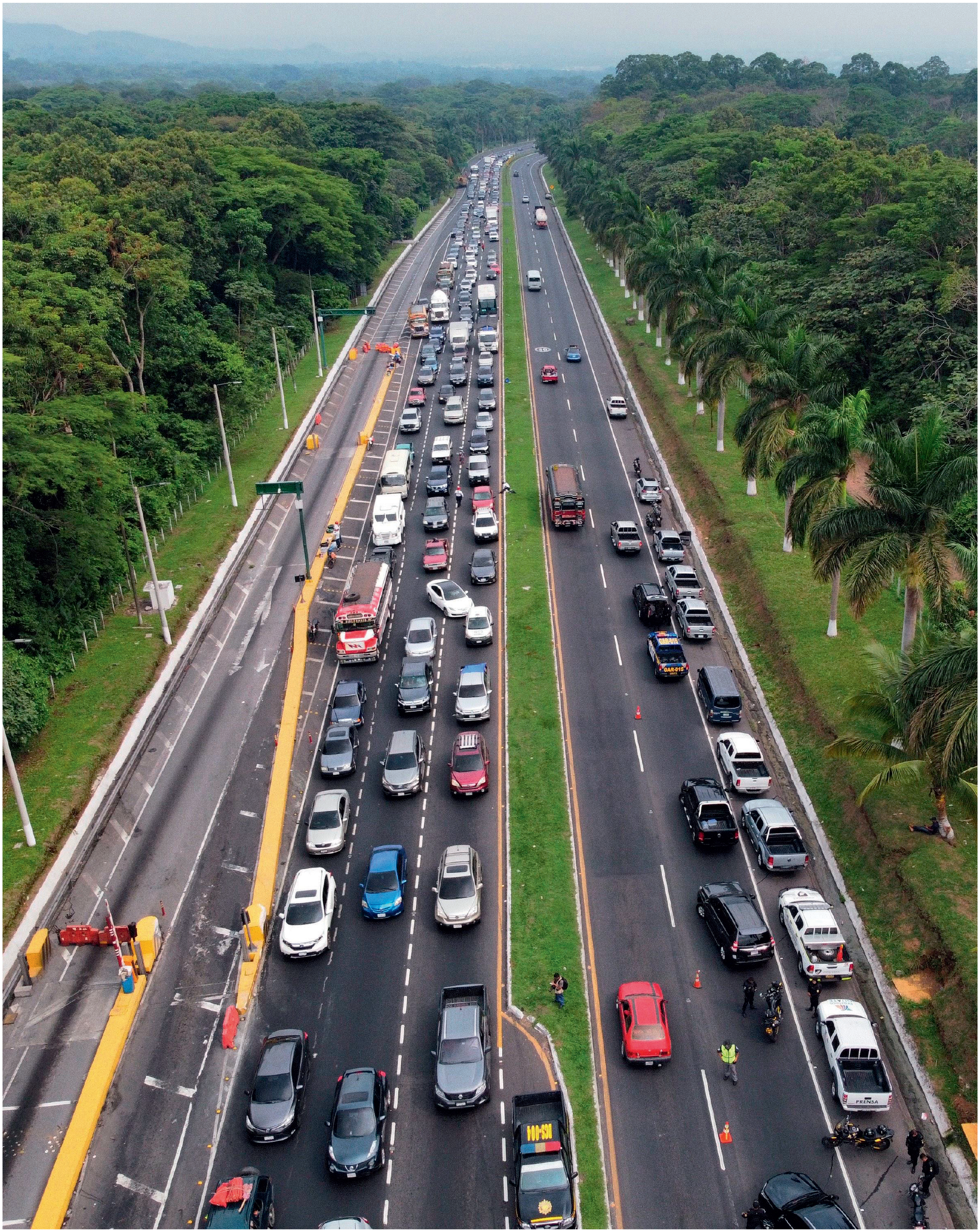
PICTURED: Getting robbed while you are stuck in traffic is commonplace in Guatemala City
CREDIT: OHAN ORDONEZ/AFP/Getty
That warm April morning, Jeremías had been sitting at the reception desk of the lobby when he saw the police officers on the screen of the security camera video, standing and smoking outside in the street in front of the building. He somehow knew, or perhaps guessed, that they were there looking for him and so he immediately bolted for the basement and hid in a small utility closet, crouched down among all the mops and brooms and several dingy buckets.
The police officers were frustrated by the employees’ curt and evasive answers. As always, Guatemalans have been silenced by decades of oppression and mistrust and the paralysing fear of speaking out. The police now insisted on talking to some of the tenants, including my mother and father. They went from apartment to apartment, knocking on doors and asking questions. But none of the tenants could help in locating Jeremías. None knew where he was or even if he’d showed up to work that day. Ultimately, after a couple of tense hours of threats and prying around, the officers gave up and left the building and the tenants closed the doors of their apartments, and all the employees went back to work.
Jeremías stayed hidden in the utility closet the rest of day. He waited until it was dark outside and could be sure that the police officers were no longer in the neighbourhood. He then stood up and walked out of the closet and strolled out of the building and there, in the middle of the street, he was quickly tackled and captured by the police officers, who’d been waiting for him in unmarked cars.
Everyone’s first thought was that Jeremías had been wrongly apprehended, something all too frequent in the country. Usually because of a personal vendetta, or because of a bureaucratic mistake, or more likely because a corrupt government official cooked up false charges against someone in order to then ask for a hefty bribe. It would take weeks to find out what had really happened.
After repeated phone calls and letters and several expensive lawyer visits, the building’s tenants were finally informed that Jeremías was being held at the state penitentiary of Mazatenango, a city on the coastal plain leading to the Pacific Ocean, for his involvement in a series of what locals have termed, in Spanish, secuestros exprés. Or express kidnappings.
This is how they work:
You get a call from a kidnapper who will tell you that someone is presently following the car of one of your family members, your elderly father or your teenage daughter or maybe even your wife, and they will proceed to shoot your father or daughter or wife unless you deposit a given sum in their bank account within an hour, usually the equivalent of no more than a couple of thousand dollars. As proof, the kidnapper will first mention all your family member’s personal information, complete name, home address, business address, phone number, driving licence number; the kidnapper will then tell you exactly what clothes your family member is wearing at that very moment and on which road of the city your family member is currently driving; lastly, the kidnapper will give you a precise description of the make of your family member’s car, including the model, the year, the specific colour, the plate number and any unique features like visible dents or scratches or bumper stickers. All so it’s made clear to you that your father or daughter or wife has, in a sense, already been kidnapped and is being held captive in their own car and without them knowing it and perhaps even with a shotgun pointed at their head from a few cars away, and will only be released from that cruel and strange form of captivity if you swiftly and discreetly make the required deposit.
For years, Jeremías, our softspoken Jeremías, had been the money man in these operations. It was his personal bank account that the gang of kidnappers had repeatedly used for receiving all the ransom payments.
So, señor Halfon, he would say with a shy smile, here to stay or just passing through?
Just passing through, Jeremías. Always just passing through.