




Abstract

Violence against practitioners of Afro-Brazilian religions is on the rise in Brazil.
Many cases of violence against those from traditional communities associated with the Black diaspora involve vandalism of their places of worship. A recent example was the attack on the Mãe Oxum monument in Porto Alegre on 25 January.
The monument, considered a historical and cultural site in the southern city, was vandalised with graffiti saying “pagan” and “Christ lives”. The perpetrators have not yet been identified by the police.
In 2022, a survey conducted by the Ilê Omolu Oxum centre and the National Network of Afro-Brazilian Religions and Health (Renafro) consulted 255 Pais and Mães de Santo (priests and priestesses) across Brazil.
The findings revealed that 60% of terreiros (Afro-Brazilian religious centres) in the country had been vandalised at least once in the preceding two years, while 80% of the interviewed leaders reported that members of their communities had suffered some form of violence motivated by religious racism.
“It is unacceptable that in 2024 we have to face such barbarity. We are outraged,” the president of the Federation of Afro-Brazilian Religions (Afrobras), José Antônio Salvador de Iemanjá, told Index.
“It’s hard to put into words, as it strikes at the heart of faith, which is the most sacred thing in this world. If we let this crime go unpunished, there may be further actions of this nature, culminating in increasingly violent acts.”
It is not uncommon for people to be insulted and attacked, and terreiros to be closed due to neighbourhood hostility, but in some cases this has escalated to murder, as was the case with Mãe Bernadete, a yalorixá (priestess) who was fatally shot in Bahia last year.
“Physical assaults also occur in the streets, such as when Uber drivers refuse to transport people dressed in religious attire or carrying sacred instruments. I have personally experienced situations where drivers refused to take me because of this,” said Janine “Nina Fola” Cunha, a member of GeAfro (the Centre for African, Afro-Brazilian and Indigenous Studies at The Federal University of Rio Grande do Sul) and an anti-racist activist for more than 30 years.
The rights to practise Afro-Brazilian religions are both recognised and guaranteed by Brazilian legislation. As stated in the federal constitution, “Freedom of conscience and belief is inviolable, ensuring the free exercise of religious worship and protecting places of worship and their liturgies”.
Last year, a law was brought in equating the crime of religious insult with racism, once again protecting religious freedom. Anyone who obstructs, impedes or employs violence against any religious person or practice now faces up to five years in prison.
But data shows a large gap between constitutionally granted rights and the treatment of minorities.
“Several laws address not only religious freedom but also freedom of worship, especially those aimed at traditional African-derived peoples. Despite that, these laws are not duly respected,” said lawyer Pai Tiago de Bara-Onilu, legal co-ordinator of the Independent Association in Defence of Afro-Brazilian Religions. He explained that widespread fear had come to characterise those who are part of these faiths, and that they feel too vulnerable to openly express their beliefs.
According to Cunha, the increase in aggression is mainly due to the rise of the extreme right, with many factions allied with neo-Pentecostalism. “This combination has resulted in a noticeable increase in violence against our religiosity, often with impunity, as some sectors view defending their religion as legitimate at the expense of others.”
Bàbá Hendrix de Òrúnmìlà, a historian, afrotheologian and babalorixá (priest), attests to the rise in violence in recent years. “The best definition is not intolerance; it’s religious racism. Many religions face religious intolerance, but none experience the racism that we do. The neo-Pentecostal sector actively persecutes us, especially after [former president Jair] Bolsonaro’s last government regime; the persecutions have become more intense, with a kind of permissiveness to openly declare hatred,” he told Index.
He uses an example to explain: the time when an evangelical pastor kicked an image of Our Lady of Aparecida (the patron saint of Brazil).
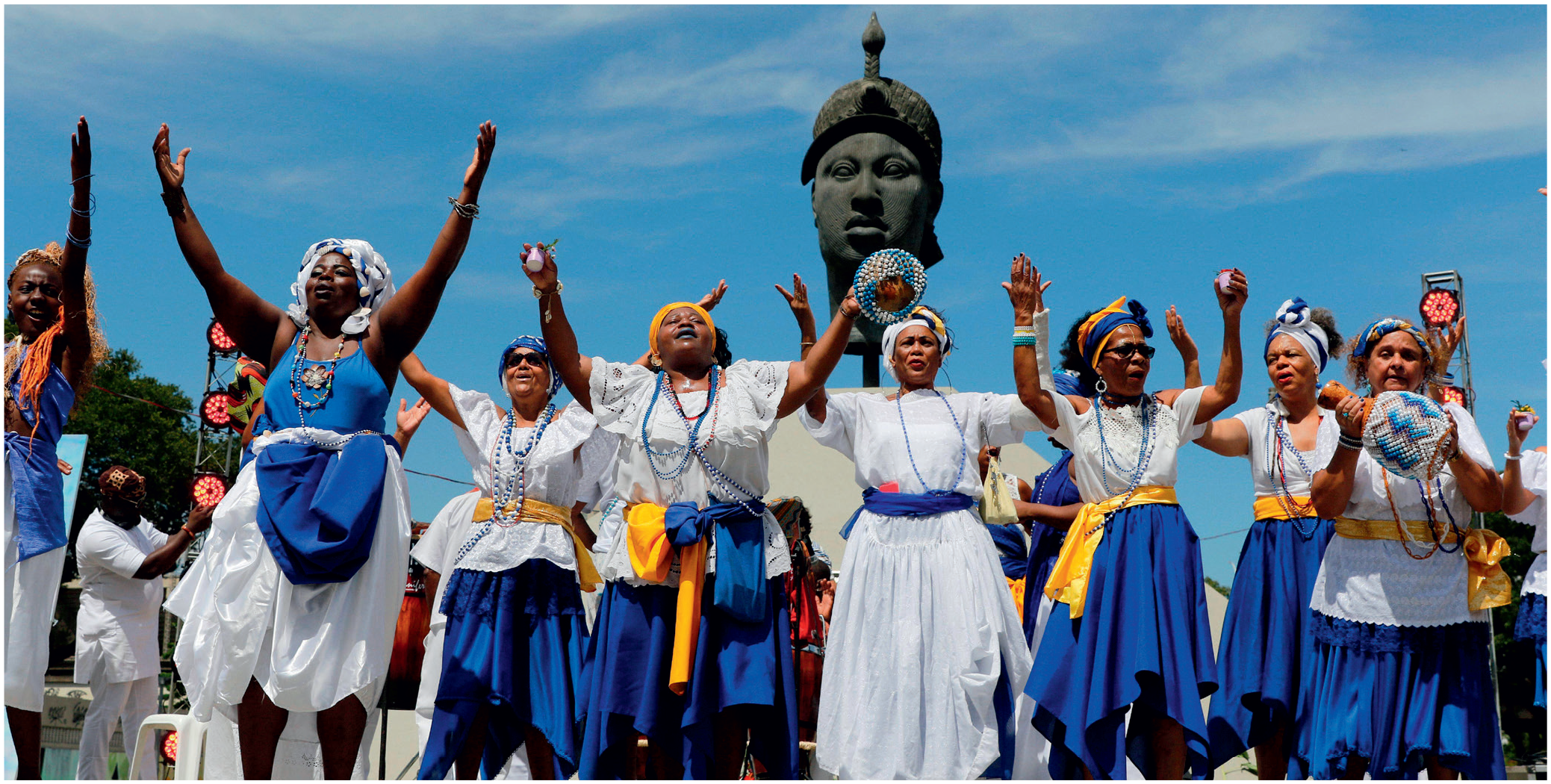
Candomblé women celebrate Black Awareness Day at the monument to Zumbi dos Palmares in Rio de Janeiro
CREDIT: Salty View / Alamy
“There, it was Christian against Christian, a matter of intolerance. But what happens to us goes beyond religiosity; it’s not just about religious practice - it’s racism. We have our freedom of religion curtailed; it is prohibitive to express ourselves without being exposed to acts of religious racism,” Òrúnmìlà said.
“In recent years, there has been a period of convergence of political and religious conservatism, which attributes salvation through politics. This led politicians to legitimise racism and violent acts propagated by religious conservatives.
“This will generate, for example, the ‘Traffickers of Jesus’ in Rio de Janeiro - criminals converted to Christianity who expel the Mães de Santo from the Rio Hills with machine guns at their heads, accusing them of being ‘of the devil’.”
The motivation that links the devil to African traditions is convenient, as it externalises evil and justifies its eradication. The belief that “the demon is always external” has led to tragic consequences, including the murder of Mother Mukumbi in 2013 and others across different regions of the country, as well as the desecration, vilifications and fires at terreiros, said Òrúnmìlà.
In Brazil, associating religions of African origin with devil worship has a long history, reaching back to the end of the 19th century when Catholicism became Brazil’s dominant religion. Then with the rise of the neo-Pentecostal churches - and through the press - African religions were demonised further. It all happened in tandem with more general racism. The view was that everything with black roots was inferior while white was superior.
“It is, indeed, persecution. First, the terreiros were persecuted by a segment of the Catholic Church. Then, between the 1970s and 1980s, the Pentecostal churches began to emerge who intensified the persecution, to the point of this becoming religious racism,” said Renafro co-ordinator Baba Diba de Iyemonja.
“But there was also the weight of institutional racism on the part of the state through the security apparatus, such as the police.”
Religious racism has intensified with social media. By 2014, Index On Censorship had already documented numerous incidents, including the dissemination of 16 videos on YouTube that encouraged violence against practitioners of Candomblé and Umbanda. These videos, posted by the Igreja Universal do Reino de Deus, a neo-Pentecostal church, remained online until a protracted legal dispute finally forced their removal. Some experts and leaders of terreiros have labelled the phenomenon as religious terrorism.
According to the 2010 census by the Brazilian Institute of Geography and Statistics, about 600,000 people in Brazil identify as followers of African-derived religions.
It’s thought these numbers are under-reported, which shows how high the stakes are now to be open about practising a religion that isn’t mainstream.