




Abstract

Ecuador is facing a crisis of trust, and drugs are at its root.
The armed men who shocked Ecuador by storming the TC Television station in a violent raid were detained and presented to the press
CREDIT: AP Photo/César Munoz/Alamy
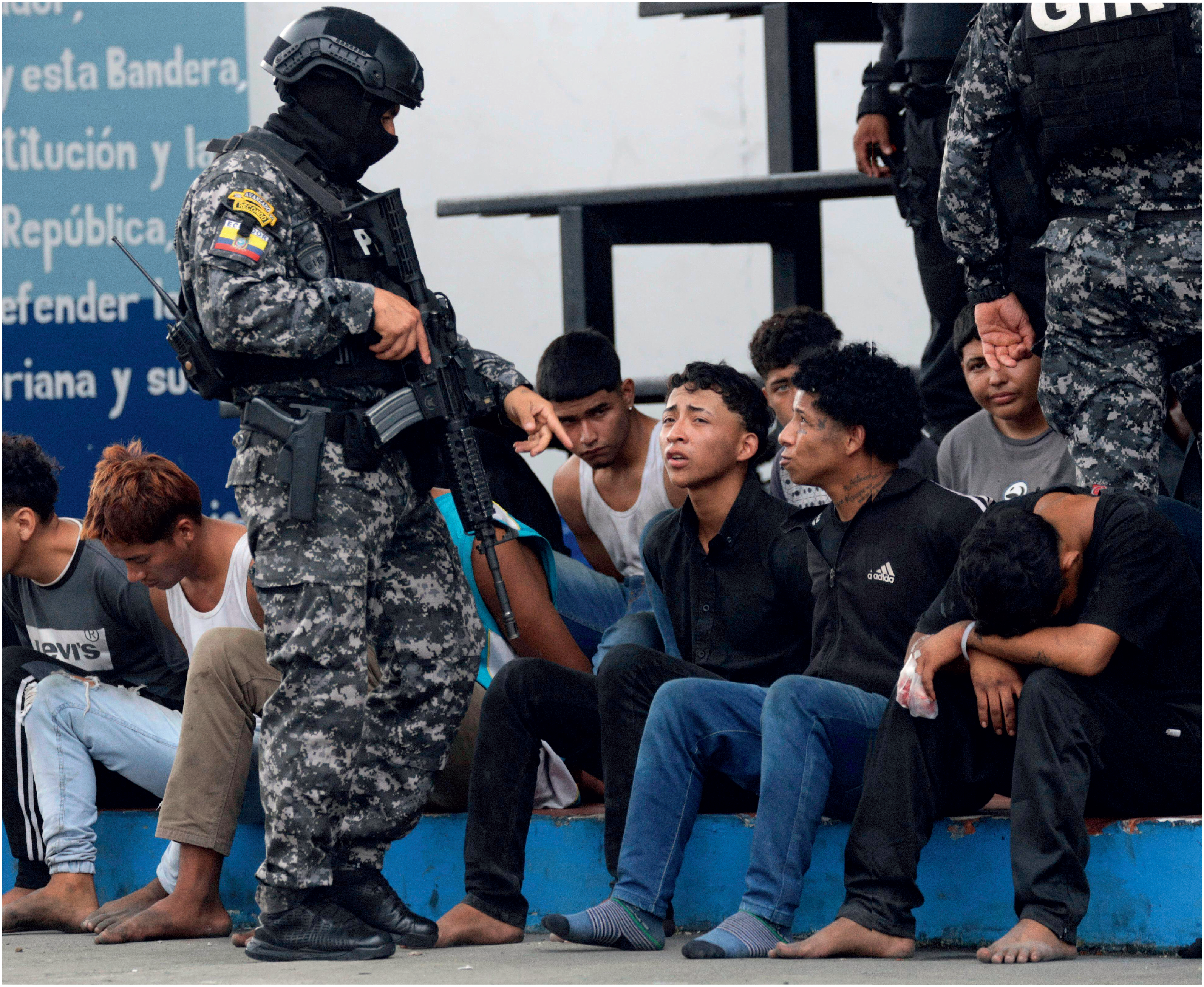
Two months after taking office last November, President Daniel Noboa responded to this violence by declaring a war on 22 armed groups he calls “terrorists”.
He immediately deployed the military onto the streets and into prisons, and claims he is taking back the country. But experts are sceptical that brute force can fix Ecuador’s systemic problems or rectify the damage that’s already been done to some of its key institutions.
Both journalists and the judiciary have faced increasing threats and pressure to co-operate with criminal gangs over the years, with no safeguards from the state. In extreme instances, these take the form of murder.
Two main events brought Ecuador’s violence into focus on the international scene: the public assassination of journalist and political candidate Fernando Villavicencio as he was leaving his campaign rally in August last year, and the takeover of the TC television news station by masked armed men in January, while the station was broadcasting live. Both these events were flagrant attacks on freedom of speech and the media, instilling fear into Ecuador’s population.
Press under stress
These threats aren’t new. In 2023, local press freedom group Fundamedios registered 265 attacks against journalists and freedom of speech, including incidents such as letter bombs and assassination attempts, making it one of the most violent years on record for media workers.
Another press freedom watchdog, Periodistas Sin Cadenas (Journalists Without Chains), said death threats directed at journalists increased by 275% in 2023 from the previous year. Last year, nine journalists were forced to abandon their homes and secretly relocate abroad or to other parts of the country - something Ecuadorian journalists have never had to face before.
Karol Norona was one of the first forced to flee the country last March. She had long been covering the deadly riots taking place inside Ecuador’s prisons and the dynamics of armed groups behind bars for national media. But after two sources connected to criminal gangs told her that her name was on an assassination list, she fled the country.
“I had access to chats and audios where I heard that this person was going to kill me. They had identified where I lived, where I worked, had photographs of me,” Norona told Index.
Dagmar Flores, of Fundamedios, says most threats and attacks are directed at journalists covering organised crime or corruption among local officials. As a result, many have abandoned these topics altogether, choosing to focus on lifestyle and entertainment rather than local news.
This has left major gaps in information, particularly about communities along the coast where violence by criminal groups has been the strongest, and in some inland provinces that lie along the drug routes or where illegal mining is prominent, she says.
One journalist, who asked not to be named, told Index about a hyper-local news website they started years ago from their town on the coast, where they published community complaints and eventually began reporting on murders and questioning the municipal authorities.
They were forced to leave their home after receiving severe threats and dodging an assassination attempt. Today, they continue to work in journalism occasionally from their new location, but they’ve stopped reporting from the streets, rarely publish with their real name, and refuse to mention violent murders in order to avoid future threats.
The first murder of journalists in the country happened in 2018, when two of them and their driver were kidnapped and killed, shocking the country.
Families and colleagues continue to pressure the state for answers, saying an adequate investigation was never conducted. Susana Moran, a journalist and representative with Periodistas Sin Cadenas, says the impunity from this case set a dangerous precedent for journalists, who are living with those repercussions now.
After years of pressure from press organisations, the government finally created a security mechanism last year to protect journalists facing threats, called the Mechanism for the Prevention and Protection of Journalistic Work. Though still in its initial stages, Flores says it lacks the major funding needed to be implemented properly. One of the mechanism’s biggest challenges will be gaining the trust of journalists, as most don’t report threats they receive or seek help from the state, concerned that local authorities are often connected to organised crime.
An unjust system
While journalists feel gagged, a lack of trust in authorities and government institutions is another key issue in the country, where corruption scandals break on a regular basis. The most recent came to light in December, when the Attorney General’s Office arrested nearly 30 government officials, lawyers and judges for their connections to organised crime in an ongoing investigation dubbed “Metastasis”. The investigations don’t bode well for Ecuador’s justice system, which is already facing increasing scrutiny by the public. One Ipsos poll from 2023 showed less than 12% of the population trusted the justice system.
But deep-seated corruption is only one of the crises facing Ecuador’s judicial system. In recent years, lawyers, judges and other judicial operators have themselves faced increasing threats and attempts on their lives for the work they do. In 2023, the Observatory of Rights and Justice of Ecuador (ODJ) counted four assassinations, as well as 28 attacks against lawyers, judges and judicial operators - everything from attempted killings, bomb threats and direct threats and intimidations. The year before, six judicial operators were killed, according to the ODJ.
The most recent victim was prosecutor César Suárez, who was known for taking on corruption cases. He was killed in the coastal city of Guayaquil in January, just days after he began investigating the takeover of the TC television station.
Judge Heidy Borja, president of the Ecuadorian Association of Magistrates and Judges in the province of Guayas, received a death threat in 2022 from a criminal gang who demanded she work for them and rule in the gang’s favour in applicable cases.
If she refused, they told her, they would put an explosive in her car, and then named several family members. She reported the threat and worked from home until the state finally gave her protection. She has been accompanied by bodyguards ever since.
Sadly, not everyone receives this protection, and that’s one of the main problems, said Borja. If the state can’t guarantee the safety of judicial workers, that makes them more susceptible to falling prey to these kinds of threats, and ultimately corruption, she added.
Little wonder, then, that Ecuador sees a high rate of impunity in all sorts of crimes, ranging from car theft to assassinations, depending on whose interests are involved, explained Jose Andres Murgueytio, a lawyer and special projects co-ordinator with the ODJ.
Last August, Margaret Satterthwaite, the UN special rapporteur on the independence of judges and lawyers, said in a press release that she was “dismayed by the great vulnerability of justice officials" in Ecuador, adding that officials needed to do more to protect judicial workers. But the reaction from the presidential office has been the opposite, choosing to denounce judges publicly or label prosecutors defending accused gang members as “terrorists”.
This public shaming often puts the lives of judges and prosecutors more at risk, said Murgueytio. Meanwhile, none of the recent presidents have denounced the many crimes and threats terrifying the judiciary or the media.
In Ecuador, no one knows who to trust anymore.