




Abstract
Donald Trump believes in First Amendment rights for himself but not for others. He believes in due process unless it concerns him.
“I think it’s highly likely that Trump is going to be spending the rest of his life in prison,” Tristan Snell said from his home in New York.
“A conviction will probably happen by early May and then Trump will be sentenced by August, before we get down to the home stretch of the election season.”
The lawyer and media legal commentator was previously assistant attorney-general for the state of New York. With a following of nearly half a million people on X/Twitter, Snell regularly offers his opinion on legal matters. And now his attention is focused on Trump, who’s looking to make a quick return to the White House later this year.
Snell recently published Taking Down Trump, a book that outlines “12 rules" for prosecuting Trump, who faces multiple lawsuits and criminal cases, both federally and in a number of states - even while being the Republican party candidate for the 2024 presidential election.
In February, Trump filed an application at the US Supreme Court to keep a federal election interference case on hold while he appeals a lower court’s ruling that he is not immune from prosecution. Trump’s lawyers have claimed the case threatens the First Amendment rights of Trump, his supporters and volunteers, and all US voters. (The First Amendment of the US Constitution guarantees free speech, a free press and the right to assembly.)
Snell said Trump was cynically attempting to “try and convince a lot of Americans that he is the one who is the guardian of democracy and the rule of law”, when in fact Trump had spent decades “believing he was untouchable, invincible and had carte blanche to float above the law”.
Snell points to an early Trump tangle with the government, in 1973, when federal prosecutors filed a civil suit against him and his father, Fred, for allegedly discriminating against Black prospective tenants in New York in violation of the Fair Housing Act (charges that Trump to this day denies). The Trumps, represented by notorious lawyer Roy Cohn, responded by filing a lawsuit against the government for $100 million (the equivalent of more than $500 million today). After nearly two years of delays, the case ultimately resulted in a relative slap on the wrist for the Trumps.
“That case established Donald Trump’s reputation as someone that you didn’t fuck around,” said Snell. “The Cohn legal playbook was always: delay, divert, destroy. It was, like, ‘Whatever you do to me, I’m going to come back and do to you 10 times worse’.”
He added: “Through campaign contributions or charitable donations, or the promise of cheques, Trump always tried to buy off or cosy up to whoever was the elected prosecutor, so they could come to an understanding.”
Fast-forward to today and, as we saw during his four years in power, which were defined by regular attacks of the media, Trump has become even more brazen.
Some of the current charges against Trump relate to his actions before and during the riot at the US Capitol in Washington, DC, on 6 January 2021. Others relate to the misuse of classified information. Jack Smith, a special counsel in the Justice Department, has charged Trump with 37 felonies in connection with his removal of documents when he left office in January 2021. The case has been scheduled to go to trial in May.
Snell refers to evidence published by CNN and The New York Times last summer in which Trump was heard on an audio recording at his golf club in New Jersey, in July 2021, openly boasting about a classified military plan for a US attack on Iran. When the tape is played before a jury at trial, it will be extremely difficult for Trump to get out from under it, Snell reckons.
“This recording completely destroys Trump’s attempted defence that he didn’t know the documents were classified,” he said. “It also establishes that Trump had the criminal intent required by the Espionage Act for the wilful retention of defence-related documents.
“In this case, there is also the possibility that there will be security camera footage, where Trump and people in his inner circle are on camera actually moving the documents around or rifling through them. If that evidence is [shown] to exist then it will become clear that Trump was trying to delete the security cam footage as best he could. Then we have a Nixon-Watergate situation, except that it’s multiplied by 10.”
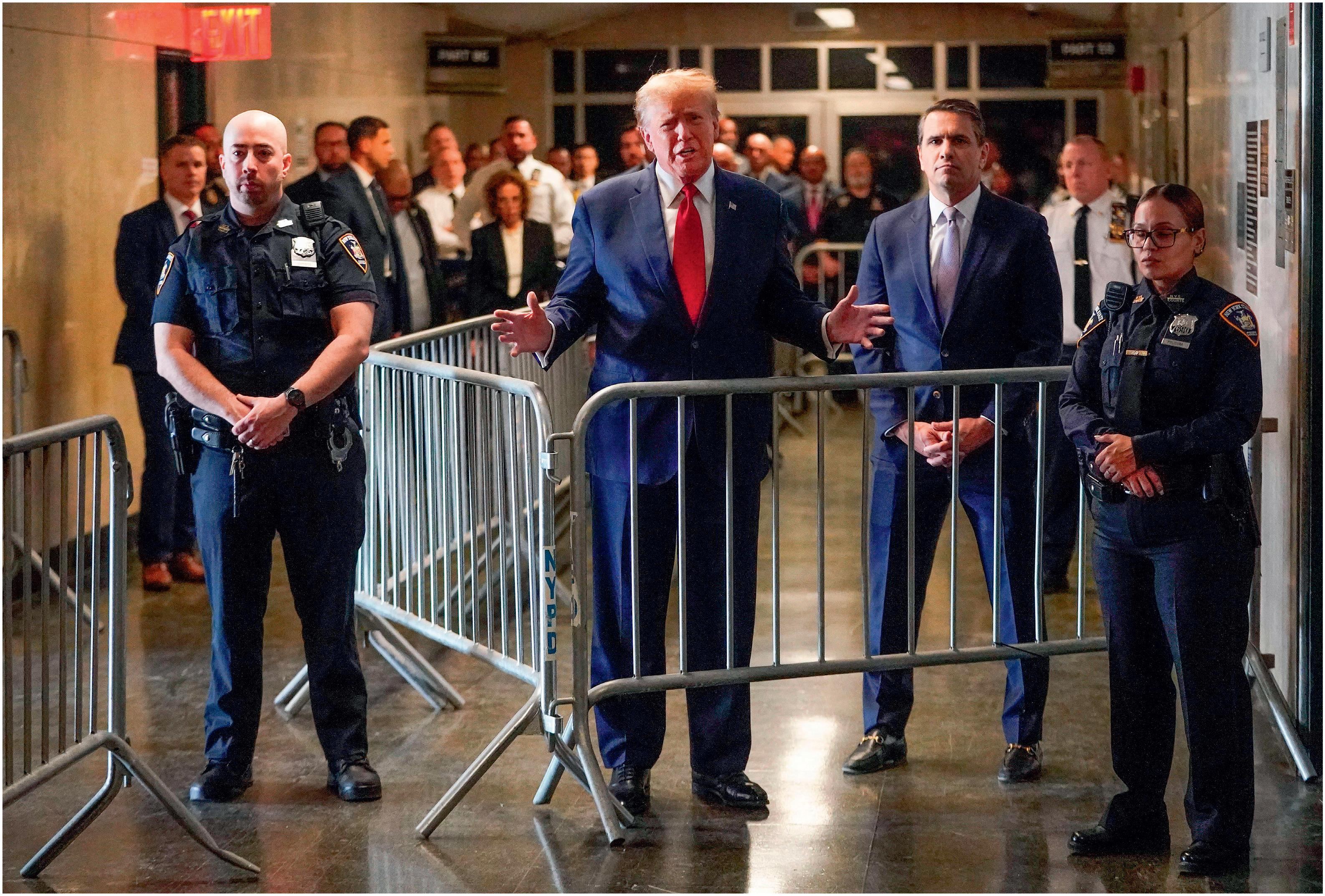
Donald Trump speaks before entering a courtroom at Manhattan criminal court, February 2024
CREDIT: AP Photo/Mary Altaffer/Alamy
Smith has also charged Trump with four federal felonies in connection with his attempt to remain in power as president after losing the 2020 election. Snell believes this case - which is scheduled to begin in March - is the most serious one Trump faces. “The case is moving very fast, so there is not as much room for Trump to delay it,” he explained.
One of the great unknowns is whether Trump - if he is elected president again in November - will try to pardon himself of any federal convictions he might have received by then. If he did try to pardon himself, he would be in legally uncharted waters and it’s unclear if he would be successful.
There is one case in which he would definitely not be able to pull it off. Fani Willis, a district attorney in Fulton County, Georgia, has brought a racketeering case against Trump and 18 others, alleging they tried to steal the last presidential election. That case is scheduled to begin this August. A bigger case with more defendants, it’s going to be more logistically complex to bring to trial, according to Snell. But it is a case brought by a state prosecutor rather than by the federal government, and that has implications when it comes to presidential pardons.
“If Trump becomes president [in November] and this case results in a conviction, Trump cannot pardon himself for state crimes,” he said.
This January, Trump appeared in court several times. One of those appearances was in a civil fraud trial, led by New York attorney-general Letitia James, who has sued Trump and accused him and his family of committing financial fraud to gain better credit ratings.
Another of his January court appearances resulted in him being ordered to pay $83.3 million to writer E Jean Carroll for defamation. It followed a previous award of $5 million to Carroll after Trump was found liable last year for sexually abusing and defaming her.
An earlier case Snell worked on involved Trump’s previously largest legal financial settlement, and the lawyer examines the finer details of that case in Taking Down Trump. That investigation began in 2011 when Snell began working with a team of lawyers employed with the New York attorney-general’s office. Together, they built a civil prosecution against Trump, which they filed in 2013 and won. The case resulted in a $25 million settlement to former students at Trump University.
Founded in 2005 and in existence until 2010, the fake training college offered its “students" the chance to gain knowledge in real-estate dealmaking. Participants paid an average of about $35,000 for fake diplomas, and Trump personally pocketed $42 million from the sham education programme. Snell said the outcome of the case was notable because “before this case, whenever Trump went up against people in court, he usually bulldozed them”.
Trump has navigated the legal system for decades through political favours and dodgy financial donations, believes the lawyer. Snell points out that many of New York’s top legal minds have looked the other way because Trump gave generously to their favourite charities.
“But the days when Trump could just go and scare - or buy off - a prosecutor are well and truly over. These are very serious offences with which Trump is charged,” he added.
At the same time Snell warned that Trump’s various trials over the coming weeks and months were not a slam dunk on the side of justice, and if the former president were elected to the White House in November, an extremist agenda “to destroy the American Republic and the Constitution" could prevail.
If Trump manages to become president again, “it’s going to show how he has convinced, conned and fooled a majority of the country that he does believe in the rule of law and equal justice, and that is very problematic”.
He added: “Trump is on trial many times in the months to come, but it is really a trial for the soul of the American Republic.”