




Abstract

Mexico’s president refuses to risk letting the press tarnish his legacy - and he has created the perfect propaganda machine, writes
Fuelled by his two failed earlier runs for the top job - for which he blames the media - Amlo, as he is ubiquitously known, has spent his entire presidency as an advocate for the poor, uplifting Mexico’s most impoverished regions, renationalising key industries and building infrastructure fit for the modern era.
Or so he claims.
There is some truth in these statements, but the tidal wave of success that he portrays is the result of a complex and aggressive propaganda machine that comes disguised as openness and accountability. What is supposedly the cornerstone of a free press in Mexico has instead been transformed into a tool to defend Amlo’s ego and legacy.
It is impossible to discuss his six years of leadership without discussing the mañanera. Every weekday morning begins with the same ritual, almost without exception.
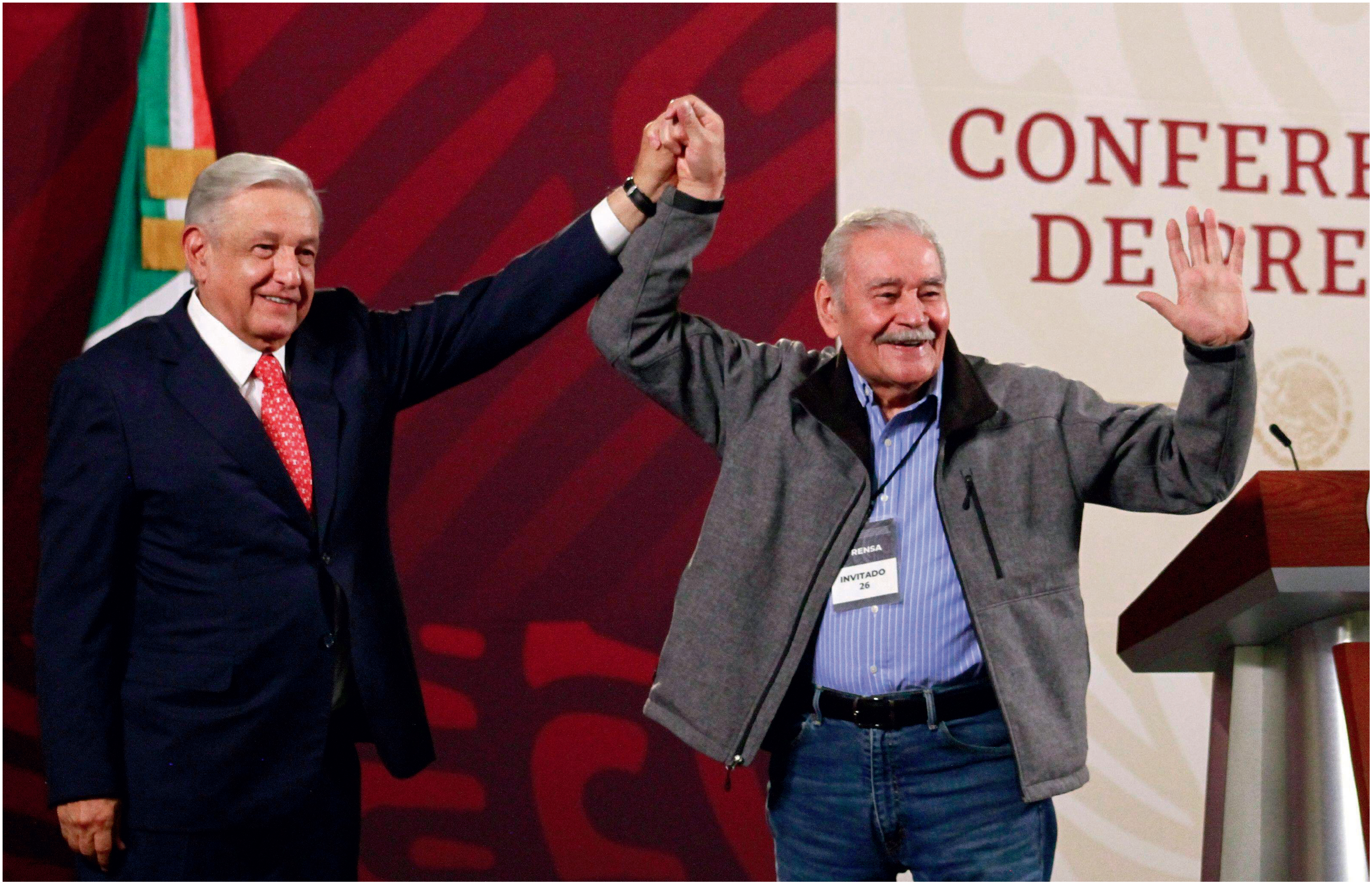
Obrador invites journalists to a press conference, where he and his cabal of trusted advisers from the military and cabinet lecture them for hours. These conferences are broadcast via the internet and appear on television, on the radio and in newspapers. The best photos, where Amlo flashes a mercurial smile or looks down benevolently from the podium, are shared on his personal webpage.
After decades of highly restricted access, the chance to sit and directly question the president was initially perceived to be an irresistible opportunity that few could pass up, winning him plaudits from the international community.
Former UK Labour Party leader Jeremy Corbyn appeared as a guest of honour, calling the briefings “very impressive and [showing] a degree of openness in government that is not found in many countries of the world”.
As praise for the new order began to fade, however, the mañaneras took on a different tone.
Joel Aguirre, a veteran Mexican political journalist, has been following successive presidencies for two decades.
“I think that the relationship of the press to President Amlo during these last five years of government has been very tense, it has been difficult - perhaps more than we’ve seen in previous governments,” he told Index.
This is a serious issue in a country where dozens of journalists have been killed by cartels in the same period - something the government has shown little desire to investigate.
Despite this initially positive outlook, the president now heckles and attacks journalists who oppose him, denouncing them and their work.
Aguirre said: “At the start of this government [Obrador] said: ‘They might speak badly of me, but we must let them speak’.”
But Aguirre adds that the press conferences are now reduced to little more than “the gallery of the president [and] a platform for propaganda”.
Aguirre is direct in his assessment of what has happened.
“The mañanera has lost all its value,” he said. “In years gone by we would have loved this, because there was no way to confront the president. Now you can, but only if you belong to a selected outlet.
“The mañanera began to be attended by journalists who are affiliated with the president. They ask ‘fashionable’ questions, things that are very obvious. The entry list is controlled to prevent a journalist from being too critical or saying the wrong things so the president is unable to evade his question.”
The mañaneras now serve only to allow Amlo to pontificate on his successes. Defiance of the new order is met with public humiliation, exclusion and defunding.
Few incidents illustrate what it has become better than the recent press conference in which Amlo publicly shared the phone number and contact address of New York Times journalist Natalie Kitroeff, who had written an article suggesting that he had been investigated by the US Drug Enforcement Agency for ties to the Sinaloa cartel.
“The moment he published her details, he exposed her to fanatics - to agents of the government. That was an attack on [press] freedom,” Aguirre said.
Amlo simply claims that his “moral and political authority are above the privacy act" and denied any risk to journalists in Mexico, claiming such risks are the fabrication of “special interest groups”.
Jan-Albert Hootsen, the Mexico representative for the Committee to Protect Journalists, has been reporting on press freedom from the country since 2016. He told Index this:
“Unfortunately, it’s getting increasingly hard for us to convey the urgency of the situation if the narrative is controlled by the president.” He added: “A very substantial fanatical following basically considers journalists to be legitimate targets of online threats and online harassment and continues to maintain this idea that if the press is attacked it’s their own fault.”
Additionally, collusion by media outlets is financially rewarded.
Traditionally, the government has funded the press by paying media companies to run public awareness campaigns and carry announcements. But the arrival of Amlo has shaken this up, with only favoured (uncritical) outlets now receiving funding, which involves reporting on the mañaneras without questioning the provenance of the information provided.
Likewise, without access to the mañaneras - which begin early in the morning and often shape the day’s national news - unfavoured sources are completely frozen out of access to the country’s top politicians.
Without access to real accountability, and by creating a system of “transparency" that serves only to broadcast propaganda, support for Amlo has become almost cult-like. Official government surveys show an extremely high level of trust and approval in the president, whose primary support base is highest amongst the very young, the elderly and those with no education.
President Obrador raises the hand of a journalist during one of his trademark mañaneras
CREDIT: Raj Valley / Alamy
Trust in the media has collapsed, with a Reuters report suggesting that the number of Mexicans who believed the news declined from 50% during Amlo’s first year in office to just 36% last year.
“The numbers of the support amongst the Mexican public are exaggerated. The federal government attempts to push the narrative that there’s about 70% of Mexicans [who] support him,” Hootsen said.
“That’s an incredibly high number in the sense that it’s just not believable. It’s not realistic. That said, he still has a very, very untraditional loyalty amongst his followers,” he added, explaining that many of Obrador’s followers are deeply distrustful of the traditional media and largely use social media.
“It is fairly easy for him to bypass the sort of traditional rules and relationships that you could have with the press, which allows him to develop these very toxic, very - I would say at this point - dangerous narrative that we saw [with the Kitroeff incident],” he said.
Ultimately, Obrador’s party, Morena, is trying to create an environment where there is no need to use the media at all.
“There is a certain very 21st-century component about it, which is the use of social media trying to bypass the regular communication channels such as the media in order to control the narrative,” Hootsen said.
The proliferation of cheap internet access in Mexico during the Amlo presidency has also made it easier for those in rural areas to access news via social media, rather than legacy media outlets.
As well as attacking freedom of expression, Amlo uses his briefings to circumvent electoral regulations.
“At this point [it’s] very clear that the mañanera and all the activities that the president’s organising around them are a form of campaigning for him. So, he’s in constant violation of electoral law,” Hootsen explained. “What he’s doing now is attacking the national electoral institute, trying to lower its budget, trying to handicap it up to the election.”
And despite leaving the top job later this year, Amlo will remain involved in the running of the country.
While he has publicly stated that he intends to retire to his ranch in his home state of Tabasco, his Morena party is a broad political church united only by respect for his vision and leadership.
His successor as head of the party, Claudia Sheinbaum - almost certain to win the upcoming presidential election - is somewhat quieter, more calculated and a shrewder political operator.
But Hootsen is unsure that this change of leadership will bring any changes from the system currently in place. “She’s not going to be able to make sufficient substantial changes in six years to make Mexico a noticeably safer country for journalists and human rights defenders,” he said. “I think that’s an illusion.”
While Sheinbaum does not go for the bombast and confrontation so beloved by her political mentor, the avoidant, deflective anti-media environment employed by Morena means that things are unlikely to get any better for the press, who remain stuck between deadly threats from organised crime and a government that intends to totally defund them unless they agree to publish propaganda.