




Abstract

Central Asian governments go after dissidents abroad with little fear of repercussion, making them some of the most ruthless international players around, writes
The authoritarianism of these behemoth neighbours means Central Asian regimes do not receive the international attention they warrant - and this is particularly true when it comes to transnational repression. According to last year’s report Still Not Safe: Transnational Repression in 2022, published by US-based human rights organisation Freedom House, Tajikistan, Turkmenistan and Uzbekistan rank alongside Russia and China as the most prolific perpetrators of transnational repression.
Despite occasional political openings, authoritarian tendencies continue to plague the nations of Central Asia. Tajikistan and Turkmenistan are both considered “Not free”, according to Freedom House’s Freedom in the World index, scoring just 7/100 and 2/100 respectively. While Kyrgyzstan ranks higher, the government of president Sadyr Japarov has increasingly eroded democratic freedoms. The security services of these countries - who are the direct implementers of transnational repression - represent the worst of these repressive tendencies.
“There was never really any reform of the security services after the Soviet collapse,” said Steve Swerdlow, an associate professor of the practice of human rights at the University of Southern California, who specialises in Central Asia. “There has never been a rupture with KGB culture. There has been no truth and reconciliation, no opening up.”
Index has spoken to three activists who live in the shadow of transnational repression. Farhod Odinaev and Fatima (a pseudonym) are from Tajikistan, the Central Asian country responsible for the highest number of transnational cases. Odinaev is a member of the banned Islamic Renaissance Party, which opposes the regime of President Emomali Rahmon, and founder of an independent TV channel based in Moscow. Fatima is a journalist and researcher focusing on social issues and press freedom in Central Asia.
Leila Nazgul Seiitbek is a lawyer and human rights activist from Kyrgyzstan who came under fire from the government after uncovering a land corruption scheme in the country’s Chui region.
All now live outside their countries of origin, yet continue to face varying degrees of intimidation because of their professional and political activities. Their experiences illuminate the commonalities in the repressive tactics used by Central Asian governments, as well as the immense toll that these can take on those who dare to speak out.
Targeting activists’ families who remain in the country is standard modus operandi for these repressive regimes. The Tajik government went after Odinaev’s father, mother and brother.
“Once the security services learned that I was the head of the TV station, they began persecuting my family … They called in my father for questioning … then they called in my brother,” he told Index.
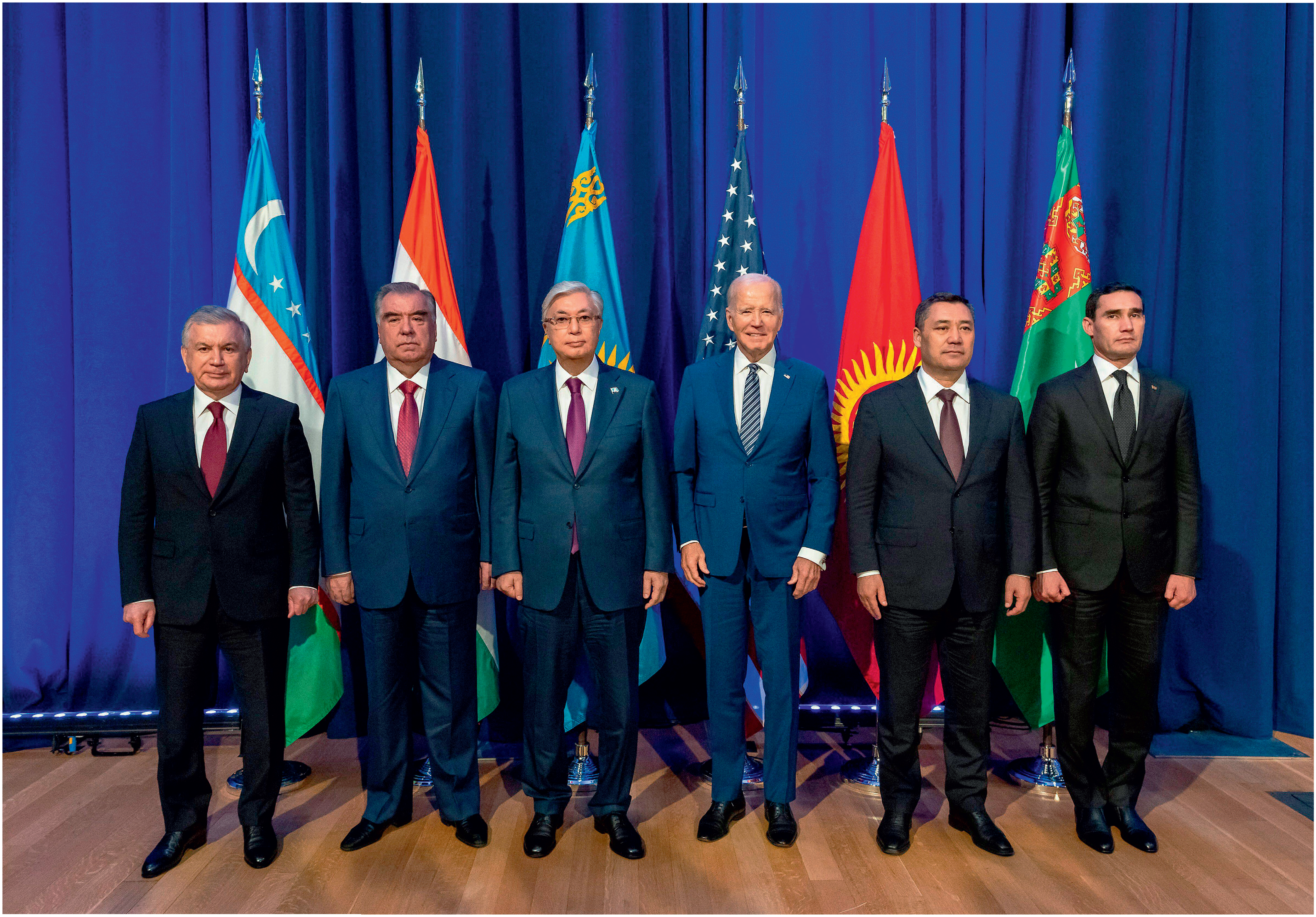
PICTURED: Left to right: Uzbek President Shavkat Mirziyoyev, Tajik President Emomali Rahmon, Kazakh President Kassym-Jomart Tokayev, US President Joe Biden, Kyrgyz President Sadyr Zhaparov and Turkmen President Serdar Berdymukhamedov at the UN in September 2023
CREDIT: Adam Schultz/White House Photo/Alamy
“They brought my mother and sister in for interrogation and subjected them to severe intimidation and threats. They threatened to rape my sister and her son who was just 19 at the time.”
While her family has not experienced such harsh treatment, Fatima told Index that her mother had received calls from the security services demanding that she tell Fatima to stop speaking and writing publicly.
The nature of transnational repression means that the victims of its most severe manifestations cannot share their experiences because they are unjustly imprisoned, scared into silence through physical attacks, or murdered. Odinaev, Fatima and Seiitbek live with the constant anxiety that they could be next.
In March 2020, Tajik activist Ilhomjon Yakubov was beaten by two men in the Lithuanian capital of Vilnius. Odinaev said: “There has always been the feeling that they could arrest me again or that the German authorities could deport me because I do not yet have refugee status, or that they could attack me on the street like they did to Ilhomjon Yakubov.”
Seiitbek reports having received graphic threats of violence over Facebook for her activism, and she told Index of her fear of deportation. “I don’t travel to countries that may be willing to hand me over to any of the post-Soviet states that are looking to have me imprisoned,” she said.
Deportation is also a constant worry for Fatima, who had an anxiety-inducing experience at Istanbul airport last December. “I was detained for two hours, with my phone and passport taken away, and questioned about my travels. My heart sank, [and I thought] ‘This is it, I am getting arrested and deported to Tajikistan because of what I do’.” The detention turned out to be a routine check and she was released.
Odinaev, Fatima and Seiitbek all speak of the psychological toll. “As a man it is difficult for me to admit that I’m afraid but these thoughts sometimes come to me,” said Odinaev. Seiitbek describes having “just no will to live" after she claimed asylum in Austria in 2016. For Fatima, it is “constant anxiety for me and my mum”.
To avoid the worst fates of dissidents, Odinaev, Fatima and Seiitbek have all engaged in self-censorship. “After [the Tajik authorities] designated me as a ‘terrorist’, I no longer expressed my opinion on social media, I no longer gave interviews,” said Odinaev. “It was this way until I left Russia for the EU in 2020.”
Seiitbek reports a similar experience, telling Index that she “kept silent for several years" until Austria granted her asylum.
As someone who regularly writes and comments for international and regionally-focused outlets, Fatima treads a difficult line between continuing to share her expertise and keeping herself and her family safe. “I do not touch certain topics, like the president and the people connected to him,” she said. “If I do end up covering a risky subject, I do not use a byline. If I am asked for a quote or for background information for a piece about Tajikistan, I ask to stay anonymous.”
Central Asian activists find themselves largely undefended by the international community. Odinaev said the international response had been woefully inadequate. “I have not seen any action from international institutions except for human rights organisations that put out statements,” he said. “Tajik officials and security services feel very comfortable, they travel all around the world, they work with all governments, there is no danger to them [… ] so year after year they continue to persecute political activists.”
Seiitbek expands on this issue, stating that while the Magnitsky Act allows the USA and its allies to sanction the perpetrators of transnational repression, it has not, thus far, been used for this purpose. This, she says, needs to change. “Sanctioning human rights abusers would send a strong signal to authorities that democratic countries will not tolerate this behaviour.”
The arms of Dushanbe, Bishkek and Tashkent are just as long and - in many cases - just as dangerous as those of Moscow and Beijing. Since 1991, the West has too often made the mistake of viewing the region either as “Putin’s backyard" or as an arena for “great power competition" between Russia and China.
This view of Central Asia makes it easy for the authoritarianism of its governments to be overlooked or dismissed as somehow being less severe than that of its larger neighbours. Until the West devotes greater resources to understanding and engaging with Central Asian countries on their own terms, activists and journalists such as Odinaev, Fatima and Seiitbek will remain at risk.
Central Asian activists abroad will keep speaking out for democracy and human rights despite the danger they face. Odinaev sums up how many Central Asian activists cope: “The feeling of fear is always with you … but this is life. You have to live somehow.”