




Abstract

Eritrea’s government is reaching across borders to sow discord and silence its critics,
Afwerki’s rule is characterised by myriad human rights abuses including indefinite military conscription and forced labour, unlawful, prolonged and abusive detentions, enforced disappearances and a clampdown on religious freedom outside the four recognised denominations (Sunni Islam and the Eritrean Orthodox, Roman Catholic and Lutheran churches). Because of these violations, hundreds of thousands of Eritreans have fled the country.
CREDIT: (both images) Dessale Berekhet
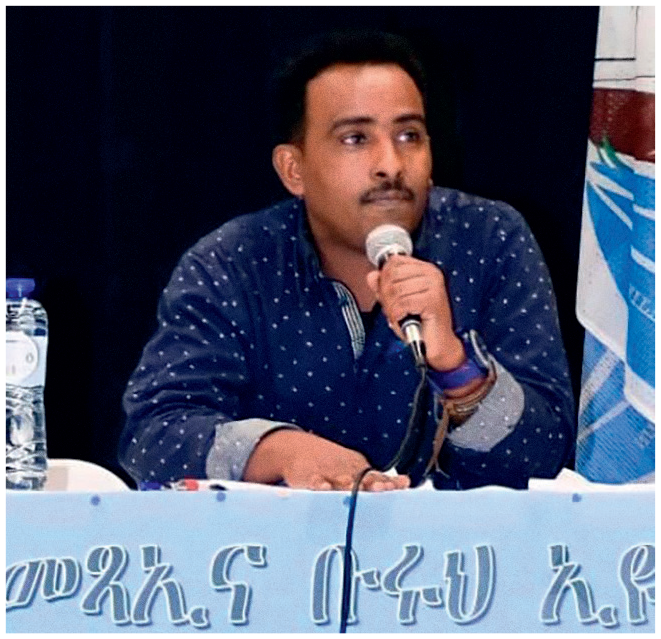
One of those people is Dessale Berekhet, a writer and journalist who now lives in Norway. Among his awards are the PEN Catala International Free Voice Prize and the International Press Freedom Award. He’s written numerous books, including Zingbaba and the Magic Tree, and in 2014 he helped found Eritrean PEN.
His move to Norway in October 2012 was preceded by two others. He lived in Sudan for the last three months of 2010 and then in Uganda. The circumstances under which he left those two countries for Norway point to the wide reach of Afwerki’s repressive apparatus.
Berekhet remembers how astonished he was when a close friend in Sudan turned against him for being critical of Afwerki.
“I could not believe it when he threatened to kill me if I did not cease my critical journalism,” he said, shocked that his friend, an educated man, could not see that Afwerki was destroying Eritrea and needed to be exposed as a tyrant and megalomaniac.
“I expected this friend to support my work the way other colleagues were doing [but] his chilling threat to end my life made me realise how people who are close to us - people we consider friends and brothers - can become the regime’s tools of transnational repression.”
With a group of friends in Eritrea and Uganda, Berekhet started a website - Unitedheartz.com - to continue his work of scrutinising Afwerki’s regime, but he was hit by another blow: the man who designed and administrated the website also turned against him. Accusing Berekhet of using the website to discredit the Eritrean government, he blocked him from accessing the domain, bringing the curtain down on the well-read dissident publication which had access to reliable and credible informants within Eritrea and the government itself.
“I could not believe that the person you have contracted to design and build a house for you can throw you out of it because you are using it for a business he does not like,” Berekhet said with a wry smile, humour being one of the resources he deploys to remain sane in a world where the people he once trusted as allies have turned out to be a tyrant’s accomplices.
With constant threats against his life, it became clear to Berekhet that it was not safe to stay in Uganda. With the help of the International Cities of Refuge Network, he relocated to Norway where he hoped for better security. Shortly after Berekhet left Kampala, a friend was beaten by fellow Eritreans, and thankfully survived.
The other tactic the Eritrean government uses to sow mayhem among dissidents beyond its borders is open intimidation. Berekhet has been a victim of this on many occasions.
He has received numerous death threats on social media from Eritreans around the world who accuse him of telling lies against Afwerki and his government. In 2022, someone posted his Norwegian address and phone number on Facebook, with instructions to assassins to silence him forever.
“Of course, this intimidation has not succeeded in frightening me into silence,” Berekhet said. “I am aware that it is because of the effectiveness of my critical commentary on the regime that the tyrant and his accomplices wish me dead.”
He explained that the government also infiltrates Eritrean asylum and refugee communities in order to sow discord among them. People are often accused of being moles hired by the government to spy on the communities, which has led to open brawls and even deaths.
Disinformation is rife as well and used as a targeting tactic.
“One time, the regime opened so many Facebook accounts in my name, and with images of me as profile pictures, that I myself would take time to tell which one was genuinely mine. Imagine the amount of misinformation and disinformation that was posted out to the public, purportedly from me, portraying me a treasonous fellow and a homosexual, which in Eritrea means a perverted human being, a beast,” Berekhet recalled.
And he said journalists faced a different disinformation trap. Somebody in Eritrea could call a dissident journalist, informing them of an important (but false) development back home - say, the death of a high-ranking military officer. Trusting the source, the dissident breaks the news to international audiences, and in the process destroys a career built over decades.
Eritrean writer Dessale Berekhet, who has been attacked across borders

“I personally, while working for the website in Uganda, received such false information. And I broke it as news,” Berekhet told Index.
Because of the menace of transnational repression, dissidents live in fear wherever they are living.
“The risk that I could be killed or kidnapped, or members of my family harmed by hired assassins of the state, is ever present,” Berekhet said.
But none of this has deterred him. He continues to tell the world about what is happening in Eritrea through journalism, creative writing, interviews and participating at conferences.
“The tyrannical regime in Eritrea thrives on ignorance and fear, so every effort to enlighten the citizens of the country that there are better ways of being governed and that it is possible to rise up against a bad regime and do away with it is important,” he said.