




Abstract

The simple lens of good versus bad that dominated the Cold War is gone. Today censorship comes from all angles, even from the well-meaning, writes
We provided a platform for dissidents in the Soviet Bloc and gave a voice to campaigners against tyranny. We ensured that inside the USSR the stories that needed to be told were heard and outside, we used our platform in the West to draw attention to the brutality that was taking place.
And while today, 52 years on, the role of Index remains clear, the world in which we operate is very different. The traditional Cold War divide that separated the champions of free speech from those seeking oppression is no longer as clearly defined. The clear-cut world of ‘good’ and ‘bad’ is now a sea of varying greys in which those seeking silence are often the self-proclaimed saviours of free speech. The advent of social media and clickbait commentators has created a whole new digital realm in which hate speech can be dressed up as free speech and where ‘pile-ons’ are frequent and considered debate is rare.
And whereas the frontline in the 70s and 80s was the threat of incarceration and death for those who speak out against tyranny, there exists a whole new series of weapons in the arsenal of people wielding the weapon of censorship.
Of course the threats of the old world are still there. The recent unexplained death of Alexei Navalny while in a Russian prison is a sad reminder that despots who seek to hold power will use every possible tool to do so. Likewise, the continuing show trial of Jimmy Lai in Hong Kong shines a light on the abuse of power against those who speak out in defence of free speech and a free press.
But what is also emerging is the proactive silencing of opinion in the new frontiers of free speech.
The use of social media to hound companies and venues to cease their partnerships with individuals or celebrities who voice their opinions is all too common. So is the targeting of venues that become sites of protests or subject to thousands of social media comments because they host an organisation or individual who holds views or opinions contrary to the detractors.
Cancel culture and a subsequent climate of self-censorship is as common a threat to freedom of expression today as the barbarity of the Soviet Union was in the 70s and 80s. In a world which now sees more people live under dictatorships than democracies, it is increasingly disappointing to see those who have the right to free speech using that right to silence others.
The growing intolerance between differing opinions is creating a vitriolic space in which dominance of opinion, backed by almost unwavering certainty of moral righteousness, is forcing out moderate and nuanced voices in favour of those who can shout the loudest with the simplest and easiest digestible slogans. Whether through trying to take away their jobs, have them de-platformed or labelled as social pariahs for daring to carry an alternative opinion, the impact on those people is all too real and it is becoming increasingly common.
And the consequence is that self-censorship is the route chosen by those who fear speaking their mind on contested or controversial topics. The thought unsaid or the opinion unspoken through fear - not always of physical attack but of a concerted attempt by organised groups to delegitimise individuals - is reducing the number of voices that take part in discussions. The tone of our public space is all the poorer for it.
Social media companies themselves also have questions to answer. They decide, via methods which are often opaque, who is and who isn’t allowed to have a platform, who is and isn’t allowed to speak and in some cases their algorithms also determine who can be heard. The result is debates dominated by the appeal of clickbait rather than content.
This can be compounded by well-meaning attempts by governments freely and fairly elected who choose to regulate the online spaces and in a series of unintended consequences can create even more tools for censorship. In an attempt to create a level playing-field in our democratic pursuits and temper what are considered to be the darkest and bleakest recesses of the digital world, these blunt tools see legitimate campaigners and content silenced and removed.
We are guided to content that social media thinks we want to see. In democratic societies, I believe this content moderation is done with good intent - whether it is protecting children or protecting our mental health - but it can lead to a bubble in which views different to our own or questions posed to deliberately start debate are side-lined in favour of the comfort of reaffirming our own view point at the expense of others.
Flowers are left by a mural of George Floyd in Denver, Colorado
CREDIT: mana5280 on Unsplash
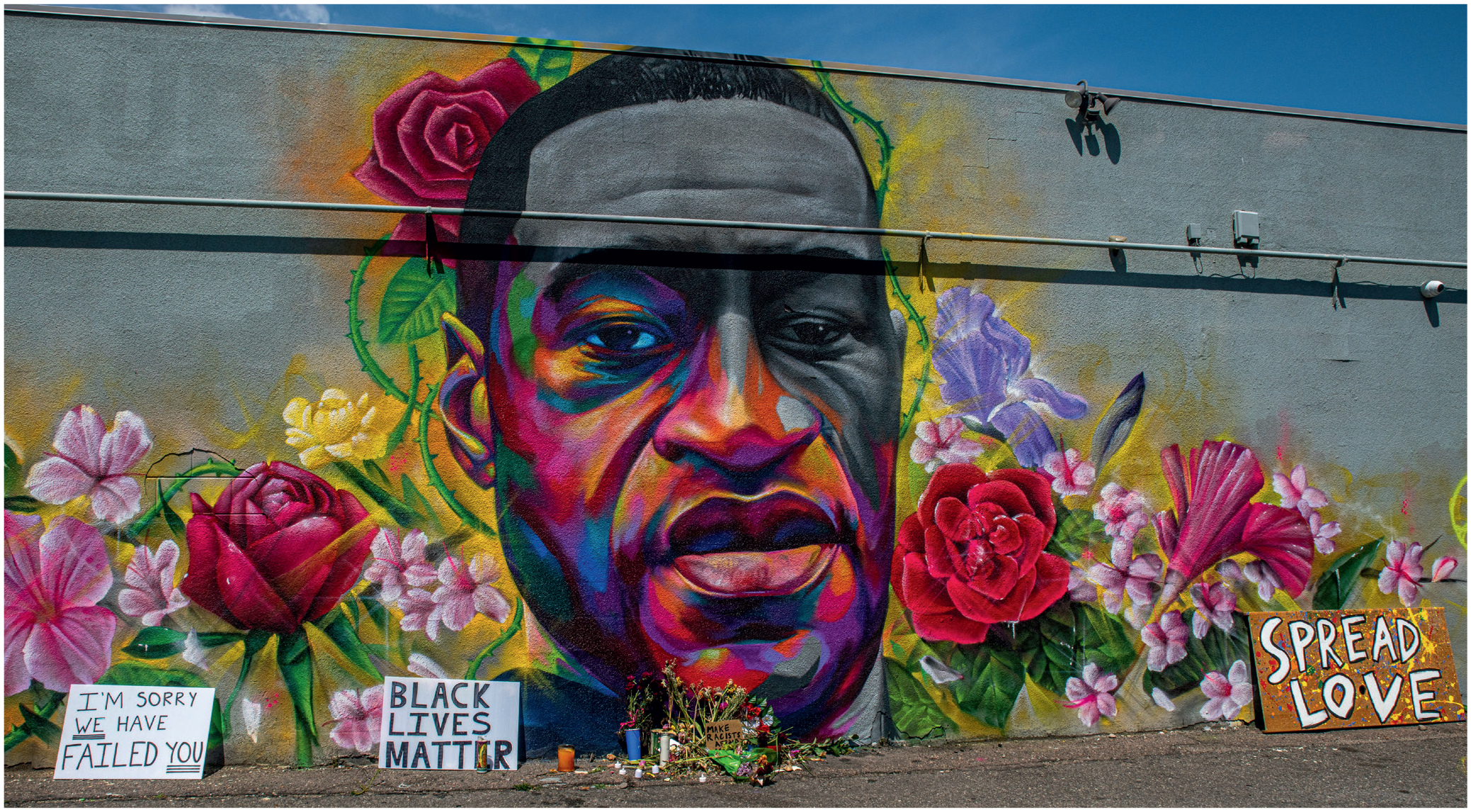
It’s not the traditional censorship of the USSR but nevertheless it is censorship. Unseen, unspoken and often unknown.
The flip-side, of course, is that the almost constant documentation of our lives, current events and news as a result of social media, citizen journalism and grassroot campaigning can change world events almost immediately. The most obvious example is the horrendous murder of George Floyd, the recording of which led to a global anti-racist movement challenging the status quo. This is also one of the reasons why autocratic regimes actively seek to turn off social media when they do not want their own citizens knowing what they are doing.
At the heart of this debate is where does freedom of expression fit and who are the good guys in a world increasingly challenged by propaganda, misinformation and conspiracy? Where is the time for analysis, for debate and for nuance in a world driven by clickbait, which impacts even the most robust media agencies?
In what feels like an increasingly divided world, how are clickbait commentators and the occasional ignorance of well-intended campaigners challenged without censoring? Or rather leading to a social media storm targeting either the commentator or the challenge? When misinformation and propaganda become normal and debatable, how do you counteract it without simply shutting it down or censoring the messenger? When our bad faith actors or the spokespeople for terror groups, despotic totalitarians and dictators are addressing the world through the internet with fantastical messages which are devoid of truth and paint a fictitious picture of their own supposed martyrdom, what approach do we take that doesn’t deny them their right to free expression? How then can we champion freedom of expression while seeking to take on tyranny when those tyrants themselves now deploy their own freedoms as weapons against others?
I pose these questions not because I know the answer but because as we move forward in an increasingly dangerous world in which alliances for freedoms are no longer binary and where international collaborations put a strain on the supposedly settled international institutions, the new frontiers of freedoms require a new approach to their protections.